The Importance of Data Utilization in Manufacturing and 4 Useful Tools for Data Integration and Use
Digitalization and DX are being widely discussed, but even when a lot of data is collected and acquired, there are many cases where that data cannot be managed or used effectively. In this article, we introduce the importance of data utilization in the manufacturing industry and the tools used to make the most of it.
Importance of Data Utilization in Manufacturing
Benefits of Data Utilization
• Understand the current state of the business
By checking various figures in existing business operations and making effective use of data that records facts, you can make decisions based on facts rather than intuition. You can also see the actual current state of the business.
• Leads to improved productivity
By utilizing data that has not been collected or used until now, you can streamline existing processes and reduce various costs. In addition to reducing costs, you can free up time for other tasks, enabling you to implement more effective measures.

• Standardize work that depends on specific individuals
When the employees who handle a task are limited and the work becomes a black box, the task may stall when that employee is absent, and it can become difficult to ensure the same level of quality. By accumulating knowledge and know-how related to the work as data, you can eliminate tacit knowledge within the company and help resolve person-dependent work.
• Differentiate yourself from other companies
Of course, using your own company’s data is important, but analyzing competitors’ product data is also essential. By analyzing what kinds of products competitors are developing and selling, and for which target audiences, you can differentiate your company.
Challenges of Data Utilization in Manufacturing
• Complexity of data integration
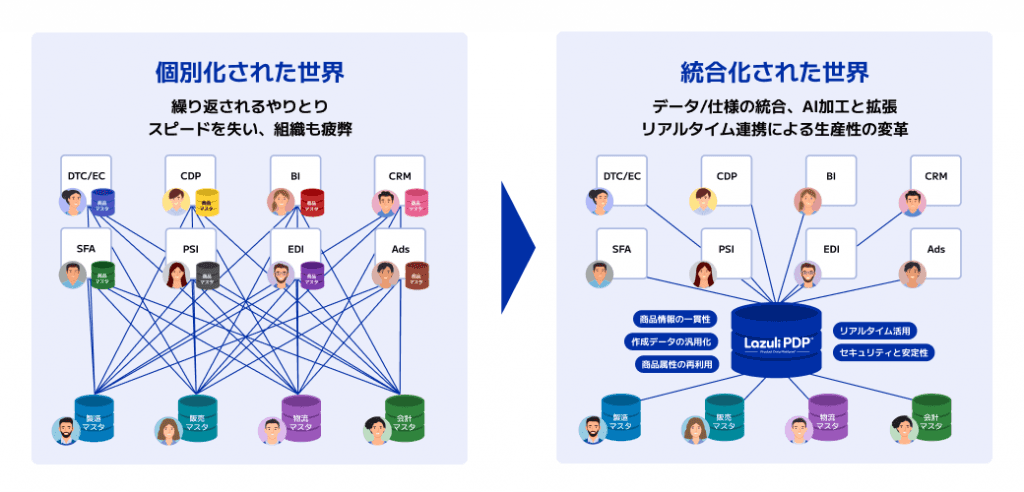
In manufacturing, product-related information is often dispersed across multiple departments and databases. If product information, production information, quality information, and inventory information are stored in separate places, information becomes fragmented and it becomes difficult to grasp the overall picture. Integrating and analyzing the various formats generated from these different data sources is a major challenge in manufacturing. In addition, the likelihood of using outdated or inaccurate information increases, which can affect production planning and inventory management and lead to excess inventory, shortages, and production quality issues.
• Data privacy and security
Manufacturing handles a large amount of confidential information, such as customer data, product design information, and production process data. It is necessary to protect the privacy and security of this data and guard it against unauthorized access.
• Securing digital talent and skills
If there is a shortage of specialists such as data scientists, data engineers, and business analysts, challenges arise in data utilization. To acquire these people, an organization needs to define the vision and conditions it aims to achieve. Securing skills and talent capable of handling data is essential.
Five Useful Tools for Data Integration and Utilization in Manufacturing
Depending on the size of a company in manufacturing, many businesses build their own systems. Here, we introduce five tools that many companies have adopted to enable data integration and utilization.
1. TreasureData
TreasureData provides a platform called CDP (Customer Data Platform) that can collect, analyze, and centrally manage customer data, which is especially important in manufacturing. By using a CDP, you can integrate customer data with store inventory data, allowing all relevant employees to access and analyze the same data. You can centrally capture communication history with customers and learn what needs they are likely to have in the near future.
2. Lazuli PDP
Lazuli PDP is a platform called PDP (Product Data Platform) that processes product information and outputs it in a form that is easy to connect with the various tools used in manufacturing. It supports a wide range of processing, including data matching, normalization, and estimation of categories and colors. By using product feature tags, it enables deeper customer preference analysis from a new angle of product features, in addition to analyses that have previously used customer data as the key. It also helps integrate and utilize siloed internal data, not just process and analyze data.
3. Tableau
It is well known as a BI (business intelligence) tool for analyzing and visualizing data accumulated within a company. Tableau allows you to start data analysis relatively easily, even without the advanced specialized knowledge that data analysis usually requires. You can perform data analysis, visualization, and report creation consistently.
4. Domo
Domo is a cloud-based, community-oriented business intelligence platform. With intuitive data visualization and reporting features, users in every department can make better and faster decisions. By introducing Domo, you can view data in one place, democratize it across the organization, socialize important goals, and build accountability.
Conclusion
In manufacturing, a great deal of data exists. To make use of that data, it is important to integrate internal data and prepare the data you have so that it can be used by anyone in the company, including processing it into a usable form.
At Lazuli, we develop and provide Lazuli PDP, which enables the integration of siloed internal data and organizes scattered product master data. It also supports processing and enriching the product information needed in an era where digital sales such as e-commerce sites are essential.
If you are interested in Lazuli PDP, please contact us here.