Learning from Walmart: How product data transforms unified commerce and the in-store experience
As a leader in digital transformation (DX) and customer experience transformation, Walmart is driving innovative use of data that goes beyond the retail industry. In this article, we introduce the challenges Walmart faced, the solutions it implemented, the results achieved through product data utilization, and the cutting-edge initiatives being put into practice on the front lines of in-store customer service, along with the latest case studies.
A series introducing examples of companies that transform customer and employee experiences by leveraging product data and advancing digitalization and data utilization.
Under the supervision of Takashi Okutani, who serves as an advisor to Lazuli, we introduce advanced data utilization examples from Japan and abroad based on various themes. This time, we introduce the case of Walmart, the world’s largest retail company.
Introduction: Walmart’s vision for "Unified Commerce" and the in-store experience
The "Unified Commerce" that is drawing attention in the retail industry refers to a system that transcends the divide between online and offline, allowing customers to enjoy a consistent experience across every channel. Walmart is leading the world in this field and is using data and AI to achieve both new customer experiences and in-store services.
Examples of how Walmart has achieved "Unified Commerce"
Walmart does not simply fuse e-commerce and physical stores; it is rolling out advanced unified commerce examples on a world-class scale, such as the following.
・Order, pick up, and return anywhere, whether in-store or online
At Walmart, the "BOPIS (Buy Online, Pickup In Store)" model—where customers buy products online and pick them up in store—has been rolled out nationwide across the U.S. It also enables in-store returns of purchased items and self-checkout via the mobile app.
・Real-time integration of inventory and pricing information
Walmart centrally manages inventory information across stores, warehouses, and e-commerce at a national scale, providing an experience in which inventory and prices are consistent across every channel.
・Integrated delivery experience through AI × logistics
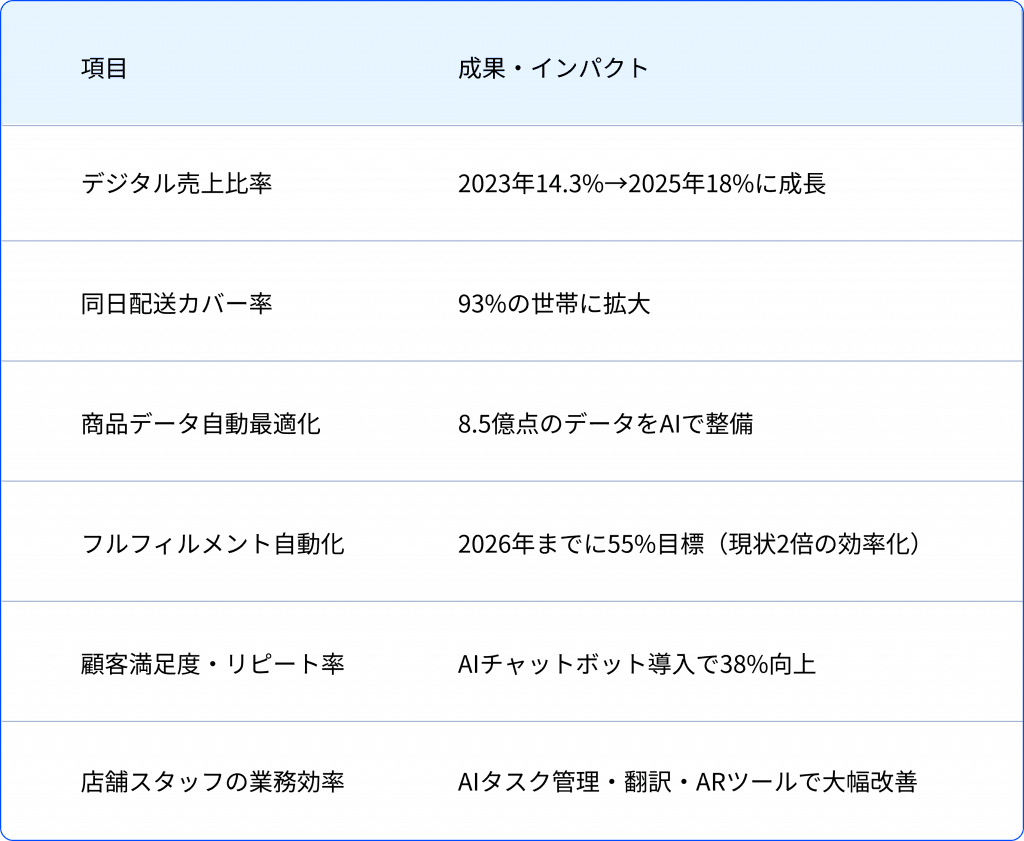
Walmart enables fast picking and same-day delivery from the nearest store or fulfillment center for online orders. Approximately 93% of households are covered by same-day delivery service areas.
・Personalized recommendations through integrated customer accounts
By integrating purchase histories and preferences across online and offline channels, AI delivers individually optimized product recommendations.
Through these efforts, Walmart’s distinctive unified commerce approach is that customers can get the best experience no matter where they buy or through which route they purchase.
Challenges: Fragmented data and inconsistent customer experiences
The biggest challenges Walmart faced were "data fragmentation" and "inconsistent customer experiences."
・Product data and inventory information fragmented by channel
・Insufficient unification of customer data
・Delays in updating and aligning information
These issues created gaps such as customers seeing a product online that was not available in store, different prices, or stockouts, leading to lost sales opportunities and lower customer satisfaction.
Initiative 1: Unified commerce through data integration and AI utilization
Walmart is promoting DX from the perspectives below and resolving fragmented customer experiences.
Integration and automated optimization of product data
・Use of generative AI and large language models (LLMs)
More than 850 million product data records were cleansed and supplemented with generative AI, reducing the effort required to create and improve product information to one-hundredth of the previous level. Both customers and staff can now access accurate product information instantly.
・Linking product data with customer data
An AI assistant combines customer intent and preference data with product data to deliver optimal product recommendations. Product detail page (PDP) information has also been enhanced, allowing customers to find products that suit them without hesitation.
Optimization of delivery and inventory management
・Optimizing delivery areas with geospatial data × AI
By subdividing areas using a hexagonal grid and reflecting real-time demand, inventory, and delivery capacity data, Walmart has made same-day delivery possible for 12 million households, greatly expanding delivery convenience and coverage.
・Strengthening fulfillment through automation and robotics
Plans are underway to raise the automation rate of fulfillment centers to 55% by 2026. In next-generation centers, throughput has doubled and handling costs have been reduced by 20%.
Initiative 2: Agentic AI and personalized experiences
To provide services optimized for each individual customer, Walmart is actively introducing Agentic AI.
Development of retail-specific AI agents
・Walmart’s proprietary AI agents propose the best products and services based on customer purchase history, preferences, and real-time inventory and pricing information.
・The AI shopping assistant "Sparky" enables product comparisons, personalized recommendations, and end-to-end shopping support on the app and the web12.
Improving customer and employee experiences through AI chatbots
By introducing AI chatbots, Walmart has automated order status checks and return handling. Customer satisfaction has improved by 38%, and the voice assistant "Ask Sam" for store staff is also helping improve operational efficiency34.
The cutting edge of AI and digital utilization in in-store customer service
Walmart is proactively introducing AI and digital tools to improve in-store service quality and operational efficiency.
AI tools supporting store staff
・AI task management tool
AI helps store managers and staff prioritize work and recommend tasks, reducing shift planning time from 90 minutes to 30 minutes. This has allowed staff to spend more time serving customers45.
・Real-time translation function
An AI translation function supporting 44 languages helps staff and customers communicate across languages. It also recognizes Walmart’s proprietary brand names accurately, preventing confusion on the shop floor34.
・Task navigation through conversational AI
A conversational AI tool used weekly by more than 900,000 staff responds in real time to questions about product guidance and return processing. In the future, generative AI will make it possible to handle more complex tasks as well34.
Digital services for customers to improve the store experience
・Voice & text shopping
Customers can order products by voice or text from smart speakers or smartphones. AI also recognizes past purchase history and brand preferences, providing a smoother shopping experience2.
・Product guidance using AR × RFID
Store staff use AR tools and RFID to speed up product placement and inventory checks on the sales floor. Because guidance to customers and replenishment can be carried out quickly, the service level in stores is improving4.
Results: The evolution of unified commerce and in-store customer service
Summary: Key points of Walmart’s product data utilization
Walmart’s product data integration and AI utilization are generating value across a wide range of areas, from seamless experiences across customer touchpoints and personalized recommendations to logistics and operational efficiency on the ground. Real-time product data integration, together with AI-linked operational optimization and improved service quality, will likely become the new standard demanded by retail companies in Japan as well.
Takashi Okutani interprets the future of product data × retail
Product data is both the starting point and the destination of customer experience. When customers search for products, compare them, and decide to buy them—at every one of those moments, accurate and rich data is needed. As Walmart’s case shows, the fusion of data and AI does not simply provide convenience; it creates a sense of trust that "this brand understands me." As trust accumulates, customers gain a reason to continue connecting with a particular company. As a result, they make repeat purchases and eventually become devoted fans. Product data can also serve as a catalyst for deepening relationships with customers. For retail companies moving forward, refining product data for the purpose of improving customer experience will likely become an important corporate asset.
To realize this kind of unified commerce, "structured product data" is essential. In many companies, product information is dispersed across departments and systems, creating challenges in building integrated experiences like Walmart’s. Lazuli PDP is a cloud-based solution that streamlines the collection, organization, and unification of such product master data.
Next time, we will take a deeper look at Sephora, a well-known retail chain for cosmetics and beauty-related products. If there are any cases you would like us to cover, or if you have opinions or requests, please feel free to contact us.
What is Lazuli PDP?
A SaaS product data platform that "collects, organizes, and unifies product information scattered inside and outside the company."
It structures and generates product names, descriptions, specifications, images, and more using proprietary AI technology, and can be used for unified commerce, e-commerce optimization, and ID-POS analysis.
*This article is a picked-up piece introducing examples of companies utilizing product data. This does not mean that all of the companies featured, including Walmart, are customers of our services.
*This article was written using AI based on Walmart’s official announcements and articles from industry media. If there are any errors in the content, we will correct them promptly, so please contact us.
https://tech.walmart.com/content/walmart-global-tech/en_us/blog/post/three-ways-we-are-using-conversational-ai-at-walmart.html
https://corporate.walmart.com/news/2025/06/24/walmart-unveils-new-ai-powered-tools-to-empower-1-5-million-associates
https://www.inc.com/jason-aten/walmart-just-made-a-big-change-and-i-cant-decide-if-customers-will-love-or-hate-it/91199832
https://www.retaildive.com/news/walmarts-ai-feature-aims-to-help-associates-overcome-language-barri/751579/
https://www.hrreporter.com/focus-areas/automation-ai/walmart-launches-new-suite-of-ai-tools-for-workers/392853