Learning from UNIQLO: The Data × AI Strategy Powering Global Expansion
As a rapidly growing global leader in fashion retail, UNIQLO delivers optimized experiences to customers around the world through data-driven marketing and an integrated commerce strategy. In this article, we introduce the challenges UNIQLO faced and the solutions it implemented, as well as how it achieved a "shopping experience that lets people express themselves without hesitation" by leveraging product data and customer data, with specific examples.
This is a series introducing examples of companies that transform customer experiences and employee experiences by leveraging product data and promoting digitalization and data use. Under the supervision of Takashi Okutani, an advisor to Lazuli, we introduce advanced data-utilization examples from Japan and abroad based on various themes. This time, we introduce the UNIQLO case.
Introduction: The shopping experience at UNIQLO made possible by its DX strategy
UNIQLO, under the philosophy of "LifeWear," operates globally with the goal of delivering functional, high-quality clothing that supports everyday life for everyone. To meet the needs of diverse cultures and lifestyles, it has eliminated the barrier between online and offline and is driving its own unique DX by leveraging product data and customer data. As a result, as introduced in this article, it has created a new shopping experience in which customers can encounter products that are "for anyone," "without getting lost," and "suited to them."
Challenges: Channel fragmentation and inefficient product information
The background behind UNIQLO's full-scale efforts included the following issues associated with its rapid global expansion.
- Fragmented customer data across channels: purchase histories from store and EC purchases were not integrated, making it impossible to grasp the full picture of each customer
- Lack of real-time inventory information: with data only current up to the previous night, it was impossible to respond to the information customers want—"Is it available at this store right now?"
- Variations in product information by region and channel: as the company expanded across diverse channels and regions, the same product had different descriptions and attribute data
- Insufficient accuracy in global demand forecasting: difficulty forecasting demand by combining multiple factors such as weather, trends, and regional needs
- Unable to fully utilize customer feedback: large amounts of qualitative data such as product reviews and inquiries to the customer center were not sufficiently reflected in product development
These issues ultimately came down to a fundamental problem: "the lack of an integrated platform for product data and customer data."
Initiative 1: Online-offline integration through unified commerce
UNIQLO is promoting unified commerce across online and offline channels. This allows customers to enjoy a consistent shopping experience from anywhere, without being conscious of the channel.
・Centralized management of product data
At the core of this effort is a product data platform managed in a unified way across all channels. Because information such as product names, sizes, colors, and inventory status is centralized, customers can easily check their purchase history from the app.
・Real-time purchasing experiences through data integration
In addition, when making payments using the UNIQLO app or UNIQLO Pay, purchase data is integrated regardless of whether the purchase was made in-store or via EC, and the latest inventory information is reflected in real time. This enables customers to always choose products based on accurate information.
・Creating a seamless shopping experience
This centralization of data enables seamless cross-channel shopping experiences, such as in-store pickup of online orders (Click & Collect).
Initiative 2: Centralized inventory management and cashierless checkout with RFID
・Inventory management challenges and RFID-based solutions
With the traditional barcode method, each item had to be scanned individually, which took time and labor and made it difficult to maintain SKU-level inventory accuracy. By introducing RFID, item-level inventory data is automatically aggregated into the product master, and AI optimizes replenishment plans and supply-demand balance. This reduces excess inventory and stockouts while dramatically improving inventory accuracy.
・Improving operational efficiency with cashierless checkout
The RFID-enabled cashierless checkout introduced in 2019 has reduced checkout time to one-third of the conventional time, achieving both operational efficiency and an improved customer experience.
・New services enabled by real-time inventory linkage
RFID data also serves as the foundation for inventory linkage between stores and EC. With "Order & Pick," EC orders can be picked up at a store in as little as two hours. The system automatically checks inventory at the nearest store, enabling immediate picking.
Initiative 3: Advancing customer data utilization through the "management cockpit"
・Integrated analysis of customer data and product data
This system analyzes a wide range of customer feedback across channels, including product reviews, inquiry details, and purchasing trends. It extracts improvement points from trends in reviews and fitting-room data and builds a mechanism that directly informs decisions on product renewals.
・A globally shared product master as the foundation
What makes this detailed analysis possible is a globally standardized product master. By centrally managing detailed information such as materials and production lots in addition to colors and sizes, the company can handle sales and production data worldwide using a common standard.
・AI-driven demand forecasting and inventory optimization
Furthermore, by combining past sales performance with external factors such as weather and events, AI automatically calculates optimal inventory levels and production plans. This helps curb excess inventory and enables the timely launch of hit products, making data-driven, rapid management decisions possible.
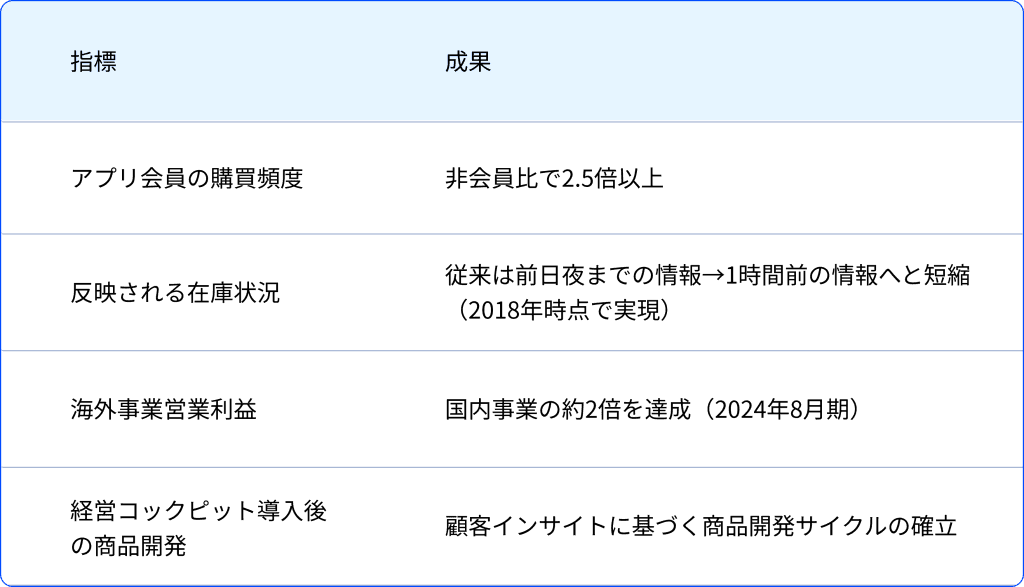
Results: The numbers created by data-driven personalization
Summary: Learning from UNIQLO, "shopping that feels right for you" supported by product data
UNIQLO's digital transformation in EC and CRM clearly shows that integrating product data becomes the foundation of business innovation.
AI technologies such as UNIQLO IQ, payment infrastructure such as UNIQLO Pay, and predictive analytics systems such as the management cockpit are all excellent initiatives, but for them to function, it is essential that they be built on a foundation of "accurate, structured product information."
As UNIQLO manages thousands of products globally and sells them across 26 countries and regions and more than 2,000 stores, it spares no investment in standardizing and continuously maintaining its product master. As a result, customers enjoy a "shopping experience without confusion," and UNIQLO achieves "providing the right products that meet customer needs."
Takashi Okutani interprets the "connected customer experience" envisioned by UNIQLO
UNIQLO's data utilization case clearly demonstrates that for success in digital-age omnichannel strategy and customer experience (CX), maintaining the product master is essential.
The challenges UNIQLO faced as it expanded globally were the fragmentation of customer and inventory data across channels and the variation in product information by region and channel. The root cause of these issues comes down to the lack of an integrated platform for product data and customer data.
To overcome this challenge, the company promoted unified commerce that integrates online and offline channels and built a product data platform managed in a unified way across all channels. At UNIQLO IQ, to reflect the "inventory information" that customers are most eager to know in real time, the company previously reflected only inventory information up to the previous night; now, through the introduction of RFID technology and related systems, it reflects information up to one hour ago. Also, it enables seamless purchasing experiences such as "Order & Pick" based on the accurate inventory information customers need.
In addition, advanced analysis through the management cockpit and AI utilization (such as UNIQLO IQ) can function only because of the underlying foundation of accurate, structured product information. The establishment of a globally standardized common product master is not limited to sales support; it also enables more sophisticated management decisions.
Because detailed information such as color, size, material, and production lot is centrally managed, the "management cockpit" can integrate and analyze diverse customer feedback (reviews and purchasing trends), making it possible to rapidly renew products and optimize production plans based on customer insights. Introducing a Product Data Platform (PDP) that collects, organizes, and standardizes scattered product information and builds a foundation for AI utilization is arguably the most reliable first step for modern retailers to achieve the two major goals of DX and improved CX.
Lazuli PDP is a SaaS product data platform that automatically maps and structures unstructured product data and builds a product master designed for AI utilization. From large enterprises to mid-sized companies, it provides the foundation for a "shopping experience without confusion" like UNIQLO's.
Organizing product data is the first step toward DX and improved customer experience.
In this series, we will continue to introduce advanced data-utilization examples and initiatives by Japanese companies. If you have any comments or requests, please feel free to share them.
What is Lazuli PDP?
A SaaS product data platform that collects, organizes, and standardizes product information scattered inside and outside the company.
It automates the organization of data needed for unified commerce, EC optimization, ID-POS analysis, and more by structuring and generating product names, descriptions, categories, specifications, images, and more using proprietary AI technology.
*This article is a pick-up article featuring company examples that utilize product data. This does not mean that all of the companies featured in the case studies, including UNIQLO, have introduced our services.
*This article was written using AI based on UNIQLO's official announcements and articles from industry media. If there are any errors in the content, we will correct them promptly, so please contact us.