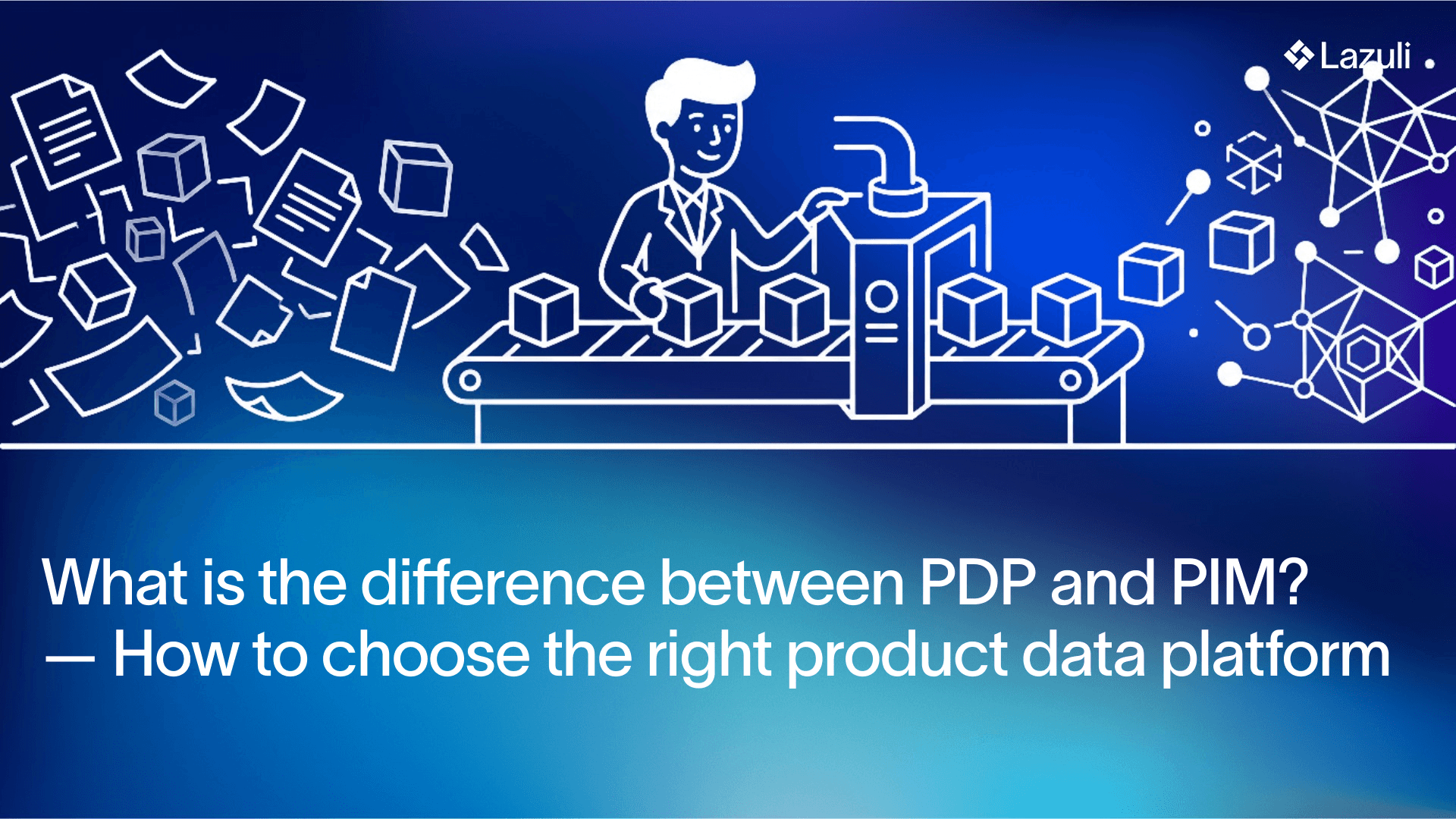
What is the difference between PDP and PIM? — How to choose the right product data platform
"We implemented a PIM, but manual tasks on the ground haven't decreased." We hear this sentiment frequently from those in charge of product data management at various companies. Despite having introduced a tool, processing files received from suppliers remains reliant on manual effort, and the time spent on data preparation continues to squeeze their core business operations—this is the reality. To understand this issue, it is helpful to think of the flow of product data by dividing it into the "input" and "output" stages.
The Role of PIM (Product Information Management)
PIM is a platform for centrally managing organized and integrated product information and distributing it to e-commerce sites and various sales channels. Many companies have already introduced and operated it as a foundation for product master governance.
PIM is most effective in "outbound" management, which delivers well-organized data in the appropriate format.
Governance management of product attributes and catalogs
Support for delivery formats by channel (e-commerce, marketplaces, printed catalogs, etc.)
Linking and publishing management of digital assets
Control of data quality through approval workflows
In these functions, PIM is a highly mature solution. Many companies have been able to significantly reduce data inconsistencies and publishing errors between channels by introducing PIM.
Why Manual Work Doesn't Decrease Even After Implementing PIM
PIM has a commonly overlooked prerequisite.
PIM truly shines only after clean data has arrived.
In actual field operations, product data arrives from diverse sources in fragmented formats.
Different Excel, CSV, and PDF formats for each supplier/vendor
Data with missing required fields or inconsistent terminology and notation
Cases where images and product information arrive as separate files, requiring manual linking
Catalog data whose structure changes every season
The tasks of preparing these into a "PIM-ready state"—conversion, cleansing, and mapping—are, in most cases, currently left to manual work by the staff in charge.
This issue is not about "low data quality." The operational mechanism to absorb differences among suppliers is structurally missing. This is not a design flaw of PIM; it is simply a "problem that PIM was not built to solve."
The "Inbound" Problem: A Structural Issue Facing the Entire Industry
This "inbound" problem is not unique to specific companies. It is a structural challenge shared across the industry.
As the number of SKUs, suppliers, and channels increases, the manual work cost at the inbound stage grows exponentially. While a few tens of thousands of SKUs and dozens of suppliers can somehow be managed manually, the same approach breaks down at the scale of 300,000 SKUs and 1,000 suppliers.
Furthermore, inbound problems ripple downstream in the following ways:
Delays in registration to PIM or e-commerce systems → Loss of sales opportunities
Lack of attributes and descriptions → Drop in e-commerce search rankings and cart abandonment
Inconsistent notation and typos in data → Increase in returns and customer complaints
Concentration of tasks on specific personnel → Dependency on individuals and handover risks
The System to Handle the "Inbound": The PDP Approach
As a response to these challenges, the category that has been gaining attention in recent years is the PDP (Product Data Platform). Lazuli PDP, provided by Lazuli, is one of its representative solutions.
While PIM specializes in "outbound" management, Lazuli PDP specializes in the "inbound"—automating and systematizing the process of receiving raw supplier data and converting it into a reliable product master.
The processing flow handled by Lazuli PDP is as follows:
① Extraction Receives files of any format—CSV, Excel, PDF, images, etc.—as they are, and extracts them as structured data. No preprocessing or manual cleansing is required.
② Conversion & Integration Integrates data from multiple sources and automatically maps it to the target schema. Category estimation and attribute enrichment are also executed automatically.
③ Validation Automatically detects missing values, format inconsistencies, and low-reliability data, and escalates only the parts that require verification to the person in charge. It does not perform total manual checks.
④ Product Master Creation Generates and maintains an integrated master as the single source of truth. Schema changes can be handled immediately by business users.
⑤ Syndication Distributes data in the formats required for each channel, such as e-commerce, PIM, and ERP systems.
Defining the Division of Roles Between PIM and Lazuli PDP
PIM and Lazuli PDP do not compete; rather, they are complementary entities that handle different processes in the product data supply chain.
Comparison Dimension | PIM | Lazuli PDP |
|---|---|---|
Primary Role | Management and distribution of organized data | Receiving, converting, and refining raw data |
Corresponding Process | Outbound (Distribution & Governance) | Inbound (Inbound Processing) |
Data Prerequisite | Assumes arrival of clean data | Can receive data in fragmented formats as-is |
Schema Changes | Often requires going through the IT department | Can be handled immediately by business users |
Supplier Handling | Requires standardized formats | Absorbs any format |
By having Lazuli PDP organize a clean product master, PIM can fully leverage its inherent strength in distribution and governance management. By sharing the load, the two resolve problems that neither could solve alone.
Why the "Product Data Foundation" Is Being Questioned in the AI Era
There is another context that cannot be ignored: the evolution of AI.
"Agentic Commerce," where AI agents handle product searches, comparisons, and purchasing assistance, is already becoming a reality. However, no matter how smart AI becomes, its accuracy depends on the quality of product data.
If attributes are not normalized, search accuracy drops
If numerical data is not structured, similar product recommendations are impossible
If there are duplicate SKUs, the accuracy of inventory checks is compromised
For companies considering AI implementation, preparing the product data foundation is not a task for "later"; it is a prerequisite for AI utilization. Systematizing the inbound (receiving and preparing data) before polishing the outbound (AI, e-commerce) ultimately improves overall accuracy.
Three Questions to Evaluate Your Company's "Inbound"
Finally, here are three questions to reflect on your company's product data management:
How much time do you spend each week receiving and converting files sent by suppliers?
Does a dedicated conversion task occur every time a new business partner is added?
Are staff members manually performing cleansing and mapping before registering data to PIM or e-commerce systems?
If you continue to answer "yes" to these questions, it might be the right time to consider systematizing your inbound process.
Product data organization directly impacts revenue, conversion rates, and operational costs. Real efficiency across the entire supply chain is realized not just by polishing the "outbound," but by reviewing it from the "inbound" first.
Lazuli provides a platform that centralizes and streamlines product data management for manufacturers, retailers, and distributors. If you would like to run a more detailed diagnosis of your company's challenges, please feel free to consult with us.