
SYNERGY DX MEETUP 2025 Event Report
Introduction
On June 26, 2025, SYNERGY DX MEETUP was held, co-hosted by SUPER STUDIO Co., Ltd. and Lazuli Inc. The event aims to measure the synergies in participants' DX initiatives.
In Part 1, POLA Co., Ltd. President and Representative Director Takuma Kobayashi and ORBIS Co., Ltd. CDO Morio Ishikawa took the stage and held a panel discussion on the theme, “What were the key points that led to the success of ORBIS's DX transformation?”
In Part 2, Lazuli Inc.'s Enterprise Sales Director Takao Ando and Daisuke Iwakura, Key Account Manager, E-Commerce Channel Sales Department, EC Retail Development Group, E-Commerce Business Division, Digital & E-Commerce Headquarters, Nestlé Japan Co., Ltd., gave a lecture on the theme, “The reality of customer design utilizing data — What is the “channel-less” customer experience Nestlé Japan aims for?”
Part 1: What Were the Key Points That Led to the Success of ORBIS's DX Transformation?
Kobayashi's return to a “beauty brand”
In Part 1, Kobayashi, who as president of ORBIS drove the company to major growth, and Ishikawa, who serves as CDO at ORBIS, took the stage and spoke about ORBIS's DX transformation.
At the time Kobayashi became president of ORBIS, the company, in its effort to raise customer LTV, had more than 1,000 SKUs and had become something like a “general mail-order retailer,” even handling products far removed from its core business such as kitchen detergents. Its revenue structure also depended on campaigns and discounts, and profit margins had fallen sharply. Based on this situation, Kobayashi explained that he refreshed the CI (corporate identity) and decided to rebuild ORBIS as a “beauty brand” once again. He also said he significantly revamped the high-rebate points program. While reducing the points rebate rate to about one-third, he also introduced a mechanism to continue the existing program privately for VIP customers in order to minimize customer churn.
Large-scale reform of the revenue structure and organizational structure
Kobayashi then said he tackled reforms of the revenue structure and organizational structure. First, he focused on a strategy to increase the share of high-value-added products. By reviewing the previous lineup centered on low-priced products and expanding sales of higher-priced items through rebranding, the company transformed into one where profit margins improved significantly even if sales stayed flat. In addition, the KPI benchmark was shifted from “sales” to “contribution margin,” thoroughly moving away from management that relied on excessive promotions and discounts.
However, he said the reforms also came with significant pain. To let go of existing values and customs, Kobayashi carried out flexible personnel changes, and as a result the key members at the department head and executive levels were largely replaced over two years. While there was confusion, he said the reorganization based on “roles, not titles” became the foundation for the next growth phase.
The DX strategy Ishikawa rooted in the front lines
At the time when ORBIS's management foundation had been put in place, it was Ishikawa whom Kobayashi brought in as CDO. Leveraging his extensive experience in e-commerce and digital marketing, Ishikawa handled the strategy's “execution.” He said that the first thing he worked on after joining was improving operations by customer segment. He clearly separated existing customers from new customers after the rebranding, and designed scenarios and KPIs suited to each. In particular, he emphasized the conversion from the first purchase to the second purchase (F2 conversion rate), and in improvement measures for the men's brand “Mr.”, he restored the F2 rate to 40% after 90 days. He explained that sharing this success internally accelerated horizontal rollout to other brands. Furthermore, he also moved to in-house ad operations, breaking away from reliance on agencies. Not only did this reduce costs by hundreds of millions of yen annually, but operational metrics also improved, boosting the front-line team's ability to operate autonomously. Ishikawa said, “The essence of DX lies not in tools but in thinking,” and emphasized the importance of building structured and automated systems that allow data to be used on a daily basis. He concluded that collaboration through the three-in-one approach of “strategy, systems, and operations” is the key to transformation.
Part 2: The Realities of Customer Design Using Data — What Is the “Channel-less” Customer Experience Nestlé Japan Aims For?
Challenges in product data maintenance and Lazuli's approach
At the beginning of Part 2, Lazuli Inc.'s Enterprise Sales Director Takao Ando took the stage and spoke about the current state and challenges of product data management within companies. He explained that in many workplaces, core systems, marketing departments, brand managers, and others each have different product masters, leaving the information unintegrated.
To address these issues, Lazuli focuses on “organizing product information in a form that anyone can use,” and provides structuring, integration, and operational support. It leverages not only its own data but also public data such as reviews and competitor information, and also works on supplementing and expanding information by generating descriptive text and tagging with AI.
Digital shelf strategy supporting Nestlé Japan's seamless brand experience
Next, Daisuke Iwakura, who handles EC retail development at Nestlé Japan, took the stage. While driving maximum sales on major channels centered on Amazon, he emphasized the importance of “delivering a consistent brand experience at every touchpoint.” The company's “seamless brand experience” refers to a state in which there is no inconsistency in the quality of information or impression as customers encounter products across multiple channels such as social media, e-commerce, and physical stores. He explained that if the amount of information or the image differs from channel to channel, customers will feel a sense of discomfort and the risk of switching to other brands will increase.
One of the initiatives toward this is “digital shelf management.” It is a way of viewing the product pages customers encounter on e-commerce platforms—such as the top page, search results, and product details—as a “digital shelf,” and quantitatively evaluating and improving whether the information is complete and appealing. Iwakura explained that Nestlé uses a dedicated tool to score each product page from three perspectives: “Available,” “Discoverable,” and “Attractive.” He said that stockouts, image deficiencies, search ranking, review counts, and ratings are visualized as KPIs and linked to improvement actions.
On the other hand, the limitations of tools were also pointed out. Even if they can handle major e-commerce malls such as Amazon and Rakuten, they cannot fully track differences across other channels or SKU variations. So last year, Nestlé collaborated with Lazuli to perform AI-based page crawling. It comprehensively checked elements such as product names, descriptions, and ingredients, and visualized the granularity of product information within the same brand and the asymmetry of information between sites.
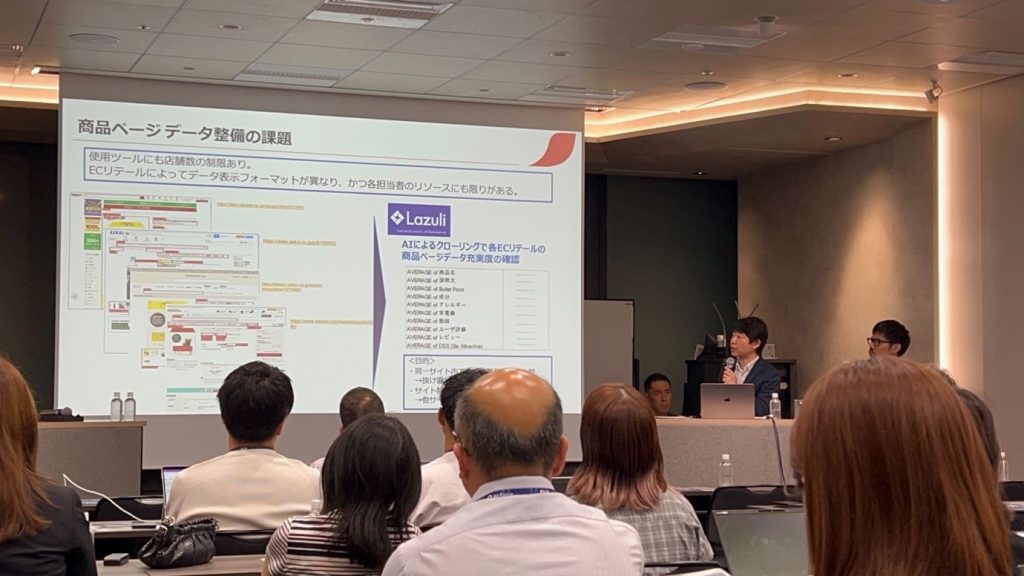
Furthermore, in A/B tests of product descriptions conducted together with Lazuli, the improved version (B pattern) showed better results for all target products, demonstrating that text alone can be effective. Going forward, based on these results, they plan to work not only on text but also on optimizing materials such as images and videos, and continue improving communication unique to e-commerce.
Summary
In Part 1, to rebuild ORBIS, which had lost sight of its brand direction, the structural reforms undertaken by Kobayashi and the on-the-ground DX execution by Ishikawa were introduced. The series of initiatives offered valuable insights as a real-world example of transformation in which “strategy, systems, and operations” functioned as one.
In Part 2, Iwakura of Nestlé Japan introduced the importance of a “channel-less brand experience” and the practice of digital shelf management that supports it. The perspective that maintaining consistency in product information across channels leads to higher customer satisfaction and purchase intent should be helpful for companies operating across multiple channels.
SYNERGY DX MEETUP is a forum organized by SUPER STUDIO Co., Ltd. to explore the synergies of DX that lead to business growth for companies.
In this event, we heard examples of initiatives from POLA, ORBIS, and Nestlé Japan. It was likely a valuable opportunity to gain hints for overcoming the DX challenges many companies face.