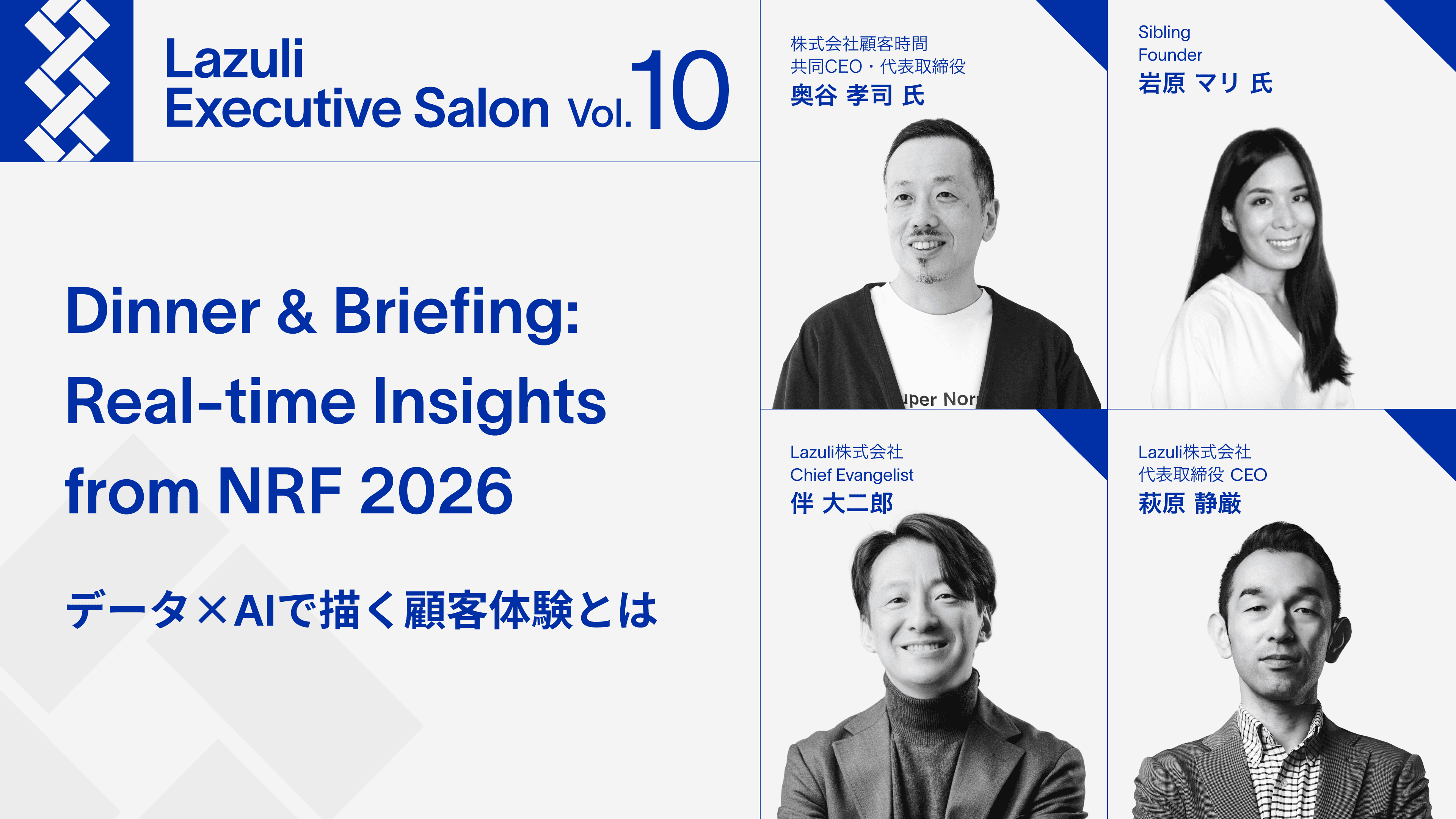
Real-time Insights from NRF — What Is Customer Experience Shaped by Data × AI? | Lazuli Executive Salon Vol. 10 Event Report
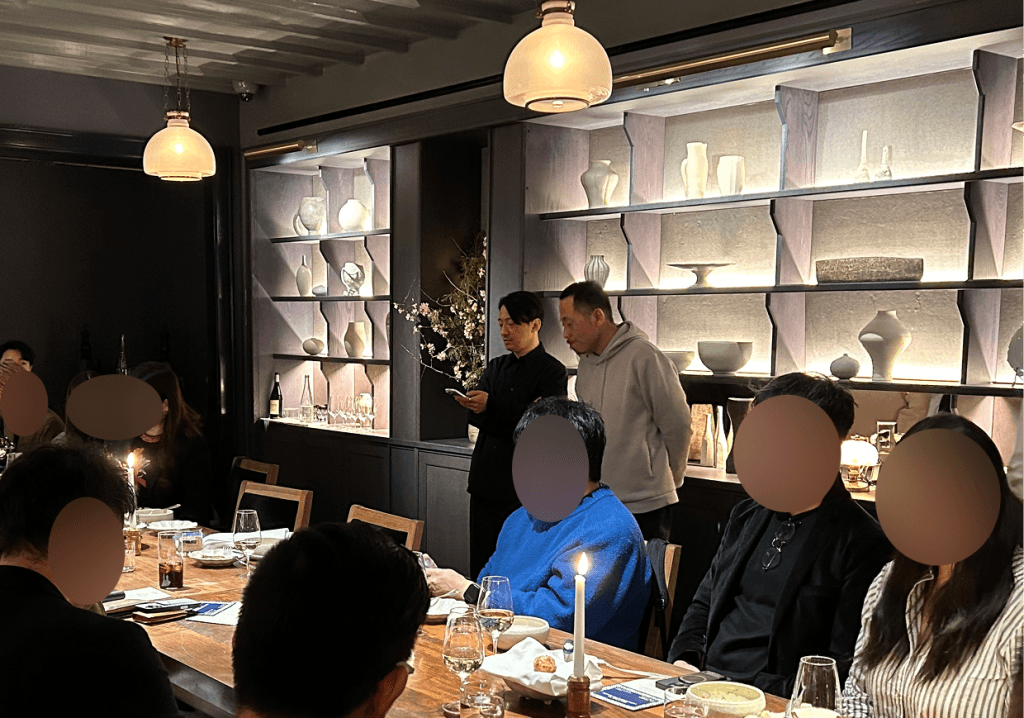
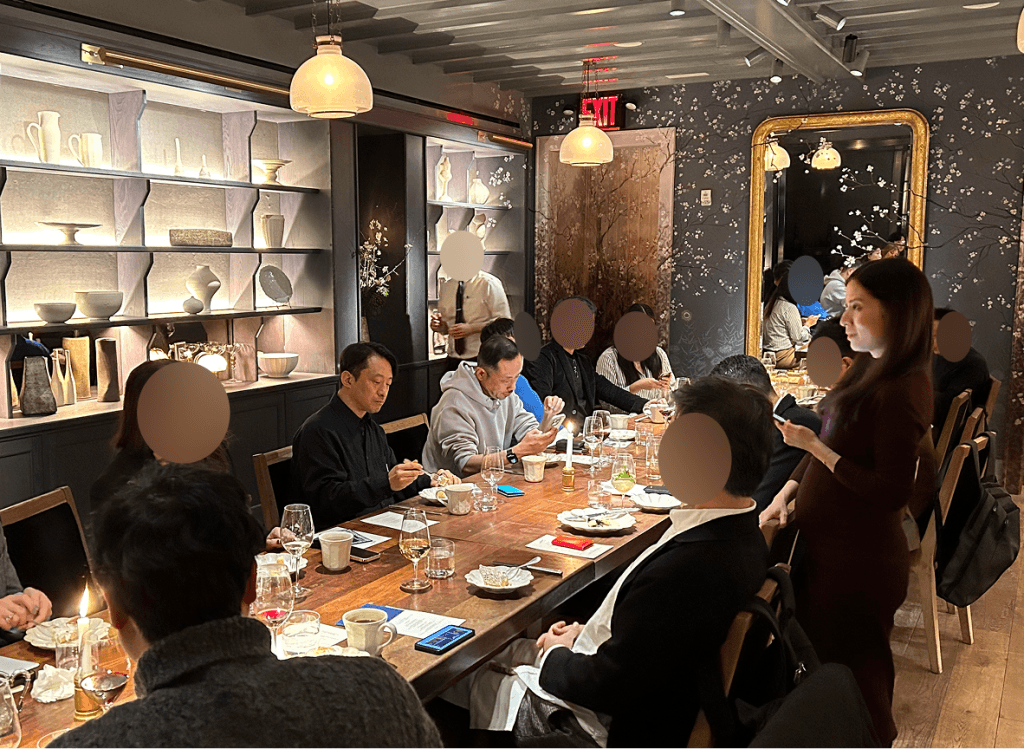
Lazuli Inc. held the 10th “Lazuli Executive Salon” in conjunction with “NRF 2026: Retail's Big Show,” one of the world’s largest retail trade shows held in New York. This time, leaders visiting New York and attending NRF joined the discussion on the future of retail and marketing in the age of AI, and the key role that “product information” plays.
The Reaffirmed Global Importance of “Product Information”
At the outset, Hagiwara, a representative of Lazuli, reported on the company’s exhibition at NRF’s “Startup Hub” booth. Through dialogues with many visitors and retail companies participating from around the world, it was confirmed that the challenge of “manual entry of product masters” is a common global issue. In line with Lazuli’s mission to organize product information using AI, it was shared that, as the times evolve, demand is increasing worldwide.
NRF 2026 Recap — The Era of “Conviction” Rather Than “Correct Answers”
Against the backdrop of recent NRF themes such as “Make it Matter” and “Next is Now,” a discussion unfolded on what retail companies should look like in the AI era, with Koji Okutani of Customer Time Inc. and Daijiro Ban, Chief Evangelist at Lazuli.
Google vs Walmart: The Struggle for Initiative
While Google is pushing “agent commerce” using generative AI, Walmart was pointed out as clearly taking a stance not to give up control by retaining in-house responsibility for trust with customers and for delivery and aftercare.
The Strategic Value of AI × Product Information
To make AI search and agent commerce function, having product information organized directly leads to business opportunities. For AI to respond accurately to customers’ vague questions (such as “the best item for a weekend camping trip that the whole family can enjoy”), it is essential to organize not only specification data but also metadata such as use cases, frequency, and cultural background.
The Power of Data That Cultivates Customers’ “Sense of Conviction”
Precisely because we are in an era where AI presents the “correct answer,” retail must offer value beyond efficiency. What matters to customers is a sense of conviction in purchasing, and if information based on context and culture is not attached to products, AI cannot make proposals that convince customers. It was said that, to realize such proposals, enriching product information (product data) is essential.
Consumer Trends Predicted by WGSN
From the session by trend forecasting company WGSN, the following key keywords for consumer trends were introduced, including:
・Sensory Adjust: In reaction to digitalization, the five senses and tactile feel become important.
・Chaos Regulation: In information overload (chaos), companies eliminate noise and provide meaningful information.
・Fragmented Identity: Respond to fluid identity rather than demographic attributes. Consumer trends predicted by WGSN
These trends, which are important for understanding future consumer behavior, indicate that in retail strategy, not only simple functionality but also the provision of sensory experiences and the importance of personalized communication will continue to grow.
The Latest Trends in AI and Data Utilization — The Expansion of Platform Providers and Challenges
From the perspective of data analysis and AI, Hagiwara, representative of Lazuli, explained the technology trends and challenges seen at NRF.
Reaffirming “Garbage in, Garbage out”
As platform providers such as Google make a full-scale entry into the retail industry with “Universal Commerce Platform (UCP)” and similar offerings, many companies are facing the hurdle of “not having their data in order to make AI produce accurate answers.” In AI applications such as chat commerce, there is rapidly spreading awareness in the U.S. that not only the algorithms but also the underlying product master (Product Data) must be prepared.
New York’s Latest Trends — Storyliving and Cultural Curiosity
From Mari Iwahara, a branding specialist active in New York, the latest trends were introduced from the perspectives of retail and culture.
Co-retailing & Third Places
In New York, where public space is limited, retail stores are starting to play the role of a “Third Place” by adjoining cafés and bars and taking on community functions (e.g., Million Goods, Colbo).
From Storytelling to “Storyliving”
Rather than merely telling a brand’s story, methods are evolving into “Storyliving,” which immerses customers in the experience. Because U.S. consumers have become skeptical, the process of actually participating and experiencing it to gain conviction is being emphasized.
Cultural Curiosity & Wellness
Behind “Cultural Curiosity” lies extreme political turmoil and social division (the Trump / anti-Trump divide). Consumers exhausted by unstable conditions are enthusiastically embracing Japanese and Asian-origin culture—such as “matcha” and “bath houses (sauna/hot springs)”—as wellness rituals that can reset them over time, reinterpreting them as rituals that offer an escape from daily life.
The Fusion of Technology and “Humanity”
In the discussion after the session, lively opinions were exchanged among the participating companies. Examples such as LVMH prominently featuring artisans (craftsmanship) were cited, and it was shared that in an era where digital can instantly produce copies, “time by human hands” and “craftsmanship” have become the ultimate luxury that AI cannot replicate. The discussion concluded with the idea that the Japanese concepts of “omotenashi” and “Eastern philosophy” could become powerful differentiators in a global market that is increasingly becoming tech-driven.
Summary
The NRF 2026 message, “Next is Now,” teaches that the future exists only as an extension of the present. Much was said about what Japanese companies need in order to find a winning chance globally while making use of AI as the “stagehand.”
1. Data maintenance as proof of Trust: In an era where AI generates misinformation and platform providers try to monopolize information, accurately maintaining your own PDP (product data) and continuing to prove consistency becomes the brand’s very own “trust contract” with customers.
2. “Heritage as a Barrier”: A time axis for beating AI: As the participants discussed, the “heritage” that Japanese companies possess—the accumulated time—is not something AI can imitate from tomorrow, and the careful care embodied in “J-Beauty” and time-intensive craftsmanship have become the source of the “conviction” the world most needs right now.
3. Integration of data and experience: By highly aligning CDP (customer preferences) and PDP (the meaning of the product), there is an increasing need to implement a “convincing shopping experience” in which customers feel they chose on their own will. The more AI advances, the more the value of human-ness and cultural context will rise, so we must fuse the “carefulness” and “coziness” we inherently possess with the latest technology and, from here, build the world-proud “convincing experience.”
Lazuli provides “Lazuli PDP,” a solution that uses AI to automatically structure, organize, and enrich product information scattered inside and outside the company. If you are interested in product meaning-making (tagging) or have challenges with AI-ready product data maintenance, please feel free to contact us anytime.
Contact us here: https://corporate.lazuli.ninja/contact