Using Product Data to Enhance Experiential Value — Kao’s DAM Evolution Expanding Customer Experience | Lazuli Executive Salon Vol. 9 Event Report
On November 19, 2025, Lazuli hosted the executive event “Lazuli Executive Salon Vol. 9,” inviting Mr. Ryo Goto, General Manager of the Customer Relationship Management Department, Digital Strategy Division at Kao Corporation, and Mr. Koji Okutani, Co-CEO and Representative Director of Kokyaku Jikan Inc., under the theme “Leveraging Product Data to Enhance Experiential Value — Kao’s Evolution of DAM to Expand Customer Experience.”
At this event, Kao gave a presentation on how it leverages product data to expand customer experience, including the practical challenges and resolution process in its long-standing efforts to improve product master data and digital asset management (DAM). In addition, based on insights from CDP World held in Las Vegas, USA at the end of October, the discussion also covered the next-generation CX enabled by connecting customer data and product data.
Kao’s Reform That Achieved “Unified Management” of Digital Assets
In Part 1, Mr. Goto of Kao Corporation gave a presentation on the theme of “Using Product Data to Enhance Experience Value — Evolving DAM to Expand Customer Experience.”
Building Digital Asset Management (DAM) and Thorough Data Standardization
In many business settings, management issues for digital assets, such as “I can’t find the creative materials” and “I don’t know which version is the latest,” have become chronic. These issues can lead not only to lower work efficiency, but also to brand damage caused by the use of incorrect materials, and barriers to multi-channel deployment. The tool drawing attention as a mechanism to address these issues is DAM (Digital Asset Management), which centrally manages digital assets such as images and videos and supports their use across multiple media. At Kao, there had been issues such as creative materials being scattered across individual PCs of in-house creators, or assets being lost when employees left the company. In response, Kao built a global digital asset management environment based on Adobe Experience Manager (AEM).
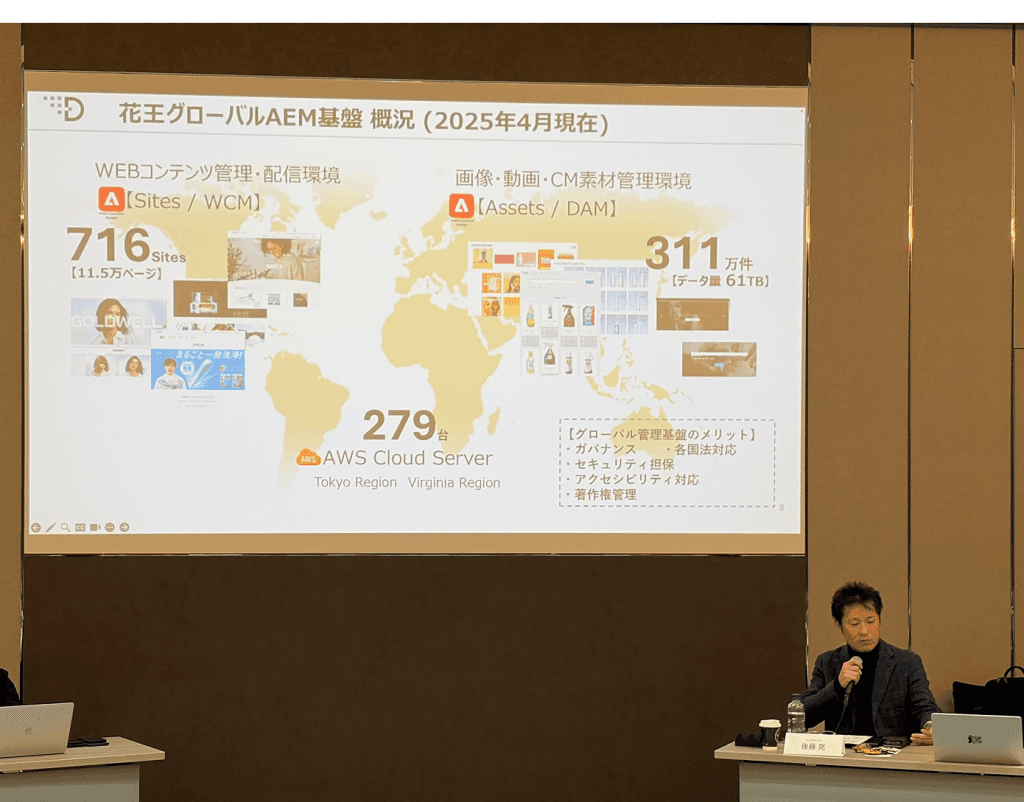
Currently, 716 sites and approximately 3.11 million assets (61 TB) are centrally managed on AEM (as of April 2025), and the following standardization measures were explained.
• Overhauling business processes:
DAM registration made mandatory in the delivery workflow. A mechanism in which “the job is not complete until the material is registered” achieves reliable data consolidation.
• One source, multi-use:
By attaching metadata to all materials, “master proliferation” is prevented, while past assets are digitized to increase their value.
Improving Customer Experience Through the Development of External Disclosure Masters
By developing “external disclosure masters” that convert and unify internal information for general consumers, the following mechanisms were realized.
• Automatic web page generation:
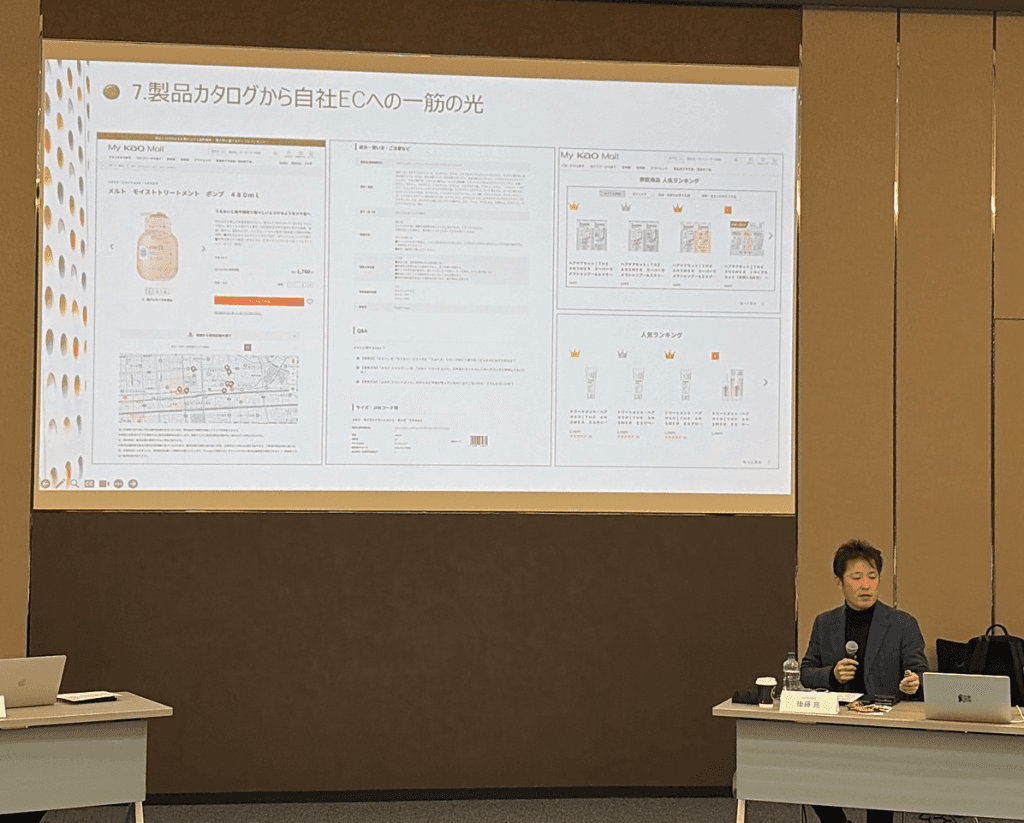
A system was built that automatically generates detail pages (features, ingredients, Q&A, etc.) in about 10 seconds with only product codes and other inputs.
• Providing in-store display functionality:
By linking delivery records with location information, stores carrying the product within 10 km of the current location are displayed on a map. Expanding the experience to meet the need to reduce time spent outside.
Future Outlook Through AI Integration and Real-Time Delivery
Furthermore, Mr. Goto said that going forward, he wants to further evolve the well-established data foundation and aim to leverage it as follows.
• Integration of generative AI:
Improve quality and speed while reducing costs through content generation and automatic tagging.
• Real-time delivery and data integration:
Work with CDP (Customer Data Platform) to improve ROI through personalized information delivery.
Mr. Goto said that, looking ahead to an era in which AI instantly creates and delivers pages based on structured information, Kao will continue building an information foundation that embodies the Kao Way (Kao’s corporate philosophy).
CDP World Participation Report — CDP Utilization and Organizational Transformation
In Part 2, Mr. Okutani from Customer Time, who attended CDP World held in Las Vegas in October 2025, reported on the latest trends in CDP utilization and specific use cases.
Integrating Data to Give Six Flags a “Second Sense”
Mr. Okutani shared the case of Six Flags, one of North America’s largest theme park operators. In response to data silos, the company built a unified profile, “Family Journey 360,” in its CDP. Especially noteworthy is the automation of SNS analysis using AI. It transformed the manual work of 15 people into real-time visualization, enabling early detection of issues and cost savings of over $1 million. It is highly praised as having “given operations a second sense.”
What Kind of Organization Should It Be?” Emerging from Conflict of Opinions
In the process of building Six Flags’ data foundation, differing opinions arose between the “speed and CX improvement” sought by the marketing department (CMO) and the “platform integration and quality” emphasized by the IT department (CDO), delaying decision-making. From this experience, it was concluded that the key to success is not IT dependency, but redesigning the decision-making structure so that it is led by the CMO and works backward from CX.

The Role of People in the AI Era
Insights were also shared about the role of people in the AI era. In an era where AI automates 95% of work, humans should focus on strategy, final decision-making, and the role of “weaving the customer story,” and establishing a “Human-in-the-Loop” system in which AI and humans collaborate was described as what supports brand trust and evolution.
A Roadmap to True DX Promotion, Depicted Through “Talent, Operations, and Data Integration”
Discussion was held with participants who were responsible for DX promotion and marketing decision-making at major domestic retail/manufacturing companies.
The Need for “Marketing×IT” Hybrid Talent That Can Break Down Organizational Walls
To truly move DX forward, it is necessary to remove the “invisible wall” between the marketing and IT departments. The key is “hybrid talent” who can understand both sides’ language and perspectives. For example, the view was shared that when someone with an engineering background joins the marketing department and serves as a “translator,” organizational collaboration becomes smoother and the speed and quality of initiative execution improve dramatically.
Support for “Operational Adoption” That Determines the Success or Failure of CDP Implementation
Even if a highly functional CDP is introduced, the challenge is how to overcome the “operations barrier” so that the frontline can actually use it effectively. There was agreement that vendors must do more than simply provide tools; what is indispensable is “hands-on support” through continuous outreach to IT departments and consulting until customers can feel the business value.
New Customer Understanding Opened Up by “Intercompany Data Collaboration” Beyond Individual Companies
There was also discussion about a “future vision” that goes beyond the scope of a single company and links data among manufacturers, and so on. Sharing product data and customer attribute tags across companies for a common purpose was discussed as a next-generation growth strategy expected to optimize the entire supply chain and enable customer understanding at an unprecedented level of granularity.
Lazuli PDP New Feature Introduction — Automatic Structuring of “Unstructured Data” by AI
Breaking Through the Wall of “Unstructured Data” with AI
Lazuli's VP of Tech, Mr. Kuyama, gave a demo of a new feature currently under development. One of the issues many companies face is the inconsistency of data formats exchanged between manufacturers, retailers, and other companies. To prepare “unstructured data” such as Excel files, PDFs, and images into “structured data” that can be used by system integrations and various services including AI requires a tremendous amount of effort. To eliminate this bottleneck at the entry point of data utilization, Lazuli is developing an AI-powered automatic structuring engine.
A Data Conversion Process That Learns and Evolves
In the demo, simply loading a complex Excel file allowed AI to automatically map fields and even perform validation checks. In addition to extracting container shapes such as “PET bottle” and ingredient information, tasks such as correcting exaggerated expressions and consolidating category names based on internal rules (e.g., “natural water” → “mineral water”) are completed within a simple UI. More importantly, the system includes a mechanism in which AI learns from the corrections made by humans and automatically improves processing accuracy in subsequent runs.
This feature is expected to improve the efficiency of data input into PIM (Product Information Management) and DAM (Digital Asset Management). By functioning as a hub for data distribution between companies and systems, Lazuli PDP will strongly support corporate DX promotion.
Summary
In this Executive Salon, a case was shared showing how Kao’s DAM implementation and thorough data standardization are contributing to the expansion of customer experience and the establishment of an AI utilization foundation.
Kao’s efforts to balance governance and customer experience may offer practical hints for companies aiming for data-driven management.
It was also agreed that true DX requires organizational transformation, such as fostering “hybrid talent” that connects marketing and IT, and creating a system in which AI and people collaborate.
Through AI-powered “automatic structuring of unstructured data” and more, Lazuli will help solve challenges in data distribution. With a highly accurate product data foundation, we will streamline data integration with DAM and other systems, contributing to corporate DX promotion.
About Lazuli Inc.:
Lazuli Inc. is a startup founded in July 2020 that provides the SaaS “Lazuli PDP,” which integrates and organizes corporate product data and supports data/AI utilization. Using advanced AI/ML technologies, it enables the collection, structuring, and linkage of product data, accelerating digitalization in manufacturing and retail. Lazuli PDP automates complex data processing and eliminates data silos between departments. By enabling companies to provide consistent product information, it contributes to improved customer experience and optimized data utilization.
Lazuli PDP: https://corporate.lazuli.ninja/product-data-platform/