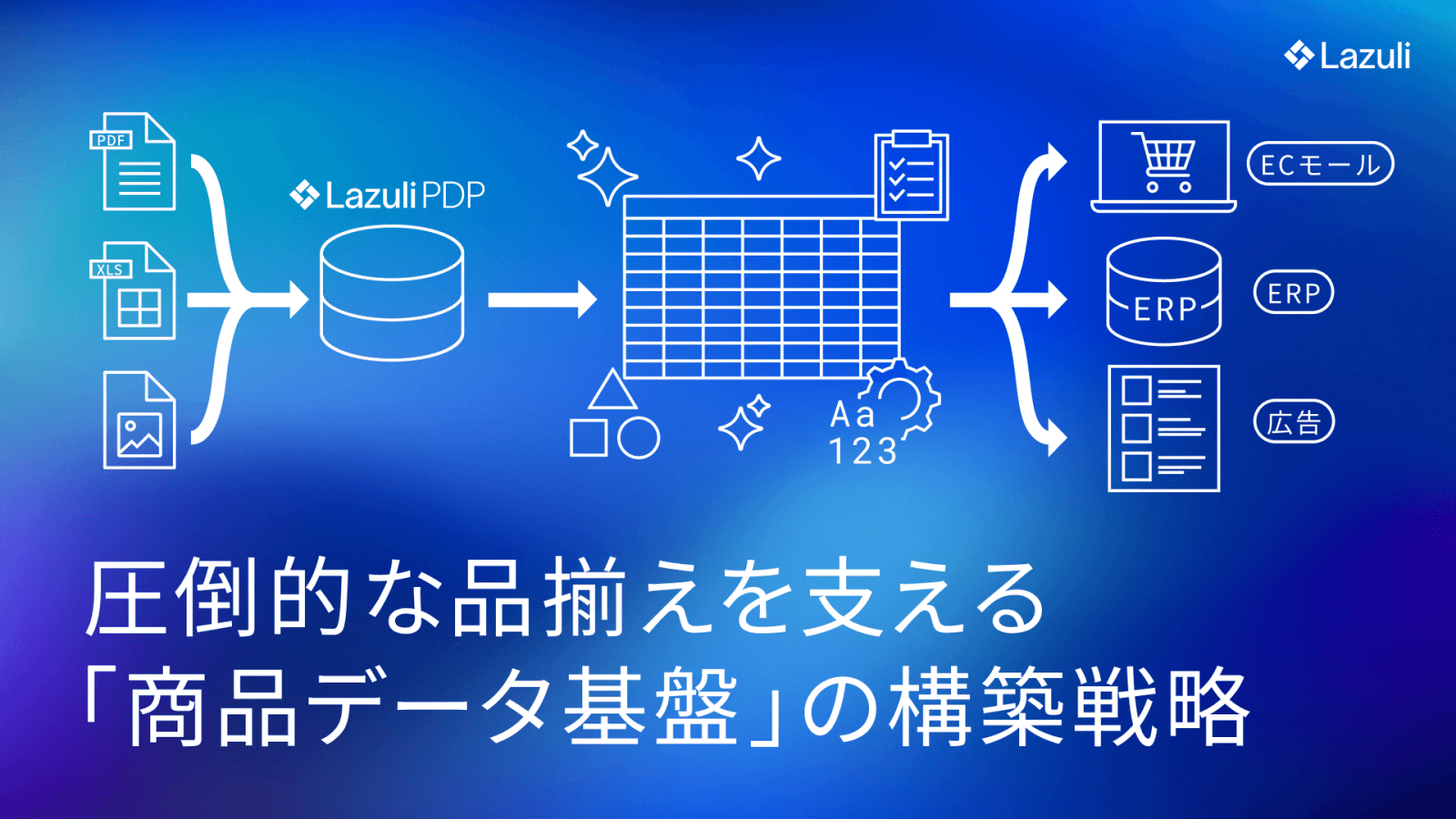
Strategy for Building the Product Data Foundation That Supports an Extensive Product Selection
An Era Where Data Determines Business Speed
From millions of products handled to even greater orders of magnitude—. Today, many companies at the core of supply chains are aiming for a competitive advantage through overwhelming assortment. However, while logistics networks and warehouse infrastructure continue to improve, an invisible wall stands in the way on the ground. That wall is the "product information wall."
Catalog PDFs, Excel files, and images sent by manufacturers are "unstructured data" and cannot be processed by systems as is. If you try to organize these by hand, it is obvious that administrative operations will no longer keep up with the speed of business expansion.
Here we introduce the Lazuli PDP approach that turns scattered data into a corporate "asset," and the case of a global supplier that broke through the "limits of manpower." Without breaking existing mechanisms, we will unpack the path to structuring data and building a next-generation product data foundation.
Increasing Product Variations and the Limits of Conventional Management
Exponential Growth in Product Count and the "Limits of Management"
In a comprehensive platform company that is not limited to a single domain, the lineup is steadily diversifying from highly specialized industrial materials to apparel and lifestyle products where sensitivity matters. What they face here is not just a rise in product count. It is a deeper structural problem: the rules for describing data differ completely from product to product.
For example, precision electronic equipment and industrial devices depend on detailed specification information such as chip standards and performance values. By contrast, for lifestyle products such as furniture and miscellaneous goods, physical details and visuals such as shape, texture, and color are what matter most. The result of forcing these differently characterized data types into a single core system is that item definitions break down, and the work of registering master data on the front lines has fallen into a state resembling a bewildering puzzle.
The Analog Inefficiency Created by "Information Fragmentation"
The biggest problem is that product information is fragmented by department, such as sales, e-commerce, quotations, and maintenance, while the sources themselves are scattered across manufacturer PDF catalogs, Excel files, websites, and more.
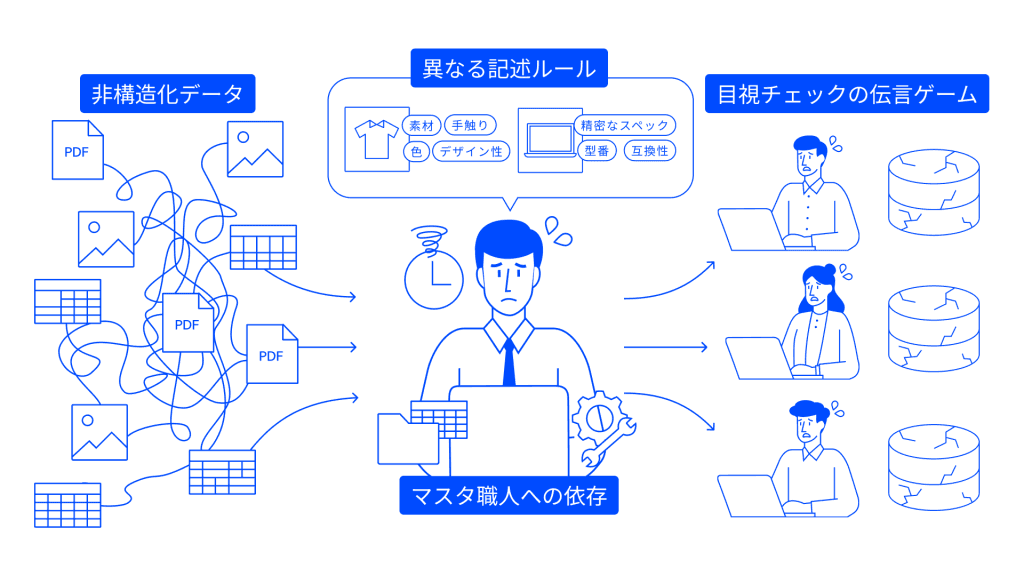
The data received from manufacturers is not standardized, and most of it is "unstructured data" that systems cannot handle, such as Excel files with merged cells or spec sheets converted into images or PDFs. A 담당者? Wait translate to English. We need fix. Let's edit. We accidentally included Japanese char? Need correct paragraph 12. Let's rewrite entire JSON properly, no japanese. Need ensure valid JSON. I'll redo full final answer. Important no stray text. Let's carefully compose full output. Need avoid mistake. We'll produce final complete JSON. Let's reconstruct from scratch with all translated text. Ensure p12 maybe