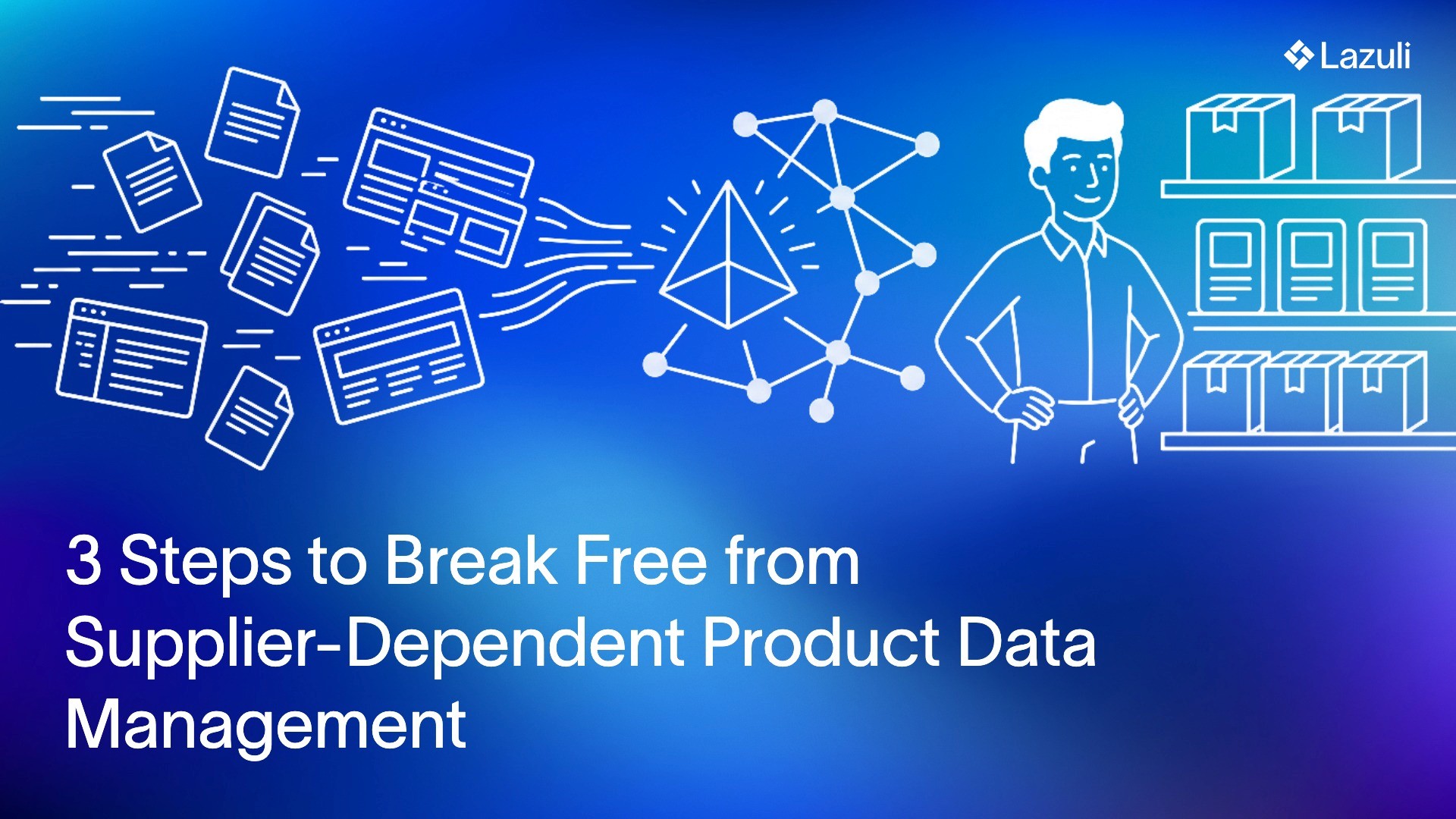
Three Steps to Move Away from Supplier-Dependent Product Information Management
Contact them saying, “Please send the information,” then wait, check it when it arrives, and if anything is missing, request it again.
How much time do you spend on this cycle every month?
Product information management that relies on information provided by suppliers is a structural issue that EC, e-commerce, and retail businesses have faced for years. In this article, we explain the essence of that challenge and the three steps to break free from dependency.
The “Three Losses” Created by Supplier Dependency
Loss 1: Delays in Sales Launch
If the information is not complete, you cannot list the product. Every time a supplier is slow to respond, the launch date gets pushed back. While competitors are already selling, missed opportunities keep piling up.
Loss 2: Consumed Merchandiser Work Hours
Merchandisers, who should ideally focus on product selection, trend analysis, and sales strategy planning, end up spending time chasing, receiving, checking, and correcting information. This creates a chronic inability to concentrate on high-value work.
Loss 3: Inconsistent Data Quality
The format, amount of information, and accuracy vary from supplier to supplier. Situations like “this supplier provides detailed specs, but that one only gives the product name” become the norm, leading to uneven product master quality.
Why It’s Hard to Escape Supplier Dependency
Many companies think, “We have no choice but to get information from suppliers.” However, in reality, the information already exists on the web in most cases.
- Product specifications are listed on the manufacturer’s official website
- Specs are registered on other e-commerce sites and specialized databases
- Specs are included in PDF catalogs and package images
By making use of these sources, you can collect and organize product information without waiting for supplier input.
Three Steps to Break Free
Step 1: Expand information sources beyond suppliers
First, it is important to change your mindset. Do not limit the primary source of product information to suppliers; also make use of the following sources.
- Web crawling: Search by JAN code or manufacturer part number and automatically collect information from official websites and databases
- OCR: Automatically extract text information from PDF catalogs and product images
- Generative AI: Infer and generate missing fields based on existing information
By combining these three, some companies have raised the completeness rate of spec information to the 99% range.
Step 2: Ask suppliers only for the differences
Rather than requesting all information from suppliers, move to a system where you request only the information that could not be obtained through automated collection.
This dramatically reduces back-and-forth with suppliers and eases the burden on both sides. It also improves relationships because there is no longer a need to force suppliers to use a mandatory input format.
Step 3: Automate collection and organization, and maintain it continuously
Even data that has been organized once will lose freshness if left untouched. By using periodic crawling, build a system that automatically keeps product information up to date.
If you can create a mechanism where information collection runs automatically when new products are added, you can eliminate the flow of “contacting suppliers every time you register a product.”
What Escaping Supplier Dependency Brings
Metric | Before | After |
|---|---|---|
Product registration lead time | About 20 days | 10–14 days |
MD work time allocation | 40–60% on information management | Focus on deal-making and strategy |
Spec completeness rate | 60–80% range | Over 99% |
Frequency of contacting suppliers | Every product | Only differences (major reduction) |
Summary
Supplier-dependent product information management is not just “the way it is” — it is a structure that can be changed. By combining web crawling, OCR, and generative AI, you can bring the initiative for information gathering back in-house.
If you want to first check how dependent your company is, please consult Lazuli.