Store Sales Strategies Transformed by LazuliPDP: Three Challenges in POS Analysis and How to Solve Them
POS data analysis is essential to sales strategies for increasing store sales. However, there are probably few companies that are able to make full use of POS data. In this article, we present the long-standing challenges of POS analysis that have remained unresolved for years, along with a solution that uses Lazuli PDP.
In this article, we propose the challenges of POS analysis using Lazuli PDP and their solutions. Traditional sales strategies that rely on intuition and experience are no longer effective, and decision-making based on data has become essential. By understanding the challenges of POS data and the solutions that can be achieved with Lazuli PDP, you can deepen your understanding of consumers, grasp market trends, and analyze competitors, greatly expanding the range of your sales strategy and setting yourself apart from competitors.
Consumer values are diversifying. Sales strategies based only on intuition and experience no longer work
The market surrounding today’s consumers is changing like never before, due to factors such as the decline in inbound demand caused by the COVID-19 pandemic, the spread of remote work, and the increase in the lifetime rate of single-person households. It will become increasingly difficult to differentiate yourself from competitors with promotional proposals that rely only on intuition and experience. To stay ahead of this wave of change and achieve an effective sales strategy, we introduce three key points.
Understand consumer values: Each consumer’s values are becoming more diverse, and mass approaches alone are becoming less effective. A commitment to pursuing personalized marketing that reflects individual values and lifestyles is required.
Decision-making based on data: The era of relying on intuition and experience is over, and evidence-based decision-making using objective information such as customer data and POS data is now required. To achieve the best results with a limited budget, it is necessary to rapidly cycle through data-driven decision-making and hypothesis verification.
Quickly grasp market trends: Capturing market changes in real time and responding quickly is essential for maintaining a competitive advantage. Product development cycles are getting shorter every year, and it is becoming increasingly difficult to grasp market trends in real time, including consumer tastes and temporary fads. If your response is delayed, you will end up repeatedly rolling out misguided measures that do not reflect the current social climate.
By leveraging customer data and POS data, you can address these challenges and realize a data-driven sales strategy. Let’s uncover the deeper needs of consumers and connect them to higher sales.
What are the three challenges of sales strategy using POS data?
I’m sure your company also has a vast amount of POS data sitting idle. In manufacturing and retail, POS analysis is an indispensable element in forming a sales strategy. However, there are deep-rooted challenges to using it effectively, as follows.
POS data quality and consistency cannot be maintained: POS data circulation volume is enormous, said to be one of Japan’s largest big data sources, and maintaining its quality and consistency is a deep-rooted challenge. Because the items and input rules for POS data differ by POS equipment manufacturer and by distributor, it is common to encounter variations in product names, units, and missing data, leaving insufficient accuracy and information for analysis. Inconsistencies and errors in data undermine analytical accuracy and carry the risk of leading to misguided strategies.
Consumer purchasing psychology cannot be reflected: It is difficult to read complex consumer behavior with the current POS data analysis. Since POS data is intended to improve inventory management efficiency, it can tell you “when, where, what, and how many” were purchased, but it lacks the information needed to know “why it was purchased.” If you cannot capture consumer values as data, then when considering concrete measures, it becomes unclear “what should be done to make consumers happy?” Seasonal and temperature-based sales trends and basket analysis alone are simply not enough.
There are no personnel with advanced data analysis skills: It is important to determine how to incorporate insights obtained from data into actual sales strategies. To make data-driven decisions, you need the skills to transform data into concrete action plans. The entire flow—from forming hypotheses, collecting data, organizing analysis items, performing data cleansing, linking with CDP and BI, and converting the results into a form usable for proposals—is difficult for beginners. In particular, when sales departments handle POS analysis, the shortage of data-utilization talent becomes a major issue.
Lazuli PDP helps solve POS analysis challenges
Lazuli PDP is a powerful tool for solving the three challenges in POS analysis. Let’s take a closer look at its effects through the following three points.
Data cleansing and integration: It can cleanse product-related data such as POS data and product master data, and organize it into a consistent data format. By integrating data from different sources and providing a centralized analysis foundation, it can reduce the enormous costs previously spent on data preprocessing, allowing you to invest more time in high-value work to gain insights.
Feature tag generation: Using proprietary AI/ML technology, it can extract market trends as data from consumer reviews and competitors’ selling prices. It is possible to provide advanced datasets that add consumer and competitor data to simple purchase records. Using the power of AI and big data, it can assign feature tags such as health-conscious, outdoor, value-for-money, and gift-lover to each product.
User-friendly operation: Even people who are not accustomed to data analysis can use it easily. Simply import a CSV of POS data or product master data, and AI processes the data to provide a rich dataset with data cleansing and the addition of necessary fields for analysis through simple operations.
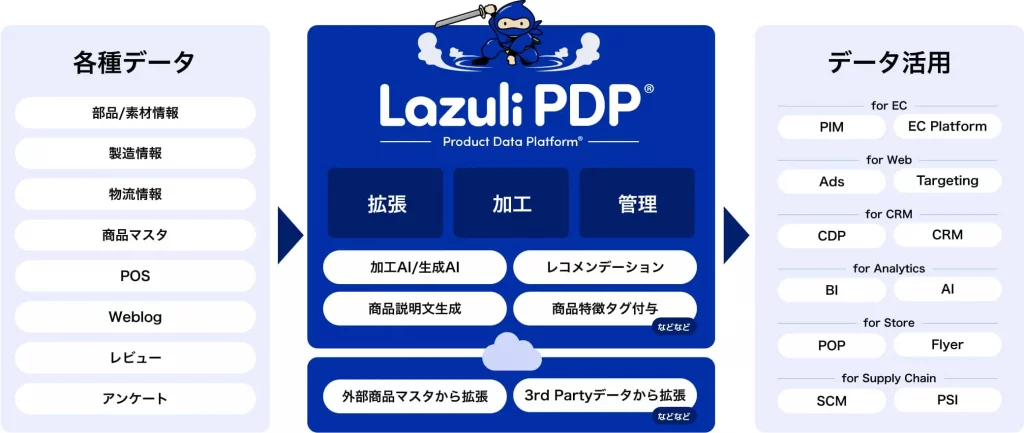
Lazuli PDP is provided as a cloud-based SaaS and can process vast amounts of data. Rather than merely cleaning data, by linking transactional POS data to Lazuli PDP and keeping the data organized at all times, you can analyze consumer insights and market trends in real time. This makes it easier to translate fast-changing times and consumer values into actionable plans without losing data freshness.
Conclusion
Lazuli PDP is a powerful tool for solving long-standing challenges in POS analysis. With data cleansing and integration, feature tag generation, and a user-friendly interface, it lowers the difficulty of data analysis. Without compromising data freshness, let’s incorporate the spirit of the times and consumer values into our action plans and transform sales strategies from intuition-and-experience-based approaches into data-driven ones.
At Lazuli, we develop and provide “Lazuli PDP,” a product data generation and delivery solution that supplies the product data needed for organizing and processing product master data in data analysis. If you are struggling with CRM optimization or making effective use of internal data, please contact us here.
About Lazuli PDP here: https://corporate.lazuli.ninja/feature/