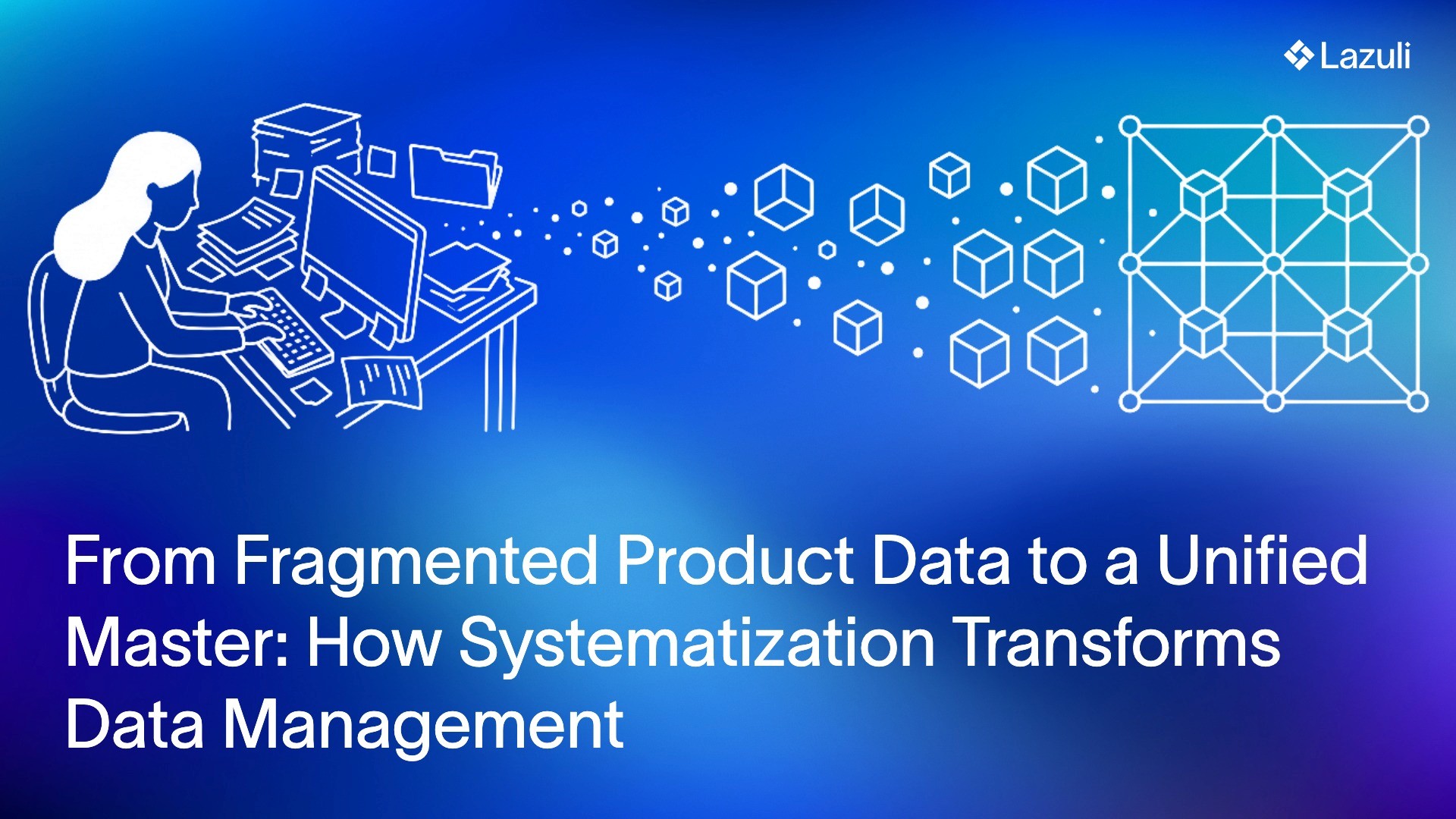
From Fragmented Product Data to a Unified Master: How Systematization Transforms Data Management
There are almost no companies left saying, “We don’t have enough product data.” The problem is not that data is lacking, but that although it “exists,” it is not in a usable form. Spec sheets from manufacturers arrive in Excel, catalogs in PDF. Image files are on employees’ PCs, and inventory data is buried deep in the core system. The data certainly exists. Even so, it takes weeks to list products on EC sites, new product information is published while still outdated, and delays in reflecting changes in the integrated master cause confusion on the front line—. This is not a problem of data “quantity.” It is a problem of “structure” and “process.”
Why Do Product Data Become So Fragmented?
The fundamental reason product data is difficult to handle is that there are too many sources of origin.
Supply data from manufacturers and suppliers, spec sheets created by in-house planning and development teams, code data for logistics management, and registration information for EC and promotional channels—.
Each is managed in a different department, on a different system, in a different format.
Without being integrated, the data just keeps accumulating. This is the state known as “data silos.”
Organizational silos create data silos as they are.
Specifically, at one retail company, simply converting different Excel formats from each supplier into the company master took more than half a day per new product. It is said that this conversion work was done by the person in charge using their own rules and was not even documented.
Three Costs Accumulated by “Making Do with Manual Work”
In response to this situation, many companies choose either to have the person in charge work harder or to add more people.
However, this approach has fundamental limits.
1. Person-Dependence Cost
The person in charge creates their own Excel macros and conversion rules, and these become tacit knowledge within the organization. The moment that person is transferred or leaves the company, that know-how disappears. Many of you may have experienced data quality dropping every time responsibilities are handed over.
2. Quality Degradation Cost
The more manual work increases, the more mistakes increase as well. Inconsistencies, duplicates, transcription errors—. These lead to errors on EC product pages, mistakes in data provided to business partners, and inventory management troubles. The effort required to fix mistakes (rework cost) also keeps steadily accumulating.
3. Opportunity Loss Cost
The time it takes to prepare data is the same as a delay in launching sales. Products listed even one step behind competitors fall behind in both search rankings and review counts. Data problems directly translate into lost business opportunities.

The Solution Is Not to Change “How Hard You Work,” but to “Design the System”
So, how should things change?
The key shift in thinking is moving from “people process it” to “data flows automatically.”
Specifically, it is important to design mechanisms like the following.
– Automatically extract and read data from multiple sources (Excel, PDF, images, system outputs)
– Absorb structural differences by source and automatically convert them into the integrated master format
– Manage conversion rules as a system so that anyone can reproduce the same results
In organizations with this kind of “design,” data preparation capacity can be expanded without increasing the number of staff.
Data can keep pace with business speed.
A New Way to Organize Product Data, Designed Together with Lazuli
Lazuli is a platform that supports data preparation, transformation, and utilization for retail, manufacturer, and distributor companies, centered on product information.
Our role is not only to provide tools. After understanding your business challenges and the realities of your data, we work with you to design the “mechanism” through which data flows correctly. “I want to organize our current preparation flow once,” or “I’m not sure where the issues are”—even at that stage, please feel free to consult us. We’ll start by organizing the current situation together.
Summary: The Essence of Product Data Challenges, and Beyond
– The issue with product data is not that there is “too little data,” but that it is not in a usable form
– The root causes are format diversity, organizational silos, and the accumulation of manual processes
– The direction of the solution is not “putting in more manual effort,” but “designing a mechanism in which data flows”
This shift in thinking opens the next stage of product data management.

Why not pause and organize your product data preparation once?
First, please let us know your current situation. Lazuli’s specialists will support you from organizing the issues onward.