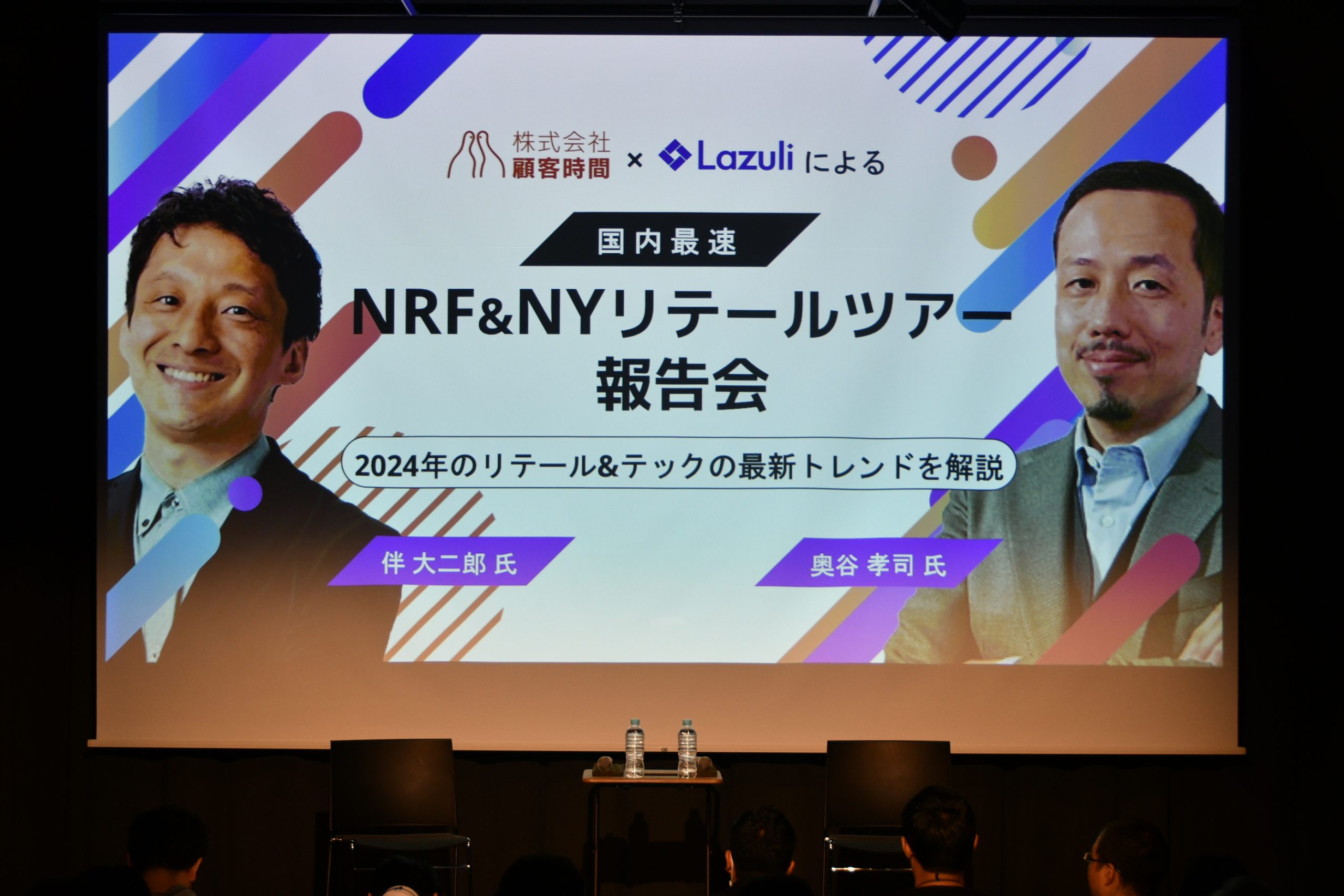
NRF2024 & NY Retail Tour Debrief: Latest Trends in Retail and Tech
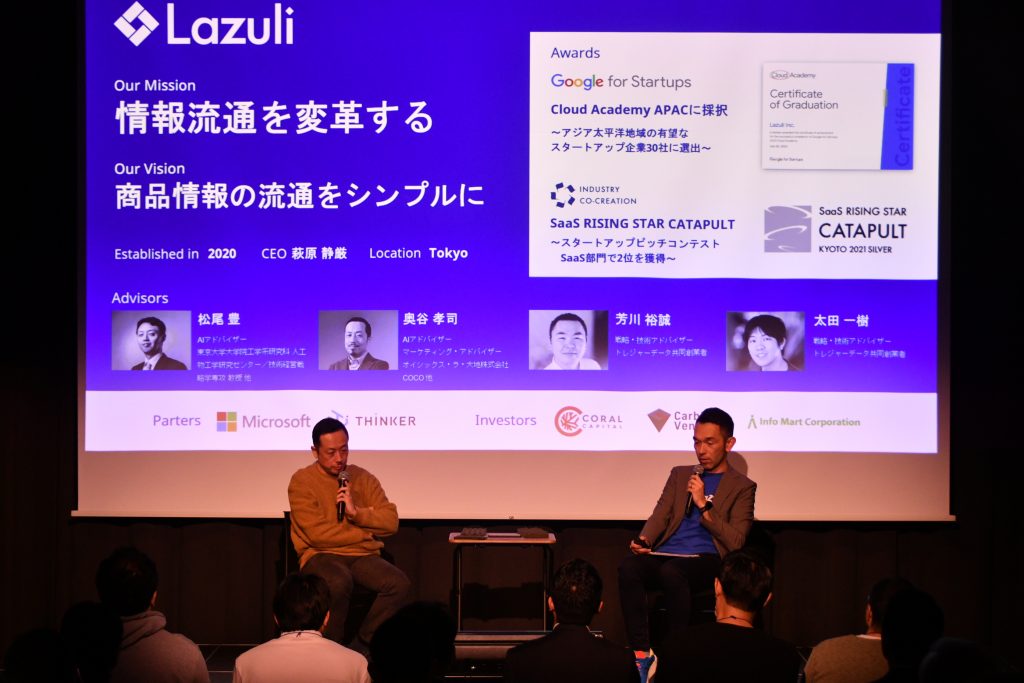
Lazuli invited Takashi Okutani, Co-CEO of Kokyaku Jikan Inc. and Executive Officer/COCO of Oisix ra daichi Inc., and Daijiro Ban, Executive Specialist at Yappli Inc. and Project Manager at Kokyaku Jikan Inc., who also attended CES, as speakers, and held a debriefing session on February 6, 2024 about the world’s largest retail event held in the U.S., “NRF 2024: Retail’s Big Show,” as well as the New York retail tour. In this article, we highlight key points from the session.
“NRF 2024:Retail's Big Show,” one of the world's largest conferences in the retail sector held every January in the United States.
As an event that predicts annual industry trends, this event attracts attention from around the world. This time, it highlighted how AI is bringing innovative CX and improved employee experience to the retail industry. It also noted that AI is being built into major cloud services as a matter of course, and that the trend has shifted from whether to use AI to how to use it.

Latest Trends in Overseas Retail
This year's NRF, themed “Make it Matter,” discussed use cases of AI in retail, the shift to DtoC (Direct to Consumer), and companies' efforts to acquire first-party data. One of the keynotes that drew attention was Gucci's use of generative AI in its call center, which increased revenue by 30% overnight, and Walmart's new business strategy.
In Europe and the U.S., generative AI has already been democratized not only in IT but also in retail, and incorporating AI into operations is already becoming a commodity. With using AI no longer a competitive advantage, companies are entering a phase in which they think about how to differentiate themselves. Capturing customer needs and jobs (the problems they want to solve), improving customer experience (CX) and employee empowerment through AI use were discussed as two important themes.
Using AI and Improving Customer Experience (CX)
Through AI use, innovations are advancing across the retail industry, including improved recommendation accuracy, more efficient customer support, improved delivery processes, and new business planning.
At the cosmetics specialty store for young consumers, Ulta Beauty, it has been realized by retaining customers' skin condition as data. AI-driven recommendation accuracy has improved, and when employees serve customers in stores, they can provide samples of cosmetics optimized for each customer, greatly advancing the shopping experience.
The pet supply retailer Chewy has successfully transformed itself from a pet goods seller into a pet health company. Formerly a pet retail business, it developed new services that meet customer needs through the use of first-party data and AI. It achieved vertical, customer-centered service expansion such as grooming lessons, pet insurance, and travel planning with pets.

A New Trend: “Employee Empowerment”
Employee empowerment is also attracting attention as a new trend, and it was suggested that AI use can dramatically improve CX. Development of employee-facing applications is progressing rapidly, and many companies are focusing on developing custom applications to improve employee productivity and satisfaction. Shift management, inventory checks, access to customer data, internal communication tools, and more support employees' daily work while providing customer information in real time, enabling employees to offer faster and more personalized service to customers.
At the rural specialty retailer Tractor Supply Co., a system has been implemented in which employees transfer conversations with customers to AI in real time through headsets and get answers on the spot. For example, even when asking abstract questions such as, “Recently, the number of eggs laid by chickens has decreased. What kind of action is needed?” everyone from new hires to veterans can provide answers at a consistent level. Such efforts are a valuable mechanism for analyzing data obtained from conversations with customers and leading to a deeper understanding of customers.
Everyone Is Aiming to Become a D2C Company
At major logistics company FedEx, driven by concern about Amazon, it is investing in strengthening its e-commerce solution tools.
Logistics companies hold enormous amounts of first-party data in the form of delivery information, and by linking it with customer information held by the retail industry, they are advancing into new businesses that further improve the customer experience.
Jeans maker Levi's is also moving toward D2C, and while wholesale business is struggling, it has achieved great success by advancing an omnichannel strategy that uses customer data in EC and directly operated stores.
The Key Is Collecting and Organizing Data Across the Entire Customer Journey
It was shown that having online touchpoints has become common, and many companies are focusing on D2C and engagement. By leveraging cutting-edge technologies such as generative AI and metaverse apps, companies aim to strengthen trust and engagement not only with customers but also with employees. In advancing these activities in a data-driven way, purpose-driven management is essential, and realizing excellent customer experiences through the use of technology was said to be key.
It was also noted that, to realize excellent customer experiences, it is necessary to collect and organize not only purchase data but also data across the entire customer journey (including not only customer data but also product data held by the company).
The Future of Product Data
As companies need to create touchpoints with customers, the ways of creating those touchpoints are diversifying. Among them, the most important point was emphasized as organizing and maintaining consistency of information at omnichannel touchpoints, especially product information.
In addition, there is a need to prepare a data foundation in order to respond to changing market needs, achieve traceability, and fulfill social responsibility, and solutions through the use of technology were presented.
2024 is expected to see the rise of domain-specific AI. “Lazuli PDP,” provided by Lazuli, specializes in organizing product data and highlighted that generative AI makes it easy to generate and process product data. The session concluded with the view that such technology should be used to minimize cost and time and that a system for improving customer experience should be put in place as quickly as possible.
Summary
We hope you gained an understanding of how the evolution and application of technology in the retail industry are transforming customer experiences and contributing to business growth. The advancement of AI technology and its application to the retail industry is not just a trend; it is becoming the foundation that will shape future business models. As a service vendor leveraging AI technology, Lazuli supports the building of new relationships with your customers and business growth from the standpoint of organizing product data.
If you are interested in improving customer experience or innovating your business model, we look forward to hearing from you at Lazuli. Let's shape the future of retail together and create the next generation of customer experience.
Contact Lazuli here.