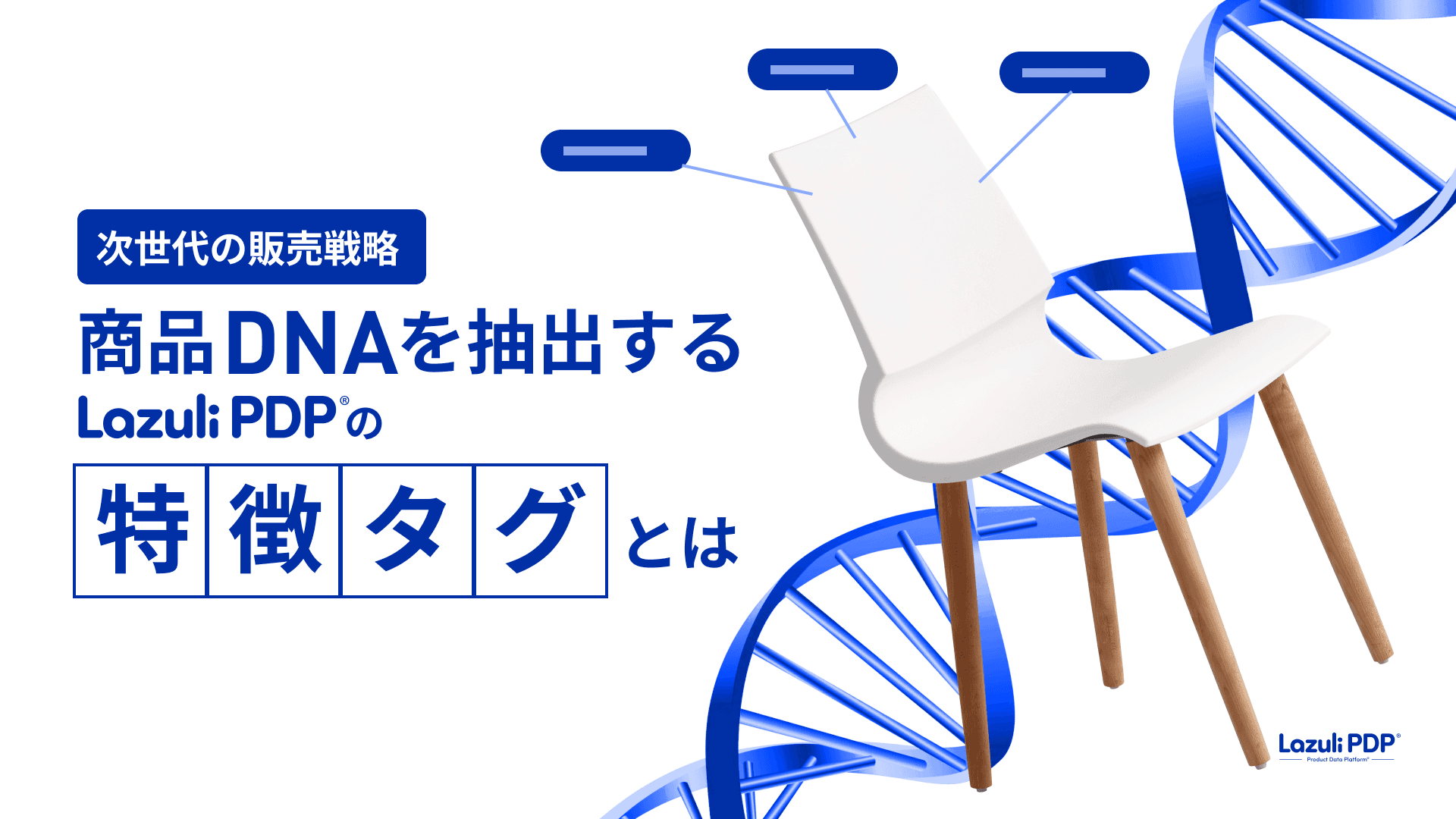
Next-Generation Sales Strategy: What Are Lazuli PDP's Feature Tags That Extract Product DNA?
In this article, we explain what product DNA is, how to extract product DNA using Lazuli PDP’s feature tags, and how to effectively drive sales promotions. It is intended to be useful for manufacturers and retail promotion staff who struggle to understand their customers.
By extracting product DNA through Lazuli PDP’s feature tags, you can gain a deeper understanding of customer needs. In an era of rapid change, let’s shift from sales strategies built on intuition and experience to data-driven sales strategies and strengthen our competitiveness in both physical stores and e-commerce.
A shortcut to customer understanding. What is product DNA?
Product DNA is text data that captures a product’s unique characteristics.
More specifically, it consolidates and assigns meaning to market evaluations such as customer reviews. For health foods, examples include “low calorie, organic, additive-free”; for children’s toys, “educational value, safety, creativity-stimulating” — concise expressions of a product’s features.
In general, there are two approaches to creating product DNA.
Company employees use their experience and product knowledge to assign meaning to each individual product.
Company employees use years of experience and painstaking research to assign product DNA to each and every one of the vast number of products. While this may yield insights that cannot be reflected in data, it has the drawback of requiring an enormous amount of work and becoming dependent on individual expertise, making it difficult to maintain data with a consistent pattern.
Use customer surveys to analyze the results and assign product DNA.
There is also a method of asking people who purchased the product to complete a survey and extracting product DNA from their actual opinions. While this makes it possible to create product DNA that reflects real customer voices, it also has drawbacks such as limits on the number of respondents due to staffing constraints and an inability to comprehensively reflect the diverse values of today’s consumers.
Many companies are trying to build sales strategies using product DNA, but at present, due to the issues mentioned above, only a small number of companies are able to put this into practice.
Three benefits of using Lazuli PDP and product DNA
Lazuli PDP makes extracting product DNA dramatically easier and more comprehensive than before.
We will explain this in the following three points.
Rapid feature-tag generation by AI: Lazuli PDP’s AI instantly generates feature tags for each product from customer review data available in the market. This enables rapid identification of product DNA and allows product recommendations tailored to consumer needs.
Analysis by product category is also possible: Until now, purchase analysis at the individual product level has been the norm, but Lazuli PDP can infer and assign categories to products. Because you can freely change the granularity of analysis from product A alone to category A or category B, it is effective when you want to grasp market trends at a broad level.
Competitive product market research is easy too: By analyzing POS data as well as your own product information, you can easily extract the product DNA of competing companies’ products. This can be used not only to develop differentiated sales strategies by product category, but also for product planning from a market research perspective.
In the next chapter, let’s look at what kinds of use cases are possible in conjunction with CRM.
Transform retail sales strategies into a data-driven approach with CRM integration
By integrating with CRM, Lazuli PDP transforms retail sales strategies into a data-driven approach.
Customer data enrichment: Lazuli PDP can integrate with CRM systems and provide product DNA to purchasing data. This makes it possible to deeply understand customers’ values and lifestyles from their purchase histories, enabling more effective segmentation and recommendations, and allowing you to formulate personalized sales strategies.
Real-time market analysis: Lazuli PDP can preprocess transaction data such as POS data and transform and enrich it for analysis. It captures rapidly changing market trends and customer behavior in real time, enabling product planning and marketing that stay ahead of trends and do not miss the right timing.
Improved demand forecasting accuracy: By combining CRM data with new analytical dimensions generated by Lazuli PDP, you can perform highly accurate inventory management based on data. By combining purchase histories with product DNA, you can visualize sales performance by product and by area, enabling inventory to be adjusted for each store. Improved demand forecasting accuracy reduces stockouts and waste at stores, achieving both profit maximization and cost reduction.
The integration of Lazuli PDP and CRM transforms retail sales strategies into a data-driven approach and accelerates business growth.
Summary
By leveraging Lazuli PDP, manufacturers and retailers can build data-driven sales strategies.
Lazuli PDP generates product DNA as feature tags, enabling product recommendations tailored to consumer preferences and lifestyles.
This allows you to develop product development and sales strategies that respond quickly to market needs. In addition, by integrating with CRM, you can make the most of customer data to deliver personalized customer experiences, increasing customer satisfaction and repeat purchase rates.
Lazuli PDP is a powerful tool that makes it easy to implement next-generation sales strategies using product DNA. If you are struggling with marketing or sales promotion, please feel free to contact us.
At Lazuli, we develop and provide "Lazuli PDP," a product data solution that offers and generates the product data needed for organizing and processing product master data in analytics. If you are having trouble optimizing CRM or utilizing internal data, please contact us from here.
About Lazuli PDP here: https://corporate.lazuli.ninja/feature/