
Manufacturing
Case Study: Examples of How Product Data Is Used in the Manufacturing Industry
Role of Lazuli PDP in the Manufacturing Industry
In the manufacturing industry, where various products are produced in large quantities and delivered to many customers, the time required to manage product information and maintain master data is enormous. By integrating and managing various master data with Lazuli PDP and adding product data as needed, what benefits can it bring to existing business processes and customer understanding?
What is Lazuli PDP (Product Data Platform)
“Lazuli PDP,” developed and provided by Lazuli, is a SaaS that centrally manages product information scattered across multiple databases and organizes and connects it into a form that makes the data easier to use. It uses AI to deduplicate diverse product master data held by manufacturers, retailers, pharmaceutical companies, and others, and adds meta tags and associations based on product features. This information is delivered to users through “Lazuli PDP.”
Use Cases from Customers in the Manufacturing Industry
Company A: Data Matching and Normalization for POS Data Analysis
When analyzing POS data obtained from a wide range of business partners, organizing the source data before analysis takes an enormous amount of time.
We perform data matching on POS data collected from various business partners that sell products. To make analysis smoother, preparing the data beforehand is the most important step. When POS data is collected from multiple business partners, inconsistencies in half-width and full-width characters and variations in how names are written occur depending on the partner. By using Lazuli PDP, you can standardize inconsistent data before analyzing POS data and start data analysis smoothly. It reduces the man-hours spent on data preparation and allows you to focus more on analysis.
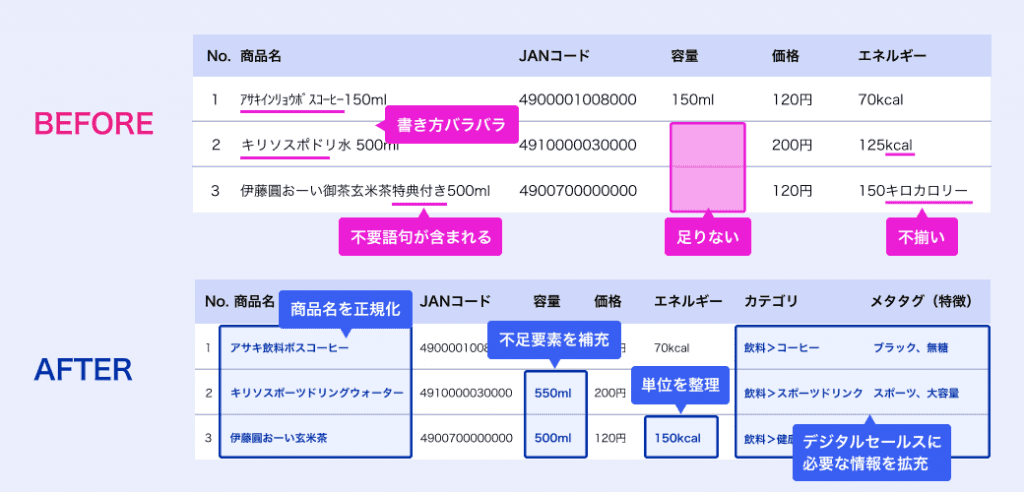
What used to take 200 hours a month can now be completed in as little as a few minutes, and at most by the next business day, by using Lazuli PDP. (Based on a case study from Asahi Soft Drinks) This allows more time to be devoted than before to product and competitive analysis, helping to advance proposals to retail companies.
Summary
Issue: Significant manual effort is required to prepare data that has been organized in each partner’s format into a form that can be analyzed
How it is used: Data matching for POS data, normalization and enrichment of product information
*Depending on some products handled, exceptions may apply.
Effect: The work that used to take 200 hours a month can now be completed in as little as a few minutes, and at most by the next business day
Company B: Improve Customer Engagement by Deepening Customer Understanding
By linking product information to customer purchasing data and behavioral data for analysis, you can gain a better understanding of customer preferences and values.
By combining product feature tags assigned by Lazuli PDP, it becomes possible to reveal customer values and preferences that could not be seen from customer purchase and behavioral data alone, greatly advancing customer understanding. Using that information in CRM improves the brand experience and customer engagement.
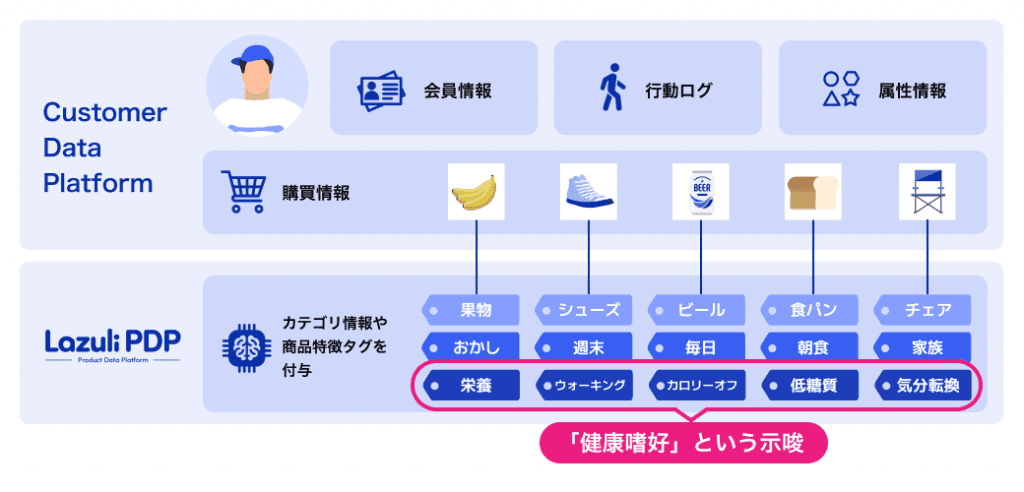
By combining various product features as product data, it becomes possible to read into lifestyles that could not be seen from purchase data alone, such as “health-conscious,” “families,” and “into outdoor activities.”
Summary
Issue: Customer understanding through data utilization is not progressing
How it is used: Use Lazuli PDP to assign product feature tags to each product data set
*Depending on some products handled, exceptions may apply.
Effect: Deeper customer understanding. Combined with CRM, improved customer engagement.
In the manufacturing industry, Lazuli PDP has been introduced by a variety of companies, including those listed below.

If you would like a demo or a detailed explanation about Lazuli PDP, please contact us here.