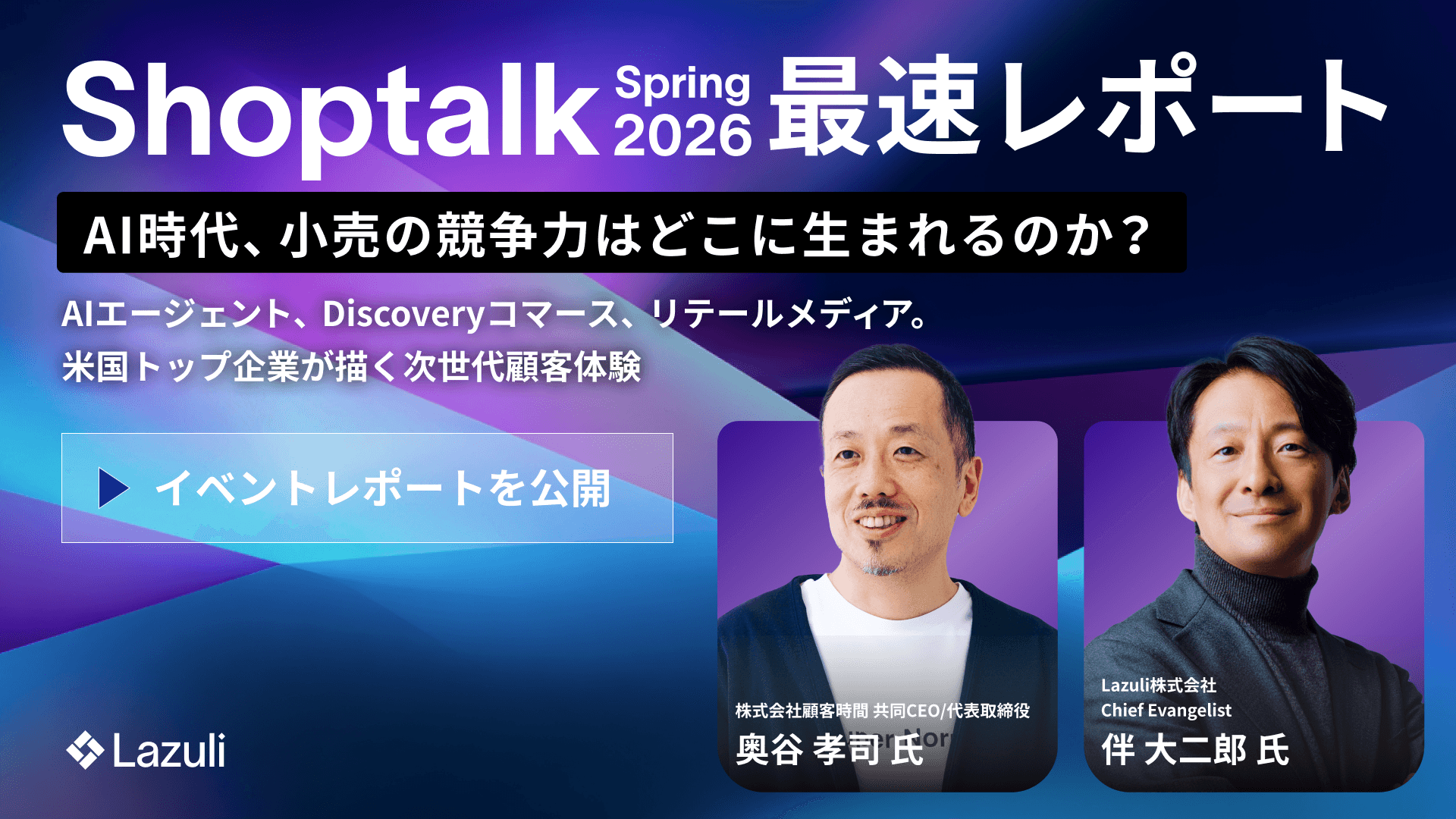
[Event Report] Shoptalk Spring 2026 First Report: In the AI Era, Where Will Retail’s Competitive Edge Come From?
“AI chooses the products.” That phrase is no longer a metaphor.
In March 2026, Shoptalk Spring 2026, the world’s largest retail tech conference, was held in Las Vegas, USA. In this report session, we shared first-hand reports from on-site attendees, an explanation of Lazuli’s proposed AI-Ready framework, and a live demo of the product.
This report summarizes the day’s key discussions and insights.
01. The decision-maker has changed
The most striking takeaway from this year’s Shoptalk was the shared recognition that it was not that “another AI channel was added,” but that “the very structure of decision-making changed”.
AI agents are different from search engines. Search was a place to compare multiple options, whereas AI is a mechanism for selecting and recommending one or two. In other words, if you are not chosen by AI, you do not even have a chance to reach the customer.
“If you’re not the number one choice for AI, it’s the same as not existing.”
With this question at the core, leading examples from top companies around the world were presented.
02. What leading companies are doing
Sephora × OpenAI | Moving customer service off-platform
The collaboration between Sephora and OpenAI is a symbolic example of where agentic commerce stands today. In conversations with ChatGPT, Sephora’s beauty advisor appears, asks about skin type and concerns, recommends products, and completes the purchase in one flow.
By teaching AI the company’s customer service know-how, Sephora can deliver “Sephora-like service” even outside its own site. This is a leading example of “off-service AI commerce.”
e.l.f. Beauty | The reason for 24 consecutive quarters of growth
Ranked No. 1 in unit share in U.S. color cosmetics, with 24 consecutive quarters of growth. Behind that success was the strength of its digital community and an early investment: they started preparing product data so AI could understand it a year ago.
CEO Tarang Amin said, “If the brand is not present there, it’s the same as not existing.” To become a recommendation target for AI, you first need to change how product information is managed and how content is created, and that requires organizational transformation first.
Stitch Fix | Improving accuracy through context
Stitch Fix continues to improve matching accuracy by combining customer data from its CDP with product tags. Customer preferences, body type, budget, past reactions, and conversations with stylists—all of these function as “context data,” improving AI recommendation accuracy.
03. The true nature of the “context” AI refers to
What does AI refer to when choosing products? What emerged at Shoptalk was the fact that it is not specs or price, but “people’s experiences, opinions, and honest feelings” that become the basis for decisions.
Reddit’s CEO said, “The internet is shifting from information to opinion.” The reason AI frequently references Reddit is that it contains structured “raw voices.”
The implication for brands is clear. Collecting, editing, and designing consumers’ real voices as context becomes a brand asset in the AI era.
04. Omnichannel is shifting from “integration” to “meaning integration”
From the era of “connecting channels” to the era of “connecting customer context.”
Through its AI assistant “Magic Apron,” Home Depot is enabling a “project-based” shopping experience that spans multiple visits and multiple products. As the CEO said, “Home Depot is a project-based retailer,” and the design is centered not on products but on solving problems.
Wayfair saw its NPS score rise significantly after opening physical stores. Even with e-commerce at its core, it proved the power of stores as a “place for trust and confirmation.”
On the other hand, Macy’s case, where AI was introduced but the company still struggled, offers an important lesson. They implemented AI. But the underlying product data lacked context. Dependence on coupon-driven promotions continued, and sales remained sluggish. “Introducing AI” and “creating a state where AI chooses you” are completely different things.
Company | AI-Ready initiatives |
|---|---|
The Home Depot | Supports project-based recommendations and purchases with “Magic Apron.” Focuses on solving problems, not products. |
Lowe's | “MyLowe’s” offers AI-based video instructions plus product recommendations. Also provides an AI companion for employees. |
Wayfair | NPS surged after opening physical stores. An AI stylist completes the flow from coordination → AR simulation → purchase. |
Walmart | Store of the Future: a context-curated sales floor. Acquisition of VIZIO enables end-to-end viewing-to-purchase data capture. |
Macy's | Ask Macy’s was introduced, but it became dysfunctional due to a lack of contextual data. Dependence on coupons continued, and sales remained weak. |
05. What does AI-Ready mean? — Lazuli’s five steps
Lazuli defines being “understood and recommended by AI” in the era of agentic commerce as AI-Ready, and organizes it into five steps.
Step | Description | Point |
|---|---|---|
Reality | Collect real-world data | Product data, POS, reviews, in-store conversations |
Structure | Organize the data | SKU integration, attribute cleanup, filling in missing data |
Meaning | Create meaning | Convert specs into context (“lightweight” → “won’t make you tired even after walking for a long time”) |
Delivery | Make it reachable by AI | Structured data, FAQs, conversational content |
Learning | Keep learning | Improve from AI search results, CVR, and customer behavior |
The core is the Meaning step. “A 300g shoe” is a spec, but “a shoe that won’t make you tired even after walking for a long time” is context. AI chooses based on meaning. That is why redesigning product data as context becomes the next source of competitive advantage.
06. Product demo — Implementing AI-Ready through technology
In the latter half of the event, PM Ike demonstrated a live demo of Lazuli’s product.
The scenario was a practical workflow directly tied to operations: “receive a PDF catalog from a manufacturer and convert it into an in-house product master.” In five steps, we visualized how to generate data that AI can understand.
① Data extraction: Automatically generate structured data from PDF, CSV, Excel, and more
② Data normalization: Remove noise such as full-width/half-width inconsistencies, spacing, and typos
③ Category inference: AI automatically categorizes products based on their characteristics
④ Schema mapping: Dynamically convert to the output schema and automatically fill in missing fields
⑤ Enrichment + validation: Automatically generate AEO keywords and check for prohibited expressions and required fields
Steps ①–③ are already operating at a practical level. Steps ④ and ⑤ are being supported through consulting.
Conclusion — What is being asked now
What emerged through this report session was a single, simple question.
“Can AI read your product data?”
Not volume of information, but structure and context. Not specs, but meaning. Not channel integration, but meaning integration.
Many Japanese companies are still in AI’s efficiency phase. But if you introduce AI without preparing the information infrastructure, all you end up with is a “cheap AI” — Okutani’s words should be taken as a warning.
The era of agentic commerce has already begun. Designing an AI-Ready state now will determine competitiveness over the next 3 to 5 years.
Lazuli helps companies build AI-Ready operations with the power of product information and AI.
If you are interested in our product or would like to consult with us, please feel free to contact us.