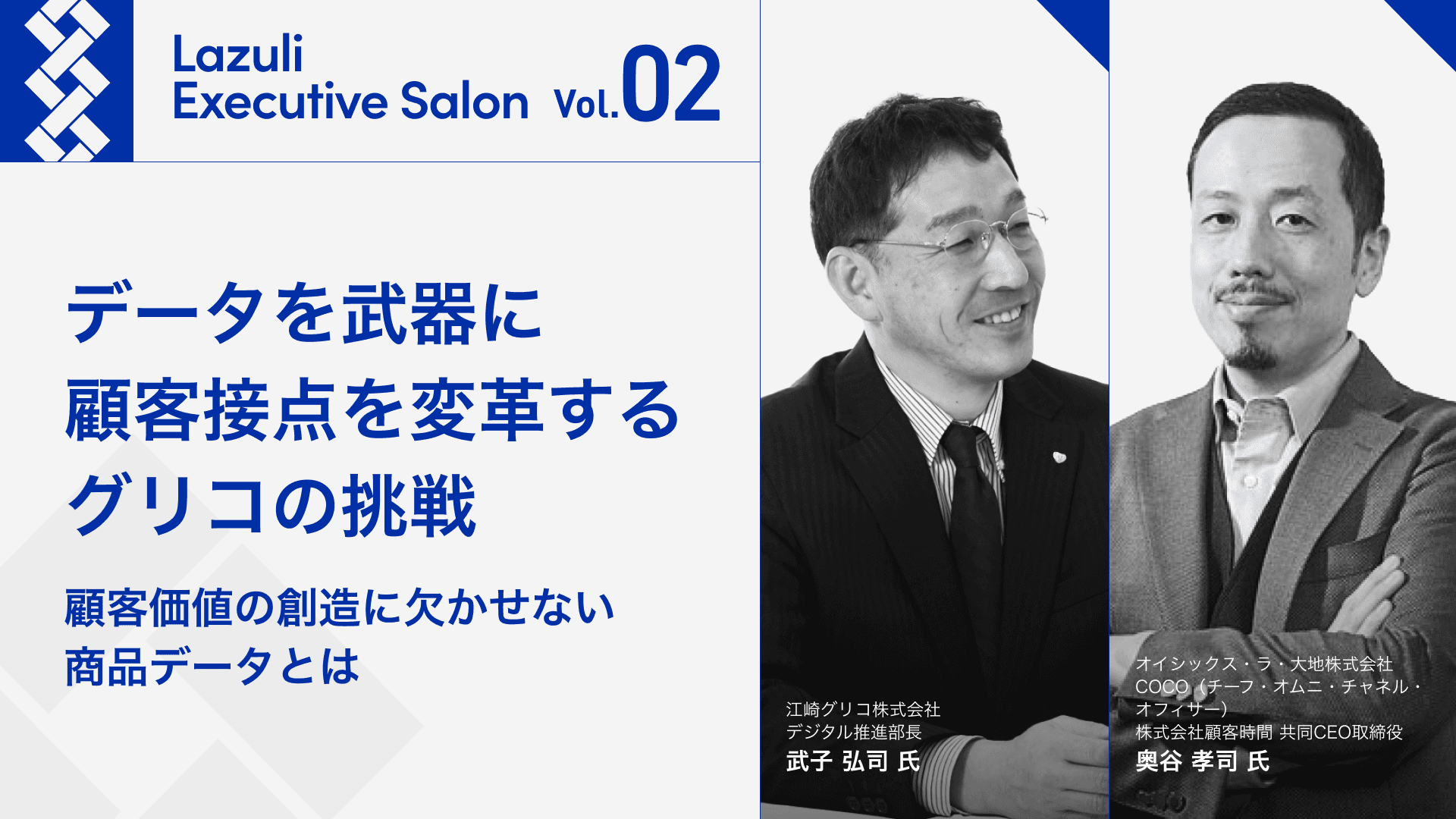
Glico's Challenge to Transform Customer Touchpoints with Data as a Weapon - Lazuli Executive Salon Vol. 2 Event Report
On May 14, 2024, Lazuli hosted the executive event “Lazuli Executive Salon Vol. 2,” welcoming Koji Takeko, Director of Digital Strategy at Ezaki Glico Co., Ltd., and Koji Okutani, Co-CEO and Representative Director of Kokyaku Jikan Inc. and COCO at Oisix ra daichi Inc., as speakers under the theme “Glico’s challenge to transform customer touchpoints with data — what product data is essential for creating customer value?” Approximately 10 companies from among Japan’s leading manufacturers and brands, all at the forefront of DX and marketing, gathered to discuss how product data should be used to help companies connect more deeply with customers.
The “Lazuli Executive Salon Vol.2,” held on May 14, 2024, is a forum where we invited 10 leaders responsible for marketing and DX departments at manufacturers and brands to discuss their initiatives and challenges. At this event, under the keyword of the “golden table” that companies should have, we shared knowledge among participants through concrete examples and discussions on how companies transform customer touchpoints by leveraging data.
Part 1: Glico’s Challenge to Transform Customer Touchpoints with Data ~What is the product data indispensable for creating customer value?~
In Part 1, Mr. Takeko from Ezaki Glico and Mr. Okutani from Customer Times took the stage and gave lectures on experience design, data utilization, and talent development for creating customer value.
At Ezaki Glico, since February 2022, when it celebrated its 100th anniversary, it has been promoting data utilization and value creation with customers as the starting point, under the purpose of "Every day healthy, a fulfilling life". In the Digital Promotion Department led by Mr. Takeko, they focus exclusively on collecting and using data that is beneficial to “customers,” accurately grasp customer needs, and develop products and marketing that are closely aligned with customers. In addition, by developing the talent needed to build an organization that drives data acquisition and utilization, they aim for further progress in data utilization.
When identifying customer profiles based on collected member information, what kind of product master data do we need in order to clarify customer behavior? Mr. Takeko says that, in addition to the basic information required when manufacturers produce and sell goods, it is necessary to enrich the product master in order to clarify what kind of services should be delivered to what kind of customers. He also noted the need to integrate information through the “golden table” because if product-related content (SNS posts and articles, etc.) is not linked in the master when a product is updated, there is a risk of providing incorrect information to purchasing customers.
Glico’s digital strategy, which always keeps the customer at the center and places the provision of value to customers at its core, will continue to evolve toward the realization of “Every day healthy, a fulfilling life”.
Mr. Okutani referred to his experience at Muji and Oisix ra daichi, as well as examples from the conference “Shoptalk” held in the United States, and pointed out that preparing product data is indispensable when promoting omnichannel and unified commerce in the digital age.
For example, P&G is advancing supply chain efficiency with a “customer journey driven” approach, and according to its COO, seamless product data flow is now necessary, and understanding consumer behavior and preferences is important. AI is to be used to understand consumers, and the need for a "Seamless Product Data Platform" was mentioned.
Also, the product master that exists as the backbone for realizing the next offer when a product is out of stock, which is essential to customer experience, can no longer be said to exist only for inventory optimization.
By accurately providing the information customers need when choosing a product, it greatly contributes to building confidence at the time of purchase and increasing repeat customers.
We also received concrete advice on how to utilize data and what information should be accumulated as master data.
Part 2: Discussion “What value do customers gain when product data is well organized?”
In Part 2, all participants discussed the value customers gain when product data is well organized. The responses collected in advance were grouped into the following three axes, creating a valuable opportunity to share insights with one another about each company’s initiatives and challenges.
Three axes
EC
CRM
Organization
Discussions were actually held on the following issues and topics.
<EC>
・How to efficiently manage data in situations with a large number of SKUs
・The product master has been created only for stores, so information for EC is lacking
<CRM>
・In transforming CRM, we feel that in addition to customer data, product data must be utilized, but in-house product information management is fragmented, and there are challenges in integrating the product data itself
・As we advance governance of the global web platform and expand direct-to-consumer EC, challenges in utilizing customer data and first-party data
<Organization>
・Cost allocation when sharing master data with internal related organizations that have vested interests
Summary
Through this event, product data should be organized from the customer’s perspective, and product information maintenance is indispensable to increase purchase intent and allow people to buy with peace of mind. There was lively discussion about the importance of defining what the data is for and what data needs to be collected for that purpose.
In this digital age, the product master that companies should have in order to connect with customers differs in the columns required by each company. Each company’s golden table (product master) maintenance will be indispensable for future digital strategies. This “Lazuli Executive Salon” provided deep insights into the importance of product data and how to manage and utilize it. Going forward, we hope to continue promoting information sharing and collaboration among companies driving digital transformation and contribute to creating even greater customer value.