Are product master data and e-commerce categories different? Four benefits of using categories
“Categories” are used to classify products. They are widely used by many companies when managing products. How do you organize your categories? And how are you using them? In this article, we’ll provide a general explanation of categories and how to make use of them.
The Role of Categories
When offering products and services, categorization plays a very important role. By creating categories appropriately, not only does it become easier for customers to find what they are looking for, but you can also clearly communicate the characteristics of each product or service. There are many ways to create categories; for example, items such as "user", "nature/material", "scene", "place", and "pain points" are classified and broken down from major to minor items. In addition, when new products are launched, new categories that did not exist before are added, so they are constantly changing. Therefore, appropriate action such as reviewing categories and adding new ones is necessary.
Are Product Master Categories and EC Categories Different?
The "categories for logistics or inventory management product masters" and the "categories for EC product masters" sound similar at first glance, but in fact they are different. Product master categories are categories used internally for products and are based on the company's product classification. Product categories differ from company to company in their underlying thinking, and they are usually created originally (although some are adapted from references). On the other hand, EC categories are categories used to make it easier for customers to find products and are designed with the purpose of improving product discoverability.
EC categories often include product type, intended use, and brand, and are used when users search for products in online stores. As mentioned above, ordinary product master categories are often internal, so new categories may be needed for an EC site. When creating new EC categories, you need to keep the following points in mind.
Avoid overlapping with existing product categories
Use category names that are easy for customers to understand
Make categories neither too detailed nor too broad so that users can search for products easily
Be careful not to make category names too long
Consider the hierarchical structure of the categories
Four Benefits of Using Categories

Benefit to Consumers 1: Comparing Similar Products
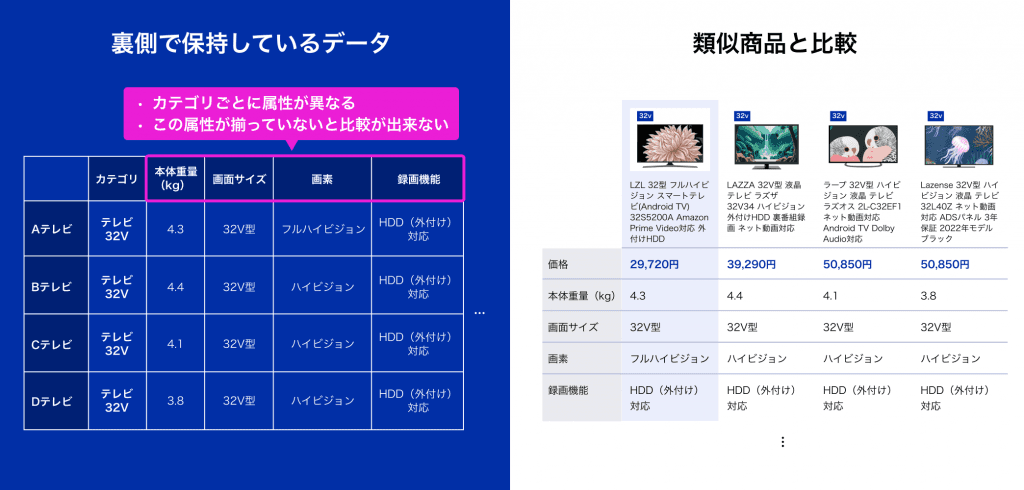
Usually, when consumers have multiple similar products, they want to compare them in order to achieve their purpose. At this time, if categories are aligned, it becomes possible to organize detailed information called "attributes" (for example, weight, size, whether a function is included, etc.), and it becomes possible to present the information in a way that is easy for consumers to compare.
Attributes vary greatly depending on the product. For example, for food products these would include ingredients, materials, and contents, but for home appliances they would include weight and power consumption; and for televisions, screen size, picture quality, and whether internet connectivity is available would also be important attributes.
By organizing categories and the attributes linked to them, the data is aligned and an environment that makes comparison and consideration easier is created, which is thought to improve CVR.
Benefit to Consumers 2: Reaching the Product They Want
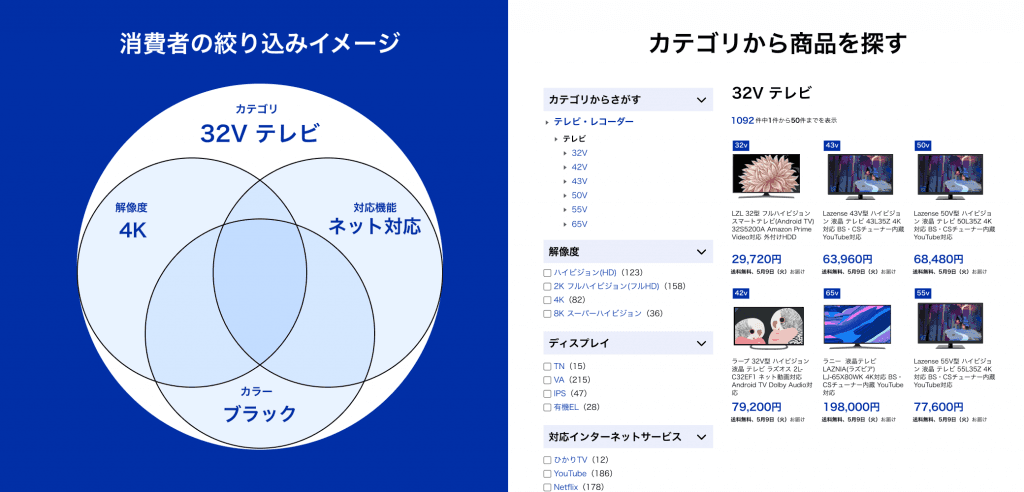
When consumers know what they want but have not decided on the specifications, they may narrow down products within that category. Even when consumers do not know what criteria to use when narrowing down products, displaying filter conditions makes it easier to narrow down products and improves product reach rate.
When consumers know what they want but have not decided on the specifications, they may narrow down products within that category. Even when consumers do not know what criteria to use when narrowing down products, displaying filter conditions makes it easier to narrow down products and improves product reach rate.
Benefit to EC Administrators 1: Identifying Issues
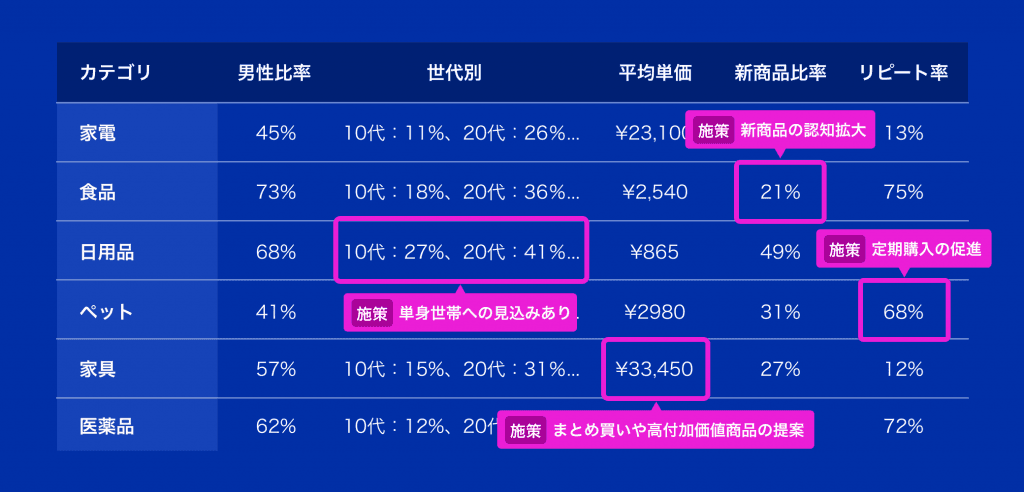
The benefit of organizing categories for EC administrators is that it enables them to provide services tailored to customer needs. When EC administrators compare sales, they can do so in the following two ways.
Trends over time (e.g., comparison with the previous year)
Comparison with other categories
For example, when analyzing sales in the home appliances category, comparing it with other categories makes it possible to judge whether the results were good or bad. In addition, with ID-POS analysis linked to member information, it is also possible to derive the gender ratio and purchase-generation results for each category. When categories are aligned, it becomes possible to quantify strengths and weaknesses against other categories, allowing for concrete measures to be implemented. Category analysis also includes data beyond sales, so by understanding customer preferences and trends, it can also help develop new products and improve sales strategies.
Benefit to EC Administrators 2: More Efficient Management and Maintenance
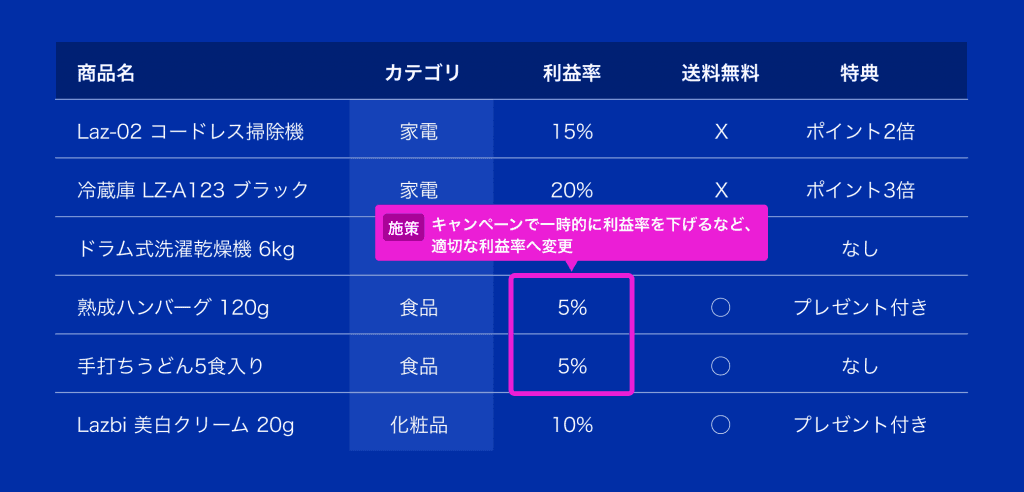
Maintaining product data (price revisions, margin changes, shipping fee changes, etc.) becomes very cumbersome if done for each individual product. However, by managing it by category, changes and improvements become easier. When categories are aligned, maintenance becomes more efficient and work effort can be minimized.
Conclusion
Product categories and attributes play a very important role in the customer experience on EC sites. By using appropriate categories and attributes, customers can quickly find the products they need.
Lazuli provides everyone with appropriate categories suggested by AI. By using AI, we have achieved category maintenance that is 5 to 10 times faster than conventional manual work.
Setting product categories is not an easy task. If you are unsure what categories to assign to products, how to assign them, or how to operate the process, please feel free to contact us using the inquiry form below.