Lazuli PDP Use Case Vol. 05: Organizing Product Information to Improve CX
As sales on e-commerce sites continue to grow, consumer experience in the purchasing process has become increasingly important. In this article, we introduce how manufacturers are organizing product information with a focus on customer experience (CX) to meet ever-changing customer needs, along with examples from companies.
At Lazuli, we are addressing various challenges related to product masters and product data, as follows.
Automatic generation of data for EC listings
Control and maintenance of attribute information
Competitor research through web crawling and optimization of our own products by channel
Visualizing theoretical inventory by linking retail POS data with wholesale and manufacturer shipment data
Product information maintenance to improve CX
This time, we will introduce “Product information maintenance to improve CX,” along with a use case at an electronics manufacturer.
As selling products on e-commerce sites and marketplaces becomes the norm across industries, the importance of customer experience (CX) in digital channels is increasing.
To deliver the experiences customers want, such as “being able to easily find products,” “being able to easily understand product information,” and “being able to compare with other companies’ products,” robust product data (product data) is indispensable.
For example, information such as a product’s performance, size, and price falls under product data. It also includes not only the data for the product itself, but also management codes, related products, search keywords, and feature tags. Recently, as more customers check reviews on comparison sites before purchasing, evaluation and review information has also come to be regarded as important product data.
On the other hand, even within a company, information may be scattered, data formats may not be aligned, and in some cases it may be necessary to go out and obtain data from external sites. As a result, product data is often dispersed across multiple locations and not standardized, so to achieve robust product data management, it is necessary to start with collecting and organizing the data.
Until now, collecting and organizing such product data has been done manually by people, taking enormous amounts of time. Lazuli PDP is what reduces that enormous workload and enables the integration, processing, and organization of product data.
◆ Examples of product data that Lazili PDP can handle
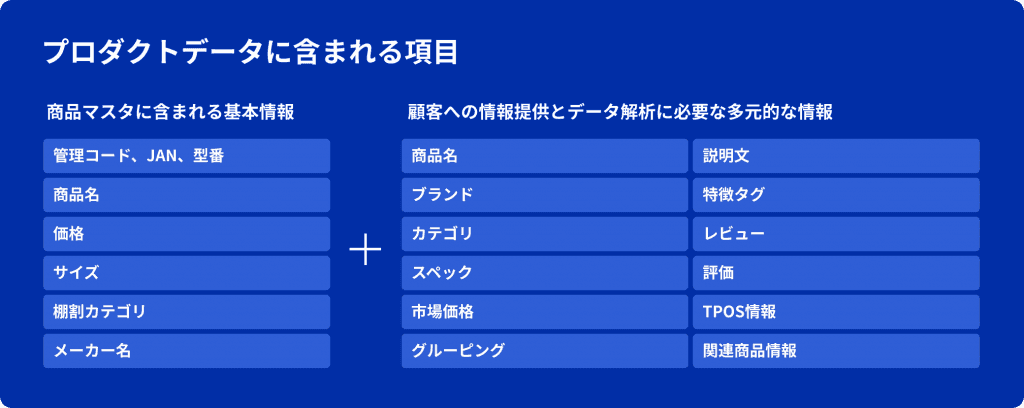
Product data is not limited to simple transaction or sales management; it provides customers with valuable information and supports data-driven decision-making. By comprehensively integrating data that was traditionally not handled in product masters and tended to be overlooked—such as category information, feature tags, and review information—companies can extract insights that reach deeper into customer needs and realize improved customer experience and accelerated business growth.
Lazuli PDP uses proprietary technology to automatically collect diverse product data from inside and outside the company. After that, it automatically generates and processes data in the required format.
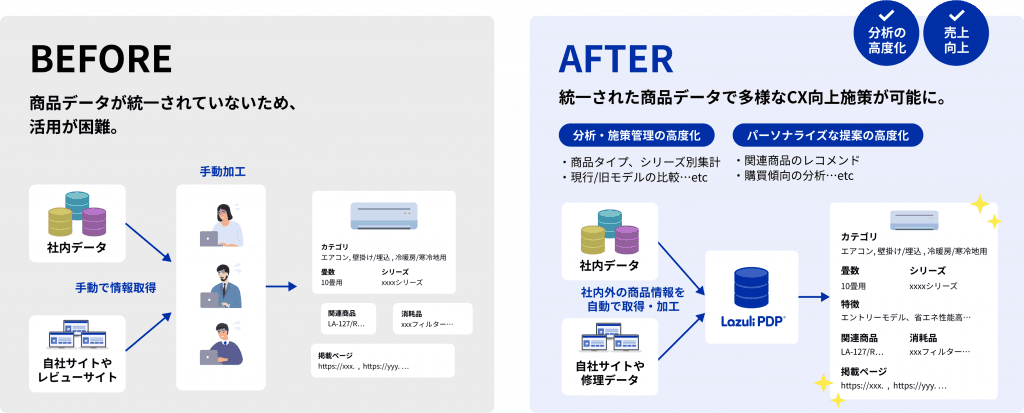
In fact, at manufacturers that have implemented Lazuli PDP, the effort and time previously spent on collecting and organizing information have been significantly reduced, and they have achieved data collection and structuring so that URLs of product-related articles published on their own sites can also be managed in the same master. In addition, by crawling external data and organizing it together with their own product master, they are aiming to provide more personalized experiences for customers and to carry out more advanced analysis and initiative management—something that had not been possible before due to a lack of data.
In this way, by using Lazuli PDP to collect and organize product data, companies can achieve data standardization and implement a wide range of CX improvement initiatives.
Also, in order to carry out advanced analysis and initiatives, it is necessary to proceed in a planned manner, such as determining “what information is needed” and “how to structure the collected data and deliver it to customers,” and mapping data usage purposes to data structures.
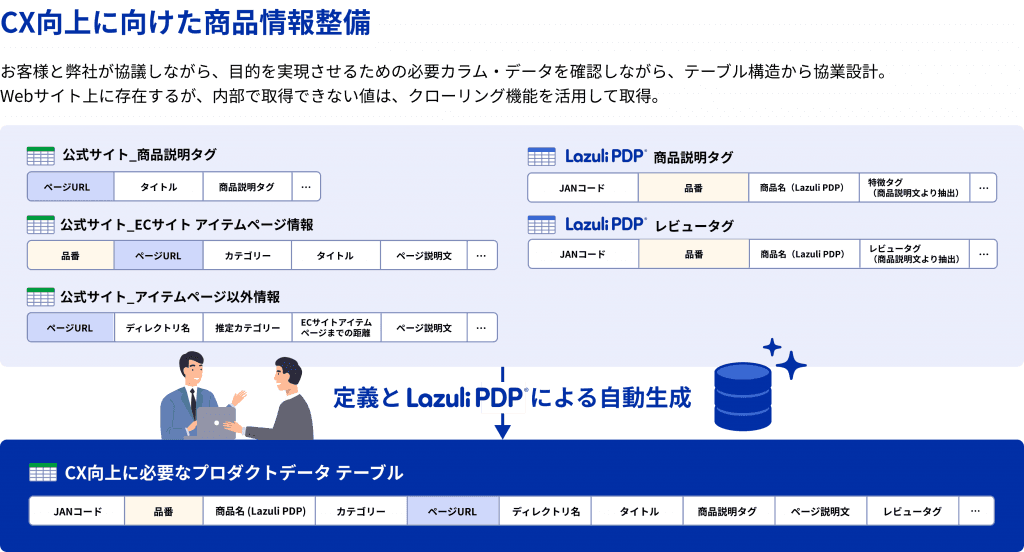
At Lazuli, with an eye on the purpose and goals of such data utilization, we discuss with our customers, confirm the necessary columns and data needed to realize those goals, and design from the table structure, enabling data organization that fits your company.
In the future, as data utilization expands, the data surrounding products is expected to become even more diverse and complex. Along with that, the experiences customers seek will also become more advanced.
In such a situation, using product data efficiently can lead to better customer experience and help drive higher sales.
For related examples of data utilization toward CX improvement and various ways to use product data, please contact us below.
https://corporate.lazuli.ninja/contact/
Examples of product data utilization in the manufacturing industry: https://corporate.lazuli.ninja/useful/manufacturer_clients_best_practices/
Examples of product data utilization in the retail industry: https://corporate.lazuli.ninja/useful/retail_clients_best_practices/