Lazuli PDP Use Case Vol. 02: Organizing and Standardizing Product Attribute Information
Even within product information (product data), organizing attribute information such as specifications and sizes is essential. However, preparing and structuring that information takes time and effort. In this article, we’ll introduce how to organize and structure attribute information, along with examples from manufacturers.
At Lazuli, we are addressing a variety of challenges related to product master and product data, such as the following.
Automatic generation of data for EC listings
Control and organization of attribute information
Competitor research through web crawling and optimizing the sale of our products across each channel
Visualizing theoretical inventory by linking retail POS data with wholesaler and manufacturer shipment data
Organizing product information to improve CX
This time, we will introduce “control and organization of attribute information” with examples from manufacturers.
Product information (product data) is indispensable for businesses that handle products, such as manufacturers and retailers. However, as online customer touchpoints increase and customers can no longer actually pick up and inspect products, its importance is growing. In addition to the basic information included in conventional product masters (such as product names and JAN codes), a wider range of information and data is now required, including reviews, categories, search keywords, and more, all related to customer purchase decisions and customer experience.
【Examples of Product Data】
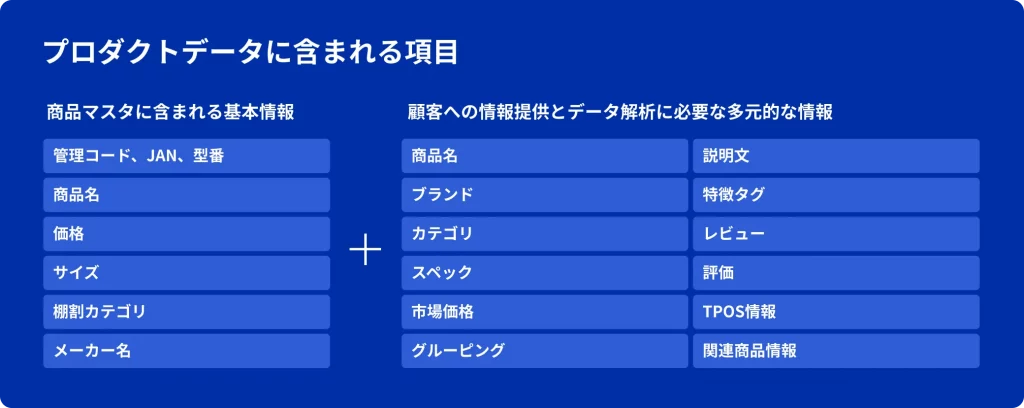
Among these, information called “attribute information,” which describes the product itself—such as color, shape, size, and material—is extremely important for clearly conveying product features to users and for data analysis.
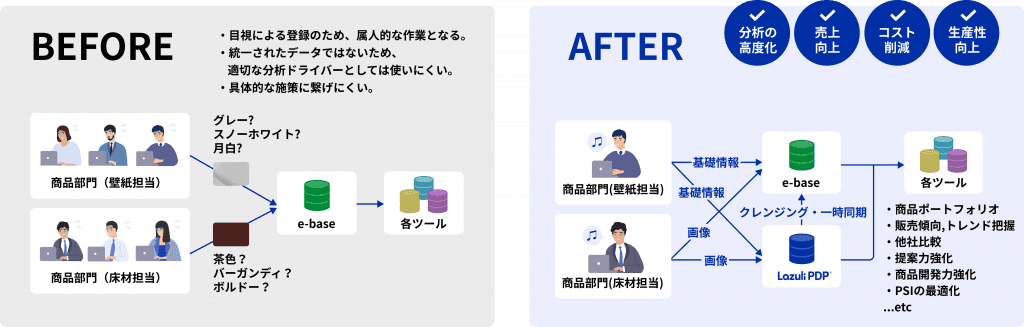
However, attribute information is often collected and managed manually and independently, making its organization a very labor-intensive and time-consuming task. In addition to the workload, there are often cases where standards differ by department or by person in charge, and we frequently hear concerns that it is difficult in the first place to unify attribute information.
【Examples of Issues Regarding Attribute Information】
・Because registration is based on visual inspection, data judgment and entry become dependent on the individual.
・Because the data is not standardized, it is difficult to use as a driver for analysis.
・It is difficult to connect it to concrete initiatives.
If attribute information is not standardized, users may not be able to reach the products they want, leading to lost sales opportunities, or data may not be properly classified, preventing analysis from progressing—potentially creating major obstacles to business growth.
That is why Lazuli PDP provides AI-powered solutions. For example, it extracts product colors and attributes from product images as text data and structures them, enabling standardized attribute information. This allows you to automate attribute information organization without relying on manual work or individual expertise, reducing labor while also promoting more advanced analysis and data utilization that supports product development.
In fact, at Company B, a manufacturer that introduced Lazuli PDP, organizing attribute information for its own products required enormous time and effort, and differences in individual understanding made it difficult to standardize attribute information, creating a bottleneck for various initiatives aimed at business growth. After introducing Lazuli PDP, AI image analysis made it possible to extract product characteristics such as “color,” “pattern,” “texture,” “touch,” “gloss,” and “taste” from fabric images as text, and to assign color categories by extracting each fabric’s color code as RGB and clustering them. This enabled the company to assign standardized attribute information from product images in catalogs.
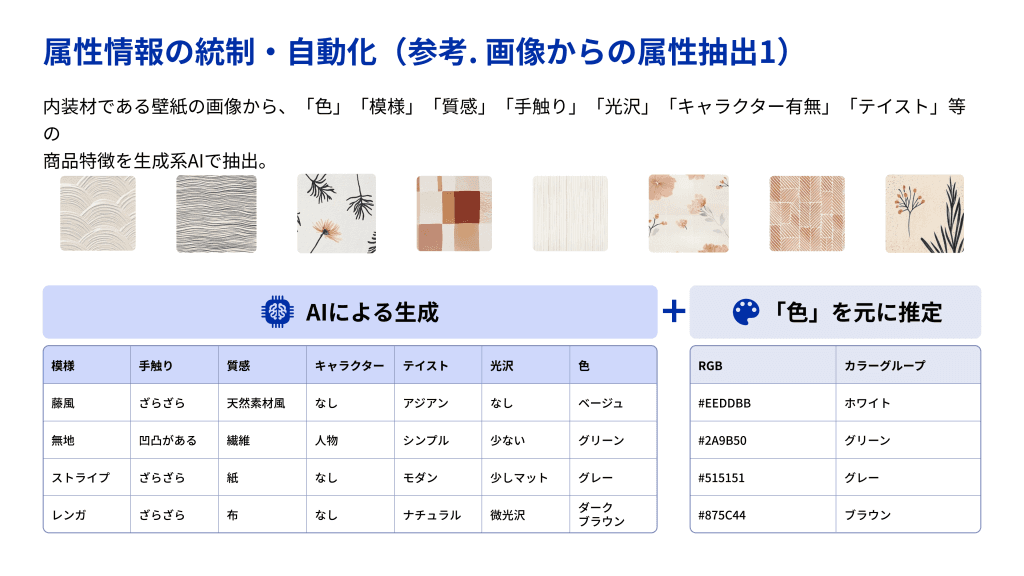
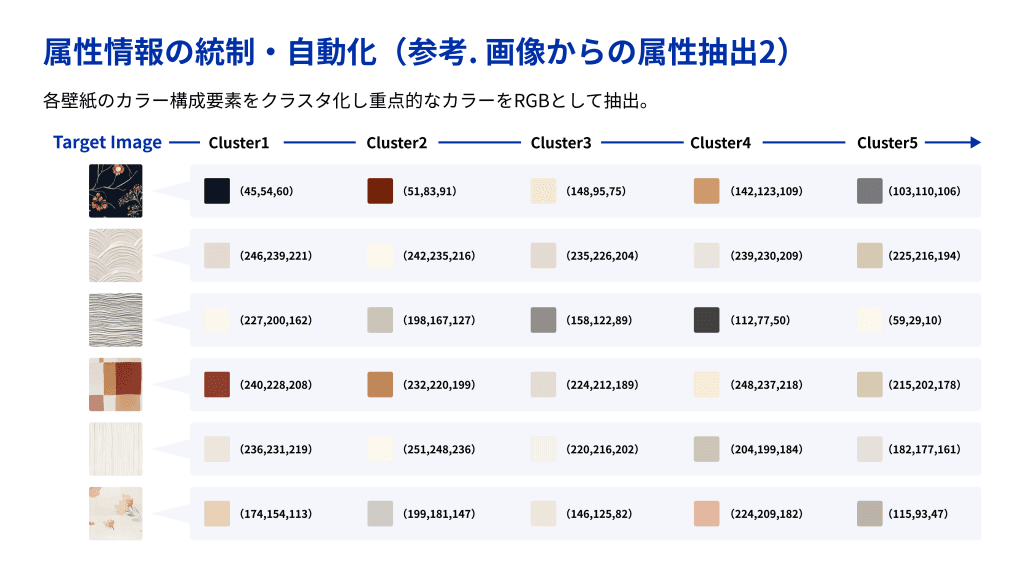
As a result, they now aim to perform more advanced analysis using controlled data and to improve product development and sales proposals by leveraging data and attribute information.
As the importance of product information (product data) continues to grow, organizing and structuring product attribute information will become even more essential. At Lazuli PDP, by leveraging not only information collection from images but also various AI-based methods, we help make it easy to organize rich product data.
For examples of cases related to controlling and organizing product attribute information, as well as other diverse uses of product data, please see below.
Sangetsu Co., Ltd. press release: https://corporate.lazuli.ninja/news/sangetsu-begins-pilot-installation-of-lazuli-pdp/
If you are facing challenges such as “data utilization is not progressing as hoped,” “I want to automate data maintenance,” or “I want to realize the organization of controlled product information,” please contact us.
https://corporate.lazuli.ninja/contact/