
Achieved a 99.98% specification fulfillment rate. What results did a major domestic retail company achieve in its proof of concept (PoC) for product information management?
Waiting for information from suppliers, then receiving, checking, and registering it—this entire process took about 20 days of lead time. This was a long-standing challenge in product registration operations for a major domestic B2B e-commerce company (hereafter, Company A). To solve this issue, Company A conducted a proof of concept (PoC) with Lazuli over approximately three months. As a result, the completeness rate for specification information reached 99.98%, and the feasibility of significantly reducing product registration lead time became clear. In this article, we introduce the background, design, and results of the PoC. We hope it will be useful for companies facing similar challenges.
Three Challenges in Product Information Management Faced by Company A
Company A sells more than several hundred thousand products across multiple EC channels. In its product information registration and management operations, the following challenges were chronicly present.
1. Supplier-dependent structure
Much of the information required for product registration depended on being provided by suppliers. Registration work could not proceed until the information arrived, and a lead time of about 20 days had become standard. This was also causing delays in the launch of new products.
2. Workload on merchandisers (MDs)
In addition to their core task of product selection, MDs were also responsible for receiving, checking, and supplementing information. This made it difficult for them to concentrate on high-value work.
3. Management cost for environmental and category information
Assigning environmental flags, such as those for products compliant with the Green Purchasing Law, and product categories required manual verification. It was time-consuming, and omissions in flag assignment and category misregistration were also prone to occur.
PoC design: Verifying a master-building process that does not wait for suppliers
Company A and Lazuli designed a three-step PoC centered on the question: can product masters be automatically built and supplemented without waiting for suppliers to provide information?
Phase | Period | Main content |
Step 1 | Month 1 | Confirmation and design of required information. Product data was analyzed to identify categories with low completeness rates and priority targets for crawling. |
Step 2 | Month 2 | Provision of basic information and spec information. Using JAN codes and manufacturer part numbers as keys, web crawling was performed, and product names, descriptions, and spec information were automatically collected and organized. |
Step 3 | Month 3 | Provision of AI-generated and processed information. Automatic assignment of environmental flags and automatic product categorization were implemented, and accuracy was verified. |
PoC results: Practical-level performance proven across three key metrics
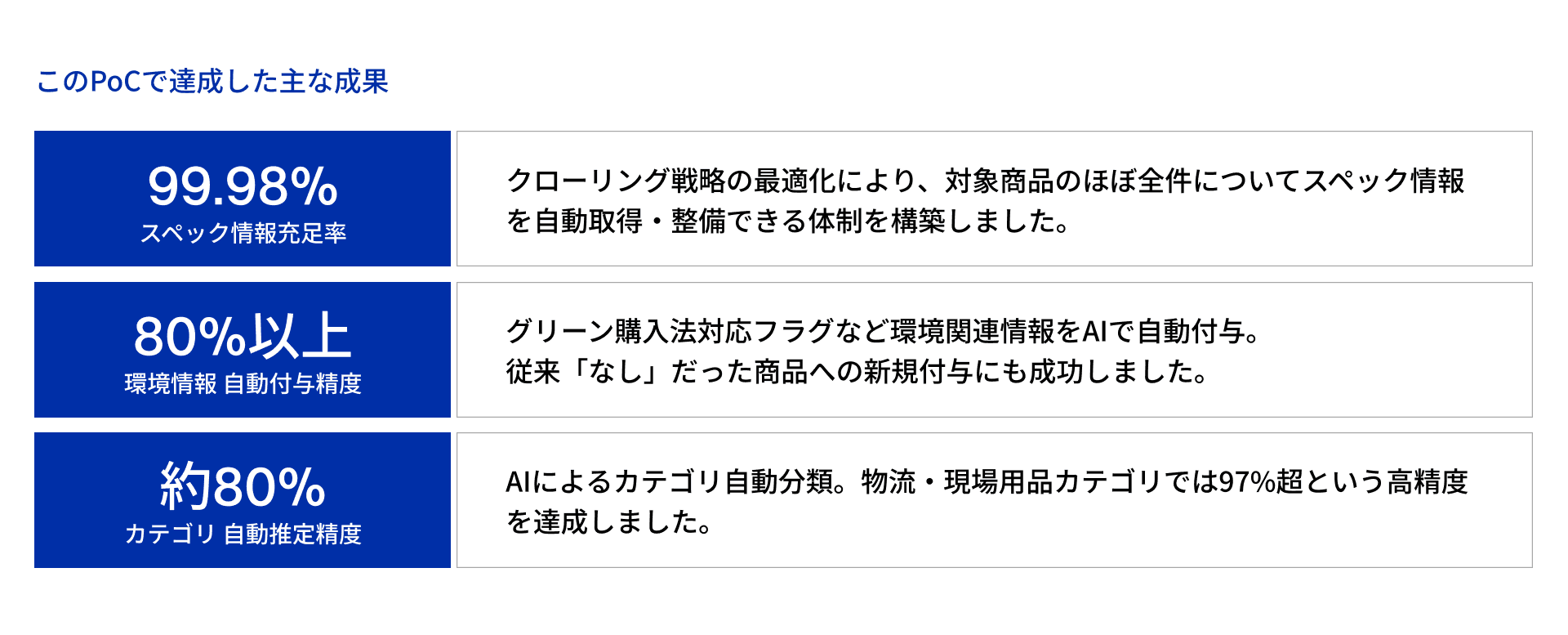
1. Spec information completeness rate: 99.98%
As a result of optimizing the crawling strategy, a spec information completeness rate of 99.98% was achieved. It was also confirmed that a system for regularly and automatically collecting product names, descriptions, and manufacturer information from major sites could be established.
2. Automatic assignment of environmental information: 80%+ accuracy
For environmental information such as Green Purchasing Law compliance flags, it was demonstrated that automatic assignment could be performed with 80%+ accuracy. In addition, it was found that many products previously registered as "none" were in fact environmentally compliant products, contributing to overall master data quality improvement.
3. Automatic estimation of product categories: Approximately 80% accuracy
In AI-based automatic category classification, overall accuracy of approximately 80% was achieved. In specific categories, accuracy exceeded 97%, revealing that accuracy varies depending on category granularity.
Next steps revealed by the PoC
Through this PoC, the following outlook became clear.
Product registration lead time can likely be reduced from about 20 days to around 10 to 14 days.
Masters can be automatically built and supplemented without waiting for supplier information.
An environment can be created that allows MDs to focus on their core work of product selection.
On the other hand, challenges also became clear, such as improving accuracy in fine-grained categories like tools and measuring instruments, and normalizing notation variations (kana/alphabet). The PoC also confirmed that these issues can be addressed through ongoing tuning.
You can start by first understanding the current situation
What this PoC showed is the possibility that even if perfect data is not available, the gaps can be compensated for through a system. The challenges of product information management do not need to be solved all at once. The most reliable approach is to first understand the actual state of your data and then tackle the highest-priority issues.
If you want to organize the current state of your data preparation efforts, or want to start with a small step like a PoC, please feel free to contact us.
Product information management challenges — why not organize them together first?
Lazuli experts will support you from understanding the current situation.
For a free consultation, visit: https://corporate.lazuli.ninja/contact/