What Is Agentic Commerce? How Businesses Should Prepare Now for the Era of AI Agents That "Choose Products"
“AI searches for products, compares them, and purchases them on behalf of consumers”
This is not near-future sci-fi. It is a real change that technology companies around the world are already implementing.
In this article, we explain the concept of Agentic Commerce and the mechanism of product search by AI agents. Then, we will specifically outline what EC, retail, and manufacturer companies should prepare for now.
What is Agentic Commerce?
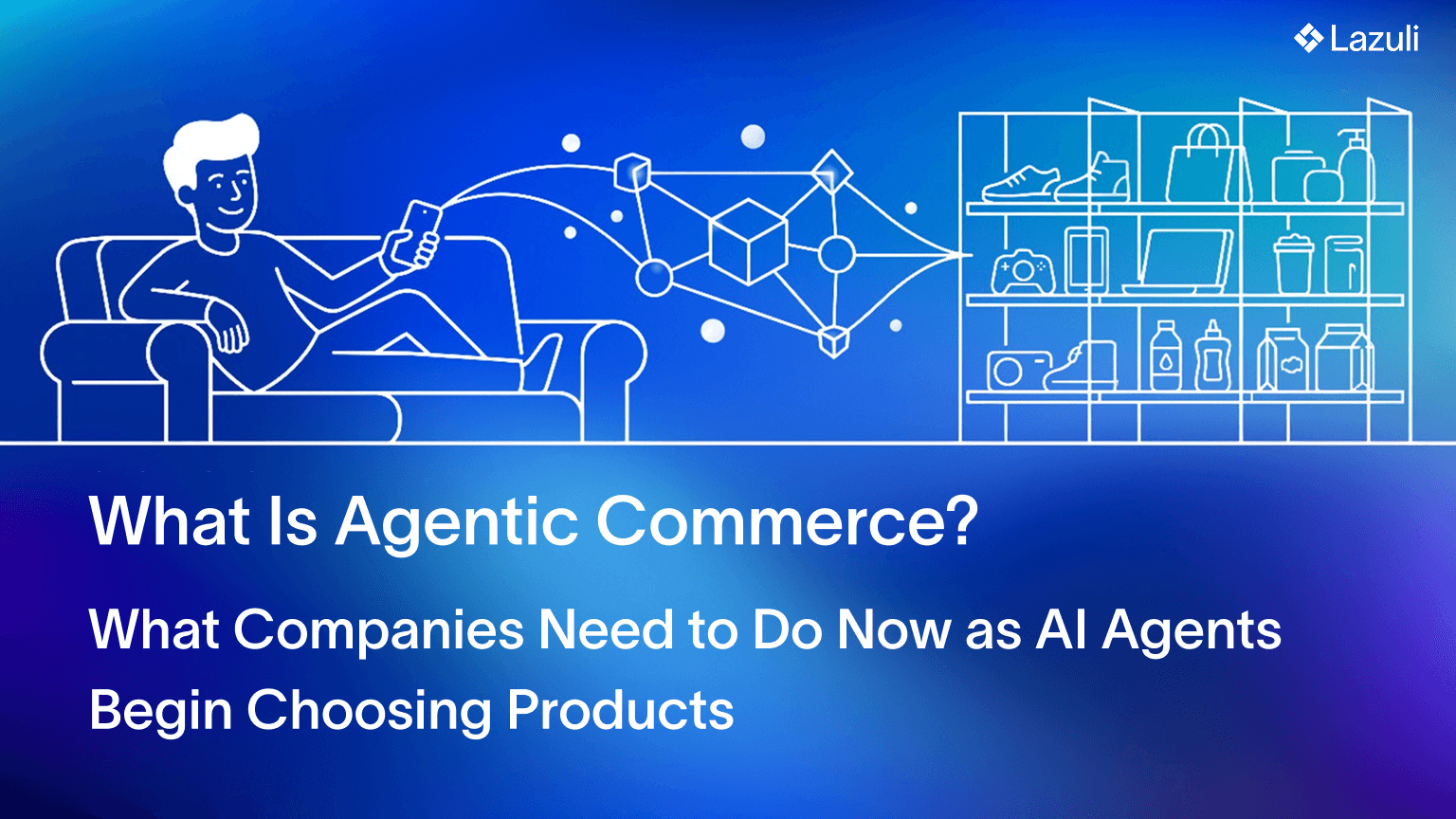
Agentic Commerce is a form of commerce in which AI agents autonomously search for, compare, and purchase products on behalf of humans.
Traditional EC involved consumers searching on their own, viewing product pages, adding items to cart, and making purchases. In Agentic Commerce, AI agents handle this entire process.
For example, the following uses are envisioned.
– Simply instructing, “Get camping gear for next week within a budget of 30,000 yen,” and having AI select candidates and place an order at the lowest price
– When inventory of regular consumables (detergent, coffee, etc.) runs low, AI automatically reorders them
– Instructing, “Procure better parts from suppliers than our competitors have,” and having AI compare catalogs and place orders

The movement has already begun.
– OpenAI is adding shopping features to ChatGPT, rolling out a mechanism where AI recommends and compares products
– Perplexity has launched “Buy with Pro,” which lets users purchase directly from AI search
– Amazon is testing an autonomous reordering system that uses LLMs
– Gartner predicts that “30% of B2B purchasing will be assisted by AI by 2028”
How do AI agents “search for and select” products?
This is the most important point for companies.
AI agents evaluate products in a completely different way from humans.
<Human product search>
– Sensory and emotional judgments come into play, such as the impression of images, brand image, reviews, and price perception
– Even if some information is missing, people can fill in the gaps and make a decision themselves
<AI agent product search>
– It reads structured attribute information and logically determines whether the product meets the conditions
– Products with missing information are excluded from the candidate set
– Products with “no description,” “inconsistent units,” or “ambiguous categories” are not evaluated correctly
In other words, to be selected by AI agents, data quality is everything.
No matter how good a product is, if the data is incomplete, it will not appear in AI search results.
Why is organizing product data important now?
Agentic Commerce is still in the early stages of adoption. That is precisely why now is the best time to start preparing.
If you wait until adoption has progressed to start organizing your data, you will fall behind competitors that already have AI-ready data.
Organizing product data takes time. This is especially true for companies with tens of thousands or hundreds of thousands of SKUs. By starting now, when the Agentic Commerce era fully arrives, you can be firmly on the side that gets chosen.
Four conditions for “AI-Ready” product data that AI agents will choose
To let AI agents properly evaluate and recommend products, the data must meet the following four conditions.
1. Structured
Attribute information for products (such as size, material, compatible standards, and ingredients) must be organized in a machine-readable format, not free text. Descriptions like “please see the catalog for details” cannot be read by AI.
2. Complete
All required attributes, such as specifications, category, units, and compatible standards, must be filled in. AI agents skip products with missing information. “Mostly filled in” is not enough.
3. Rich in context
In addition to specifications, it should also include use cases, usage scenarios, benefits, and comparison information. Because AI agents interpret user intent to choose products, they need data that conveys “what kind of product for what purpose.”
4. Consistent notation
If the same concept appears as “ml,” “mL,” and “milliliters,” or category names are inconsistent, AI cannot compare accurately. A unified notation and classification system across all SKUs is required.
Can your current product data support AI agents?
Many companies face the following challenges in product data management.
– Data from suppliers arrives in inconsistent formats, making formatting time-consuming
– The missing rate for specification information is high, and it cannot be fully supplemented manually
– A large amount of old data that was registered “for now” remains in the product master
– Definitions of categories and attributes vary by department and person in charge
In this state, it will be difficult to ride the wave of Agentic Commerce.
Three concrete actions to start now
Step 1: Understand your current data completeness
First, visualize which attributes in your product data are filled and to what extent. Knowing “where the gaps are” is the first step in organizing your data.
Step 2: Start with high-priority SKUs
Trying to organize all products at once will take too much time and cost. A practical approach is to prioritize top-selling and strategic products first.
Step 3: Introduce automation
By leveraging web crawling, OCR, and generative AI, you can automatically supplement missing information and collect specification data. Moving away from a human-dependent maintenance system will lead to long-term competitiveness.
Summary
Agentic Commerce will dramatically change the way commerce works over the next few years. When AI agents search for and select products, data quality directly determines whether a product sells or not.
What matters is not waiting until perfect data is ready, but starting to organize it from the current state.
If you want to diagnose whether your product data is AI-ready, or if you do not know where to start, please consult Lazuli. Our experts will support you from the current-state assessment through to planning the organization strategy.
Free consultation here: https://corporate.lazuli.ninja/contact/