
What Is AI-Ready Product Information? ~The New Standard for Product Data Required in the Age of Generative AI~
As generative AI rapidly becomes embedded in business operations, the role of “product information” is changing dramatically for retail and brand companies. Product data, once simply something to be managed, is now becoming a strategic asset that can determine business growth. So what exactly does “AI-ready” product information look like in the age of AI?
The Value of Product Information Changed by Generative AI
Traditionally, the focus has been on the “accuracy” and “consistency” of product information. However, with the arrival of generative AI, the value criteria required of product data have fundamentally changed. Its importance is growing not merely as information to be managed, but as “raw material” for AI to create value from that information.
This is the same structure as how the quality of cooking ingredients affects the taste of a dish. Even with an excellent chef called AI, if the product information that serves as the ingredient is insufficient, the expected results cannot be achieved. Personalized recommendations, highly accurate inventory forecasting, effective marketing initiatives—all of these are built on a foundation of AI-ready product information.
Specific Challenges Faced by Retail and Brand Companies
Declining Search Accuracy on E-commerce Sites
E-commerce sites that cannot accurately help customers find the products they need continue to lose opportunities. To enable searches not only by product name but also from diverse angles such as use case, features, and compatibility, product information must be organized in a form that AI can understand.
The Limits of Personalization
To provide experiences optimized for each individual customer, an information foundation is needed that can understand product characteristics in detail and determine how well they match customer preferences. However, in many companies, the granularity of product information is too coarse, and AI continues to lack enough material for sound judgment.
Obstacles to Executing an Omnichannel Strategy
Store, e-commerce, apps, social media— to provide a consistent product experience across multiple channels, product information optimized for each channel’s characteristics is necessary. However, for companies managing product information in different formats by channel, this is difficult to achieve.
Three Requirements for AI-Ready Product Information
1. Structured, Rich Attribute Information
For generative AI to perform at its best, it needs rich attribute information that can express product characteristics from multiple perspectives. Beyond basic details such as product name, price, and size, it requires detailed information down to use cases, scenarios, target audiences, functional features, and emotional value—at a level that allows AI to understand the product’s “DNA.”
For example, even for the same pair of sneakers, context such as “for running,” “for street fashion,” or “business casual compatible” enables AI to make accurate suggestions aligned with customer intent. This kind of information used to rely on human experience and intuition, but going forward, it is important to document it as data and make it the foundation for AI utilization.
2. Dynamic Data Updated in Real Time
As the pace of market change accelerates, product information is also shifting from static management to dynamic utilization. Inventory status, price fluctuations, seasonality, trend changes—when this information is reflected in AI in real time, more accurate decision support becomes possible.
Especially in marketing and inventory optimization using generative AI, the information “right now, in this moment” determines the outcome. In an era where yesterday’s bestseller is not necessarily today’s bestseller, data freshness is directly tied to competitiveness.
3. Standardization with System-to-System Integration in Mind
AI-ready product information does not function on its own. ERP, CRM, POS, e-commerce sites, marketing tools—all of these systems must work together seamlessly and be able to share consistent information.
To achieve this, foundational work such as standardizing data formats, normalizing attributes, and organizing naming conventions is essential. By building an environment where each system can understand product information in a “common language,” AI’s capabilities can be leveraged across the entire organization.
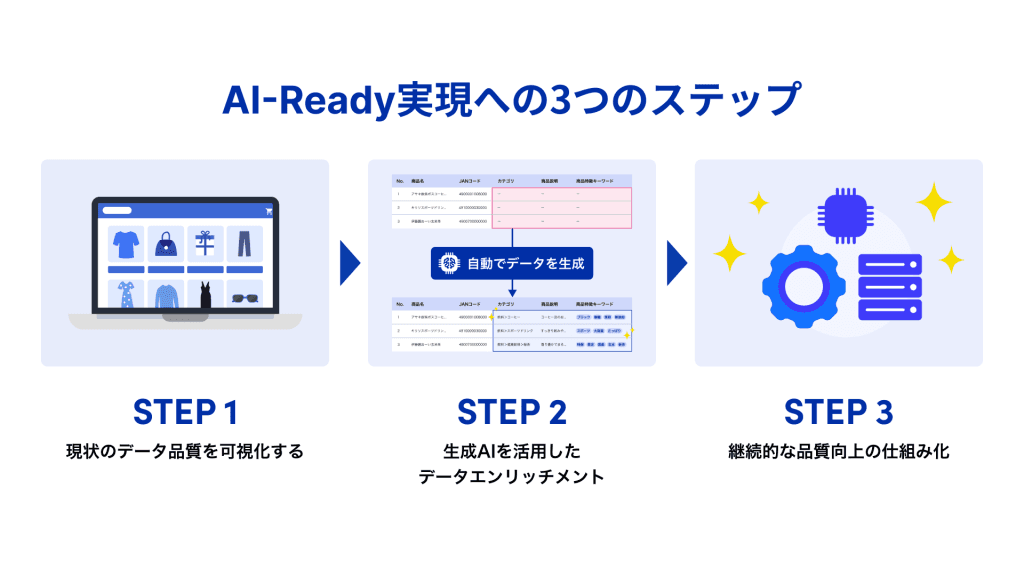
Three Steps to Achieving AI Readiness
Step 1: Visualize the Quality of Your Current Data
First, start by accurately understanding the quality of the product information you currently have. By quantitatively evaluating data missing rates, the degree of inconsistency in notation, and the richness of attribute information, the challenges for AI utilization become clear.
In many companies, product information is distributed across multiple systems and managed in different formats. In this situation, AI cannot perform at its full potential. Starting with “making it visible” is the first step toward transformation.
Step 2: Data Enrichment Using Generative AI
After understanding the current state, the next step is to enrich the product information. What matters here is not relying on manual work, but using the power of generative AI to take a scalable approach.
Feature extraction from product images, attribute generation from product descriptions, automatic classification of similar products—by automating these tasks with generative AI, you can efficiently enrich vast amounts of product data. It becomes possible to enhance the value of product information at a scale and speed that were impossible with human effort alone.
Step 3: Build a Mechanism for Continuous Quality Improvement
AI-ready product information is not something you build once and then finish. You need a mechanism that continuously updates and improves quality in response to market changes.
New product registration, updates to existing product information, responding to trend changes—these processes should be streamlined through collaboration between AI and humans, and you need a system in place to always maintain the latest, highest-quality product information.
Common Traits of Successful Companies: Investing in Data Transformation
What companies achieving results with AI have in common is that they see product information not as a “cost,” but as an “investment.” They position improvements in data quality not as a one-time project, but as an ongoing effort to strengthen competitiveness, and they pursue transformation at the organizational level.
In these companies, organizing product information has produced multiple benefits: improved customer satisfaction, better operational efficiency, and the creation of new business opportunities. Investment in product information ultimately becomes a strategic asset that delivers significant returns.
Lazuli’s AI-Ready Support Approach
Lazuli PDP fundamentally solves these challenges and supports companies in becoming AI-ready. Through data enrichment using generative AI, it integrates fragmented product information and automatically transforms it into a form that AI can fully leverage.
Improving Quality Through Automation
By automating all of the following tasks—feature extraction from product images, automatic generation of attribute information, and classification of similar products—we reduce labor costs while dramatically improving data quality. We achieve dramatic efficiency gains, turning product information maintenance that used to take weeks into a task completed in just hours.
A Company-Wide Data Utilization Foundation
Rather than simply providing a tool, we build a foundation that enables the entire organization to use AI-ready product information. By having every system—from ERP to POS to CRM—share product information of the same quality, we support cross-department collaboration and faster decision-making.
A Mechanism for Continuous Evolution
We provide a mechanism that allows product information to continue evolving in response to market changes. By having AI support the detection of new trends, the reflection of competitive movements, and responses to changing customer needs, you can maintain a product information foundation that stays ahead of the times.
A Product Information Strategy with the Future in Mind
Advances in AI technology never stop, and the required standards for product information are increasing year by year. Building an AI-ready product information foundation now is an essential investment for securing future competitive advantage.
Data transformation cannot be achieved overnight. However, with the right partner and a strategic approach, it is entirely possible to turn product information into a driver of business growth.
Why not maximize the potential of product information and create business transformation in the AI era together? Start by visualizing the current state of your product data and take the first step toward new growth.
Lazuli PDP is a product data platform that supports enterprise product information transformation using generative AI. It transforms product information into an AI-ready state and supports the acquisition of sustainable competitive advantage. For details, please seehere.