Learning from Sephora: Innovating In-Store Customer Service and Personalized Experiences
As a global leader in the beauty industry, Sephora is driving innovative use of data and the adoption of AI technologies in in-store customer service. In this article, we introduce the challenges Sephora faced, the solutions it implemented, and specific examples of how it created an experience that feels like “every customer has a personal beauty advisor,” by leveraging product data and customer data.
This is a series that introduces examples of companies transforming customer and employee experiences by leveraging product data and promoting digitalization and data utilization. Under the supervision of Takashi Okutani, an advisor to Lazuli, we introduce advanced examples of data utilization from Japan and abroad based on various themes. This time, we introduce Sephora's case.
Introduction: Sephora's vision of "democratizing personalized service"
Sephora aims to "provide the most personalized beauty experience to every customer, everywhere," and is delivering a next-generation in-store experience that combines AI and product data at the point of service.
Supporting this vision is a product data infrastructure and AI recommendation engine that cross-connects Beauty Insider member information, purchase history, skin diagnostics, and product master data. Store staff are no longer simply "salespeople"; they now play the role of "data navigators who guide each customer to the best choice."
Challenge: Limits in manpower, service quality, and fragmented product information
The background behind Sephora's full-scale efforts included the following challenges:
・There are too many products for all staff to memorize comprehensively
・There are cases where staff cannot adequately handle the number of visitors
・Risks of missed sharing or incorrect guidance regarding new and limited-edition product information
To close this "disconnect between product data and frontline operations," Sephora moved forward with "customer service assistance" by linking AI and product data.
Initiative 1: Customer support through AI tools for staff
In response to these challenges, Sephora has promoted company-wide data integration and the use of technologies such as generative AI and AR, and has been working to advance in-store customer service.
▪︎ Tablet × Beauty Insider × Product Master Data
All store staff carry tablets, giving them immediate access to the following information.
・Customer purchase history (Beauty Insider data)
・Skin type, preferences, and past reviews
・Latest product information (ingredients, inventory, color variations)
・Related products and bundle suggestions (AI recommendations)
This enables instant product comparisons and color recommendations tailored to customer preferences, making it possible to provide service that is "just for that person."
Initiative 2: Improved recommendation accuracy with AI recommendations and virtual experiences
▪︎AR × AI "Virtual Artist"
Sephora's AR makeup experience app, "Virtual Artist," makes the following possible.
・Real-time makeup try-on using the camera
・AI recommends shades and products based on skin tone, face shape, and purchase history
・The suggested products can be added to the cart immediately or tried in-store
Virtual try-on has also produced results such as a 30% reduction in returns and an 11% increase in CVR.
Initiative 3: Improving EX with multilingual support and voice assistants
To support global store expansion, staff are equipped with real-time translation features and AI-powered work navigation functions.
・Translation assistant supporting 44 languages
Instant translation of product names, ingredients, and usage instructions in multiple languages
・Voice navigation function (pilot implementation)
Voice support for product descriptions and shelf locations while assisting customers
This minimizes stress for multinational visitors and improves both customer and employee experiences (CX + EX).
Results: Dramatically improved productivity and satisfaction in store service
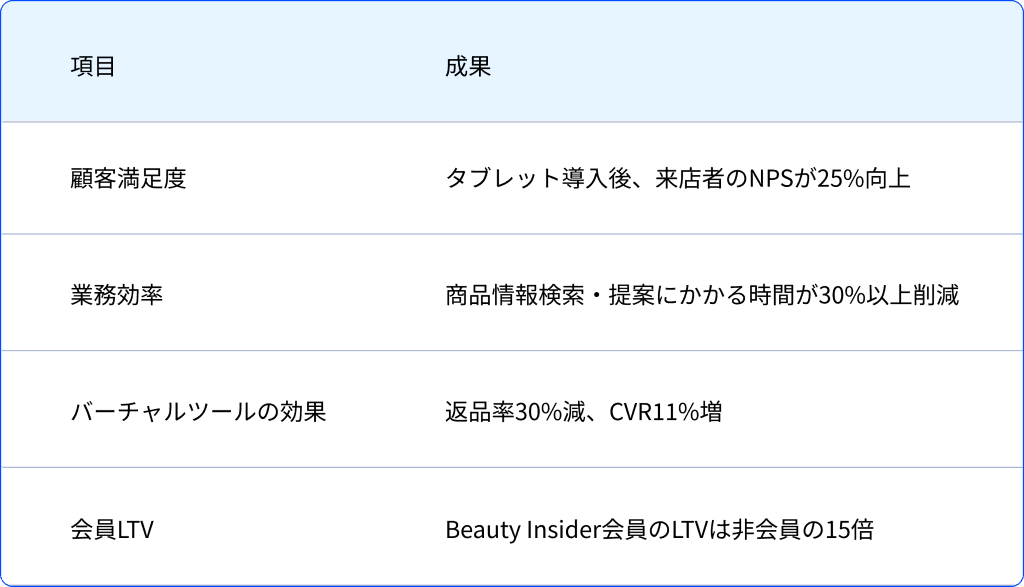
Summary: The new in-store customer service experience created by product data, as seen at Sephora
Sephora's in-store DX clearly shows that organizing product data leads to personalized value propositions for customers. Technologies such as tablets and AR are merely means; the "accurate, structured product information" behind them is what forms the foundation of service quality.
The future of product data × brands, as interpreted by Takashi Okutani
As with Sephora, integrating product data and customer data and using them in store service will likely become indispensable for Japanese retail as well. The very fact that customer and product information are now separated between headquarters and the front line already leads to a deterioration in customer experience. As a result, wrong product guidance or service, and proposals that do not contribute to solving the customer's actual needs, will reduce brand engagement. Structuring product data is directly linked not only to standardizing service quality, but also to realizing personalized experiences. We are convinced that a product data platform like Lazuli provides the foundation that will not only open up a future in which retailers can deliver a "shopping experience without hesitation" to customers, but also contribute to excellent customer service.
We often hear the following issues in Japan as well:
Product information is not shared in the field, leading to incorrect guidance
Product descriptions depend on individual staff and are not consistent
Customer attributes and product information are not linked
Lazuli PDP is a SaaS product data platform that can collect and structure this product information, and build a product master designed for AI utilization. Let's create the foundation that supports a "shopping experience without hesitation" like Sephora.
Next time, we plan to take a deeper look at other advanced examples and initiatives by domestic companies. If you have any opinions or requests, please feel free to let us know.
What is Lazuli PDP?
A SaaS-type product data platform that "collects, organizes, and standardizes product information scattered inside and outside the company."
Product names, descriptions, specifications, images, and more are structured and generated using proprietary AI technology, and can be used for unified commerce, e-commerce optimization, and ID-POS analysis.
https://lazuli.ninja/ja/pdp
* This article is a roundup of examples of companies utilizing product data. This does not mean that all of the companies featured, including Sephora, have adopted our services.
* This article was written using AI based on Sephora's official announcements and industry media articles. If any inaccuracies are found, we will promptly correct them, so please contact us.