“AI’s success or failure comes down to context” — The cutting edge of Agentic Commerce implementation seen in Las Vegas
I’m Hagiwara, Representative Director and CEO of Lazuli.
We’ve completed day 2 of Google Cloud Next 2026.
On day 1, I felt that ‘Agentic Commerce has entered the implementation and competition phase,’ and on day 2 that impression became even clearer. Through sessions from Lowe’s, Macy’s, Cox, and Anthropic, one point stood out: what determines the winners and losers in AI is not model performance, but context design.
AI from ‘search’ to ‘partner’ — the next-generation retail experience Lowe’s is showing
U.S. home improvement giant Lowe’s has been advancing Agentic Commerce as ‘the next move in the evolution of e-commerce.’ The goal was not to ‘enhance search,’ but to create an ‘AI partner that talks with customers and understands context.’
Traditional e-commerce assumed a ‘fragmented experience’: customers searched for products via keywords, and if they got stuck, they used a separate channel to contact support. Lowe’s points out that this structure itself has reached its limit. What customers truly want is ‘something that understands the condition of their home and their past purchase history and advises them like a pro.’
The answer is two AI agents.
Home Manager
‘Home Manager’ is a ‘personal assistant for your home.’
Ask ‘What yard work can I do this weekend?’ and it suggests concrete tasks such as lawn mower maintenance, turns them into a to-do list, and even works with subscription services to complete appointment changes. Behind the scenes, it is designed not as a single giant AI, but as a coordinated group of specialized sub-agents for each task, balancing practicality and scalability.
Mylow
‘Mylow’ is a ‘shopping agent that redefines the purchasing experience.’
Simply upload a photo of plumbing and it understands the intent as ‘leak repair,’ then suggests the necessary parts, tools, and repair steps. It also handles vague requests like ‘I want a modern bathroom, budget is $10,000,’ and delivers an end-to-end flow from product recommendations to cart insertion while preserving context.
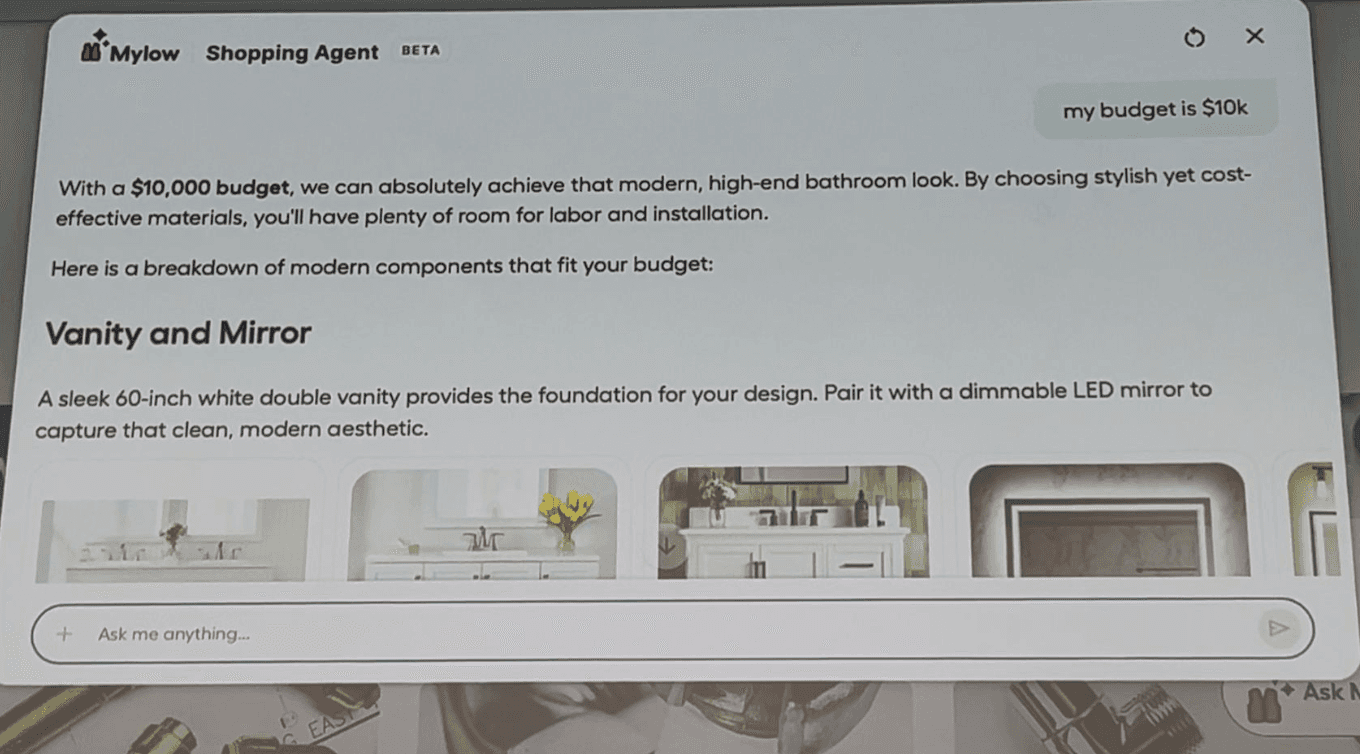
What stands out is the development speed. These advanced agents were implemented in just 4 to 6 weeks. By incorporating long-term memory that remembers across customer situations, they achieve not one-off conversations but an ongoing relationship.
From here on, AI in retail will evolve from ‘a tool for finding products’ into ‘a partner that supports customer decision-making’—Lowe’s case made that unmistakably clear.
Designing even the ‘reason to buy’ — the impact of ‘Fluid Commerce’ realized by Macy’s
While Lowe’s showed ‘AI as a partner,’ Macy’s presented an even further step — Agentic Commerce, ‘Ask Macy’s,’ that connects search, purchase, and post-purchase experience in one continuous flow.
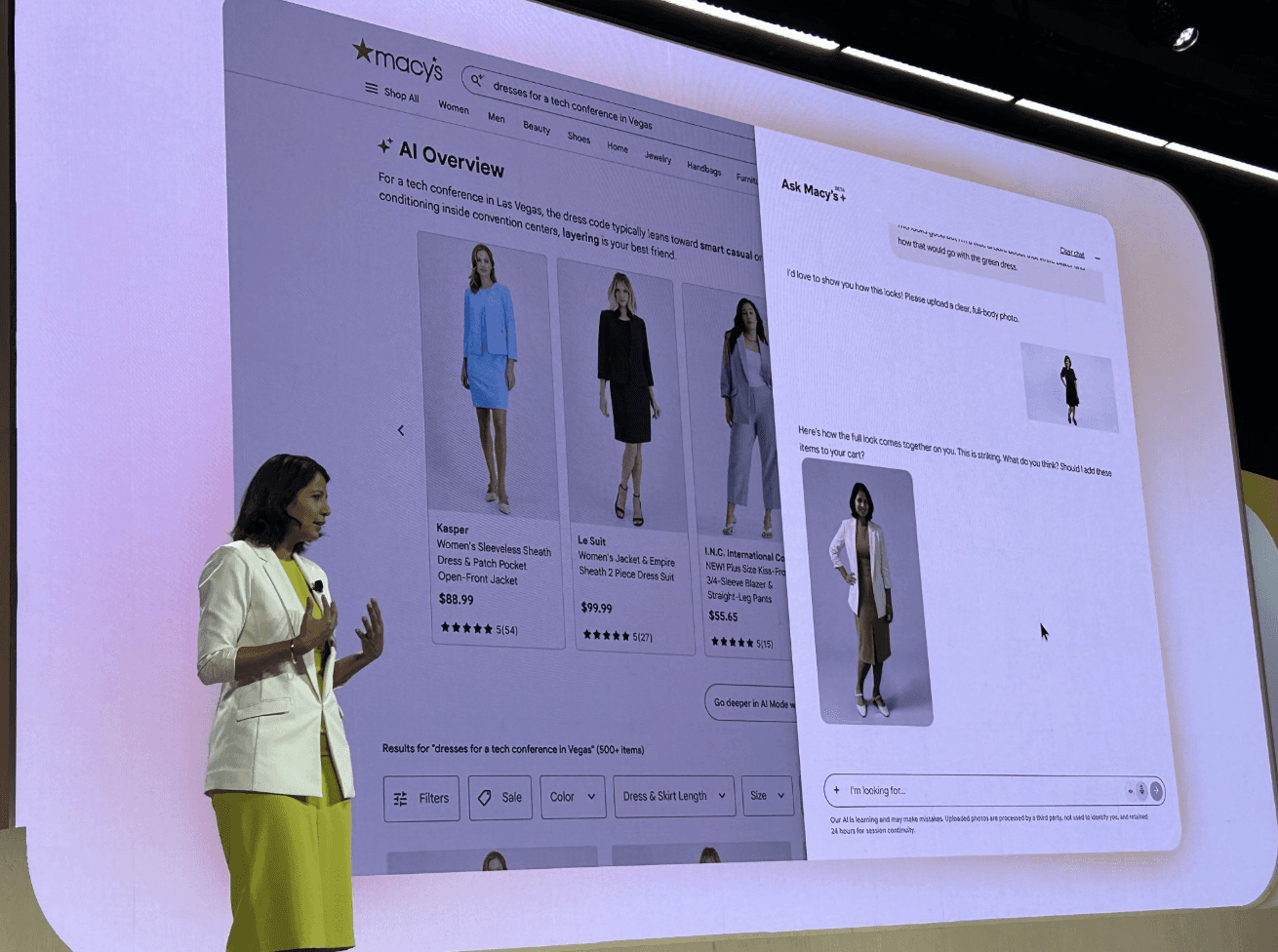
‘A dress that works both day and night for a tech conference in Las Vegas in April’—for this ambiguous request that conventional search cannot handle, ‘Ask Macy’s’ infers the climate in Las Vegas, the venue temperature, and even the event dress code, then presents the optimal item.
What matters here is not search accuracy, but ‘the depth of intent understanding’.
In addition, AI understands the user’s size from membership data and instantly analyzes hundreds of reviews. It preemptively surfaces purchase-relevant insights such as, ‘This item runs small, so one size up is recommended.’ Users are supported not just in ‘choosing,’ but all the way to ‘making a choice without mistakes’.
What is decisive is the design of ‘purchase confidence.’ Simply uploading a full-body photo enables real-time virtual try-on, dramatically lowering the psychological barrier to purchase.
This experience does not stop after purchase. Even when exchanging shoes that didn’t fit, AI remembers all past conversations and purchase history. It offers alternative products without requiring explanation, secures store inventory, and completes pickup via QR code. What exists here is not the integration of online and stores, but ‘consistency of the customer experience itself’.
What’s remarkable is that this system was put into production in just 4 weeks, and customers coming through AI are already generating a cart size 4x larger.
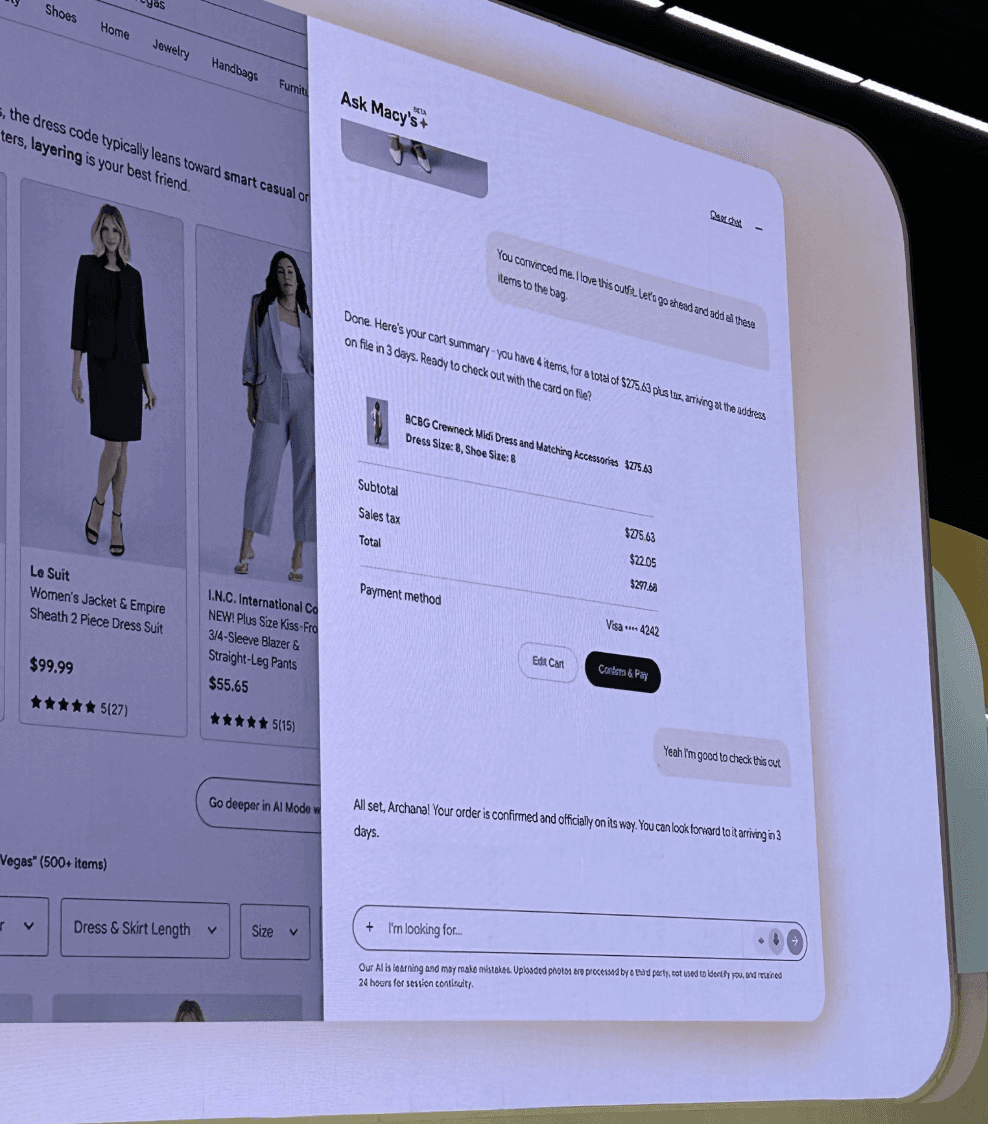
From here on, commerce will not be about ‘finding products’ or ‘buying conveniently,’ but about ‘how well we can design the reason to buy and the confidence to buy’. And AI is beginning to stand at the center of that.
Contact centers from ‘cost’ to ‘growth engine’ — the AI transformation Cox proved
Until now, customer support has been a ‘cost center’ for many companies, but Cox’s case shows that this assumption is beginning to change dramatically. The key is not introducing AI agents as standalone solutions, but a ‘build it up from the foundation’ approach.
Cox’s first step was not chatbot development, but the unification of scattered internal knowledge — in other words, ‘preparing the context.’
What matters here is that the essence of AI adoption is not ‘refreshing the UI’ but ‘redesigning the information structure’.
The chat agent ‘Oliver,’ launched on top of that, improved self-service resolution by 10% in the first month and by 17% after nine months. It was also extended to upsell, achieving a 36% conversion rate. In other words, AI is evolving from merely ‘making inquiry handling more efficient’ to a front-end function that generates revenue.
Next, the company moved into the most difficult area: voice.
The voice agent ‘Olive’ uses the knowledge and playbooks built for chat as-is, further improving self-service resolution by 30%. The design, with a pilot launched in just two weeks and strong governance through the AI council, showed the conditions for AI adoption that can withstand real operations.
Customer support is no longer merely ‘a place that handles inquiries’ but is becoming ‘an engine that generates customer experience and revenue at the same time’. And that transformation begins not with AI alone, but with ‘context design’.
AI performance is determined not by the ‘model’ but by the ‘context’ — Anthropic’s new common sense
What all the examples we’ve seen so far have in common is that AI value is determined not by which model you use, but by what context you give it.
Anthropic’s session explored this essence in the most technically deep way.
First, the thing to grasp is the ‘explosive growth of context’ in the agent era. Traditional prompts were simple. But current AI agents operate while taking in everything as context — tool execution results, documents via RAG, short-term and long-term memory, and more.
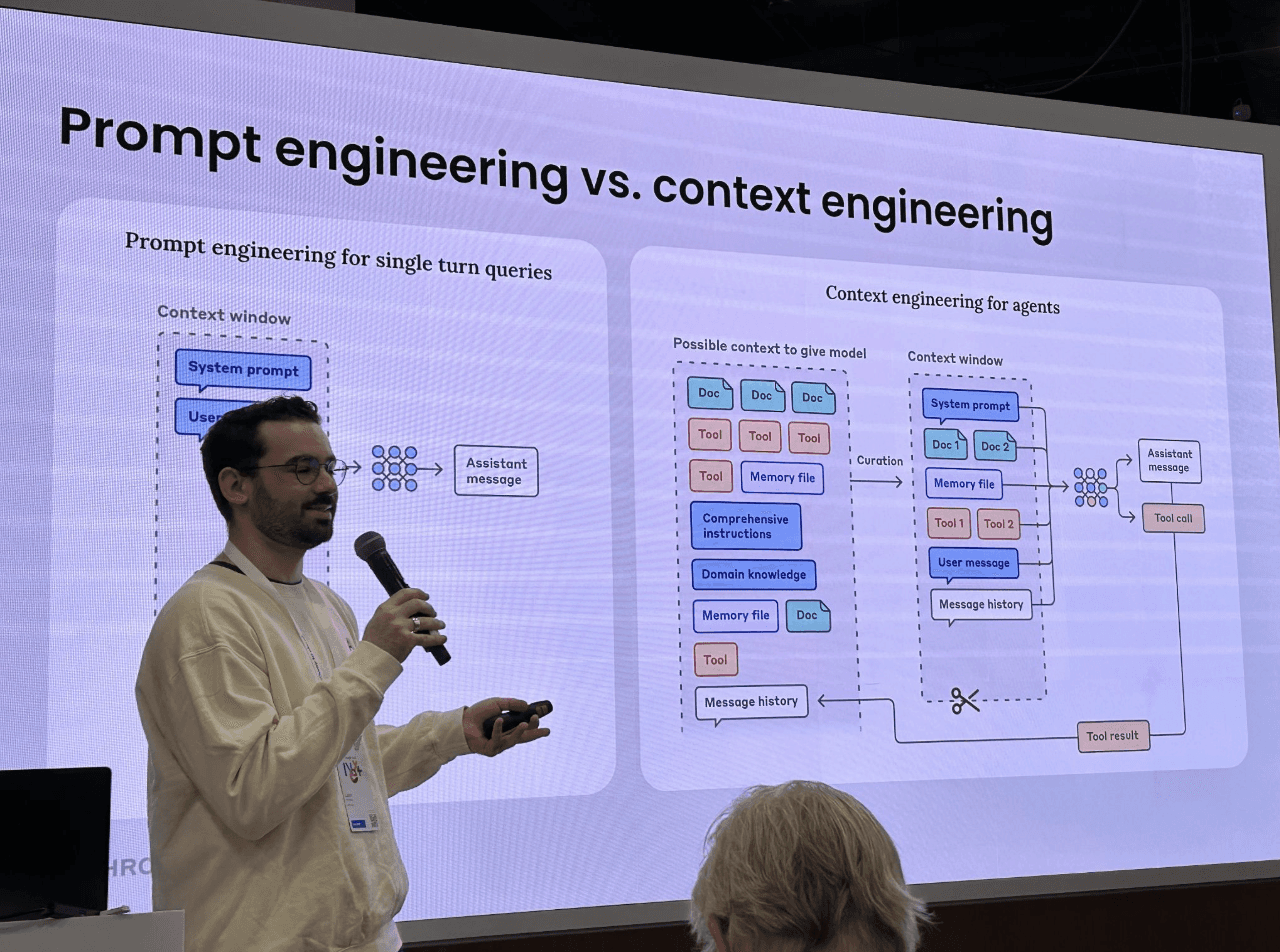
The important point here is that this is not just a simple ‘volume problem.’ The more context you add, the more relationships among the information the model must process grow exponentially, creating the paradox that accuracy declines as a result.
So what do we do?
The answer is simple, but hard to implement: ‘Give only the necessary information, at the necessary time.’
For example, simply organizing data naming conventions and schemas allows AI to understand structure without unnecessary explanation. Or, instead of passing every tool upfront, prepare a ‘tool to find tools’ and delay loading. In other words, context changes from something to ‘stuff into’ to ‘something to supply dynamically’.
This philosophy is also reflected concretely in the development environment. In Anthropic’s Claude Code, commands are provided to visualize the contents of context and strip away unnecessary information. In addition, instead of centralizing knowledge in one place, the recommended design is to distribute it across directories and load it as needed.
This is exactly ‘information design for AI = knowledge design within an organization’ itself.
Anthropic’s message is clear. What matters in AI use from here on is neither prompt tweaking nor model selection, but ‘how to design the flow of information itself’ — context engineering is becoming the core that determines competitiveness in the AI agent era.
AI winners and losers are determined by context design
After two days, my conviction became even stronger.
Lowe’s and Macy’s designed context that deeply understands customer intent and fundamentally changed the shopping experience. Cox began by organizing internal knowledge and turned support into a revenue-generating touchpoint. And Anthropic technically articulated that design philosophy.
The value of AI agents is not created by ‘smart models’ alone.
Going forward, I felt that the competitive advantage in AI will come from how deeply we understand customer context and how appropriately we can pass the necessary information to AI at the right time, becoming the key competitive edge.
At Lazuli, we will continue supporting you in organizing product data for this AI era, so if you’re interested, please contact us.
Hagiwara | Lazuli CEO Google Cloud Next 2026 Day 2 on-site report | April 2026, Las Vegas