“The experiment is over”—Google’s declaration amid thunderous cheers in Las Vegas, marking the dawn of the Agentic Era
I'm Hagiwara, CEO and Representative Director of Lazuli.
In January, when Google CEO Sundar Pichai announced UCP (Universal Commerce Protocol) at NRF 2026 in New York, I became convinced that "this would be the year of Agentic Commerce." Three months have passed since then. Now I am in Las Vegas.
At "Google Cloud Next 2026," held from April 22 to 24, attendance was said to be twice that of last year, and the venue was packed with overwhelming energy from the morning. What I strongly felt as I walked around the site was that Agentic Commerce is no longer "the future to come," but "a reality already in motion."
This time, I want to share the "current state" as seen from the venue.
Google's message is a "transition to the Agentic Era"
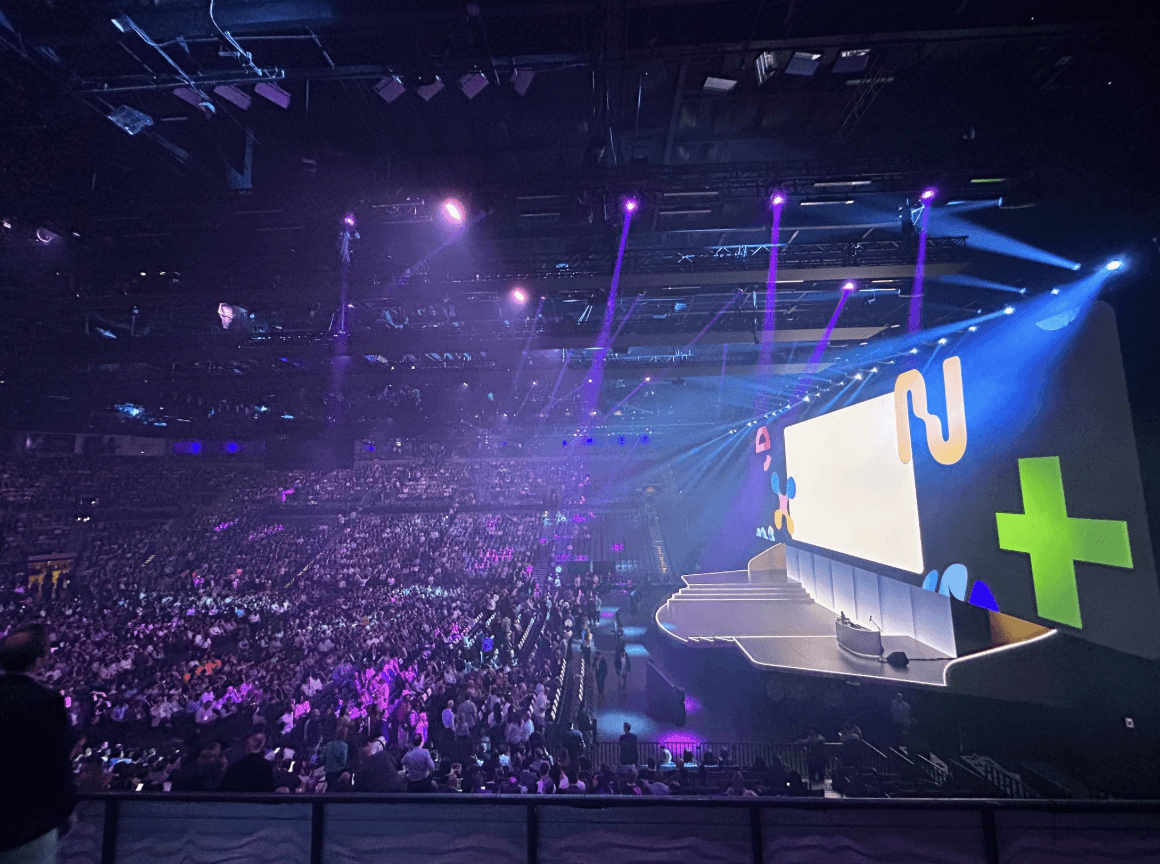
At the Keynote, which began amid thunderous applause, this was the strongest message Google put forward.
"The AI experimentation phase is over, and we've entered the age of agents."
This is not a story about features. What Google presented was a "blueprint for the agentic enterprise." The five core pillars are as follows.
① Gemini Enterprise Agent Platform A "mission control" for centrally managing thousands of agents. You can build agents in natural language and use multiple models such as Gemini and Claude across platforms.
② AI Hypercomputer (infrastructure) The 8th-generation TPU has dramatically improved the scale of training and inference. Model development lead times have been shortened from "months to weeks."
③ Agentic Data Cloud Provides the "trusted context" agents need to make decisions. It enables the structuring of unstructured data and the use of data across multi-cloud environments.
④ Agentic Defense A mechanism in which AI itself takes responsibility for security, from vulnerability detection to remediation proposals.
⑤ Workspace Intelligence It spans email, documents, and chat, understanding context and automating even the output itself.
Google's declaration was to provide "Agent × infrastructure × data × security × operations" as one integrated system and redefine the very operations of companies. The Keynote was full of rich customer case studies, and I felt that the trend of platform providers deeply embedding themselves into each industry and delivering results is steadily advancing.
Agentic Commerce is not a "US-only trend"
Looking at the individual sessions, there was one thing I strongly felt: Agentic Commerce has already started to spread globally.
If you think, "This is only about the U.S.," I would like you to revise that view.
Woolworths (Australia)
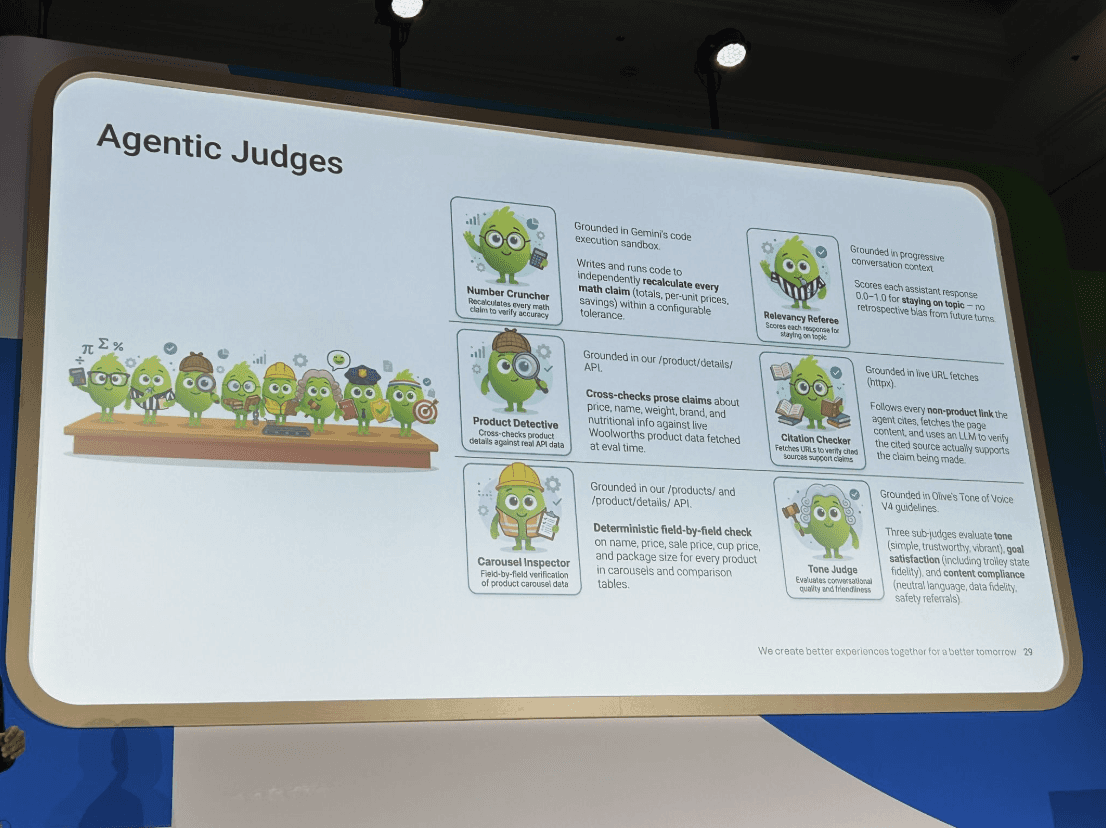
Woolworths, Australia's largest retailer, is fundamentally transforming the shopping experience through its digital assistant "Olive."
From a single abstract request like "Think about dinner tonight," Olive proposes recipes, selects the necessary ingredients, and even carries out the process all the way through to adding items to the cart. It is a true "excellent store associate," handling multimodal inputs (images and voice), cost optimization, and even bulk ordering planning for B2B. It also introduces a multi-AI-agent evaluation framework to ensure reliability even at large scale.
Bunnings (New Zealand)
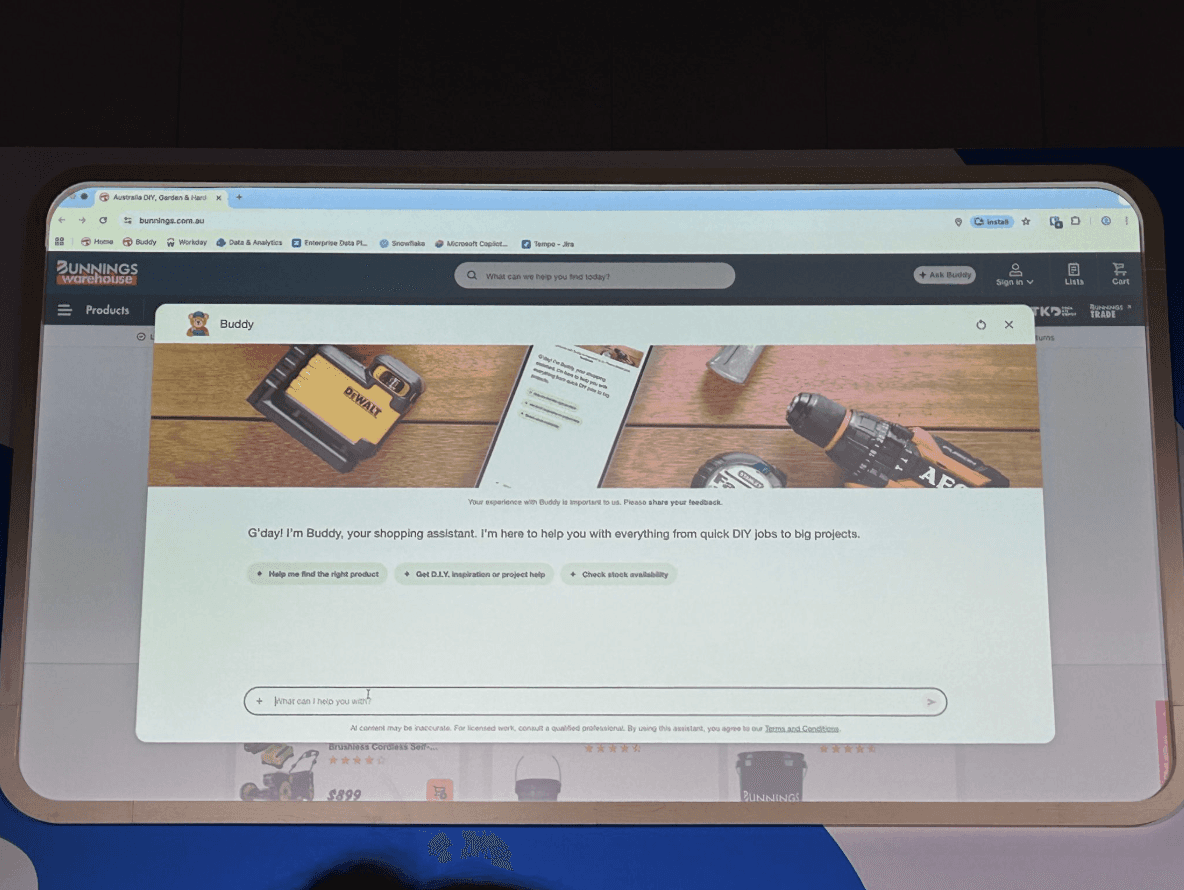
Bunnings, a home improvement retailer in New Zealand, has revamped the search-based e-commerce experience with its agent "Buddy."
From the simple request "I want to build a deck," it proposes all the necessary materials and tools at once. It identifies products from images and even checks inventory, eliminating the need to jump between multiple tabs. The speed from decision-making to launch in just a few weeks also felt emblematic of the times.
Wayfair's case shows the "winning formula"
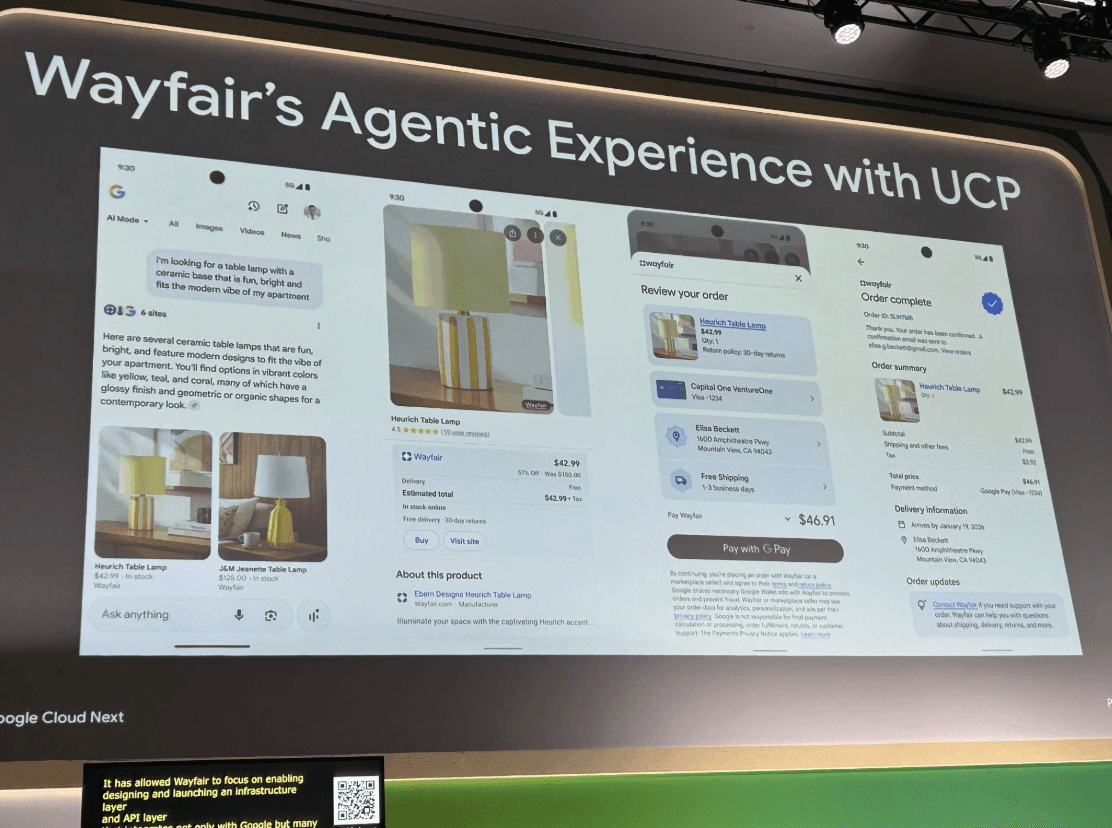
Among everything presented this time, the clearest and most detailed case was Wayfair's.
The company is working on UCP together with Google, and has been designed on the premise of shifting from conventional e-commerce, where you "search and click," to a world where "you convey intent and AI handles comparison and purchase." The numbers are already moving.
Traffic via agents has been growing twofold over the last two quarters
Higher conversion rates than traditional channels
On the other hand, because intent is clearer, drop-off is also faster when there is a mismatch
This is a "completely different purchasing characteristic" from conventional e-commerce. With that premise, Wayfair's three-pronged strategy is as follows.
① Optimize the catalog for AI It is structuring 30 million product data points and aiming to become a "trusted primary source of information for AI." Creating a state in which AI can accurately understand and match is the starting point of competitive advantage.
② Integrate agents as "new partners" Rather than building from scratch, it expanded its existing partner API foundation and implemented it in less than one quarter. It is designed so it can be quickly rolled out horizontally to other agents such as Perplexity.
③ Do not give up the customer relationship Even via agents, Wayfair consistently handles payment, delivery, and customer support. Continuing to maintain control of customer data and experience leads to long-term competitiveness.
Ulta shows "AI × brand experience"
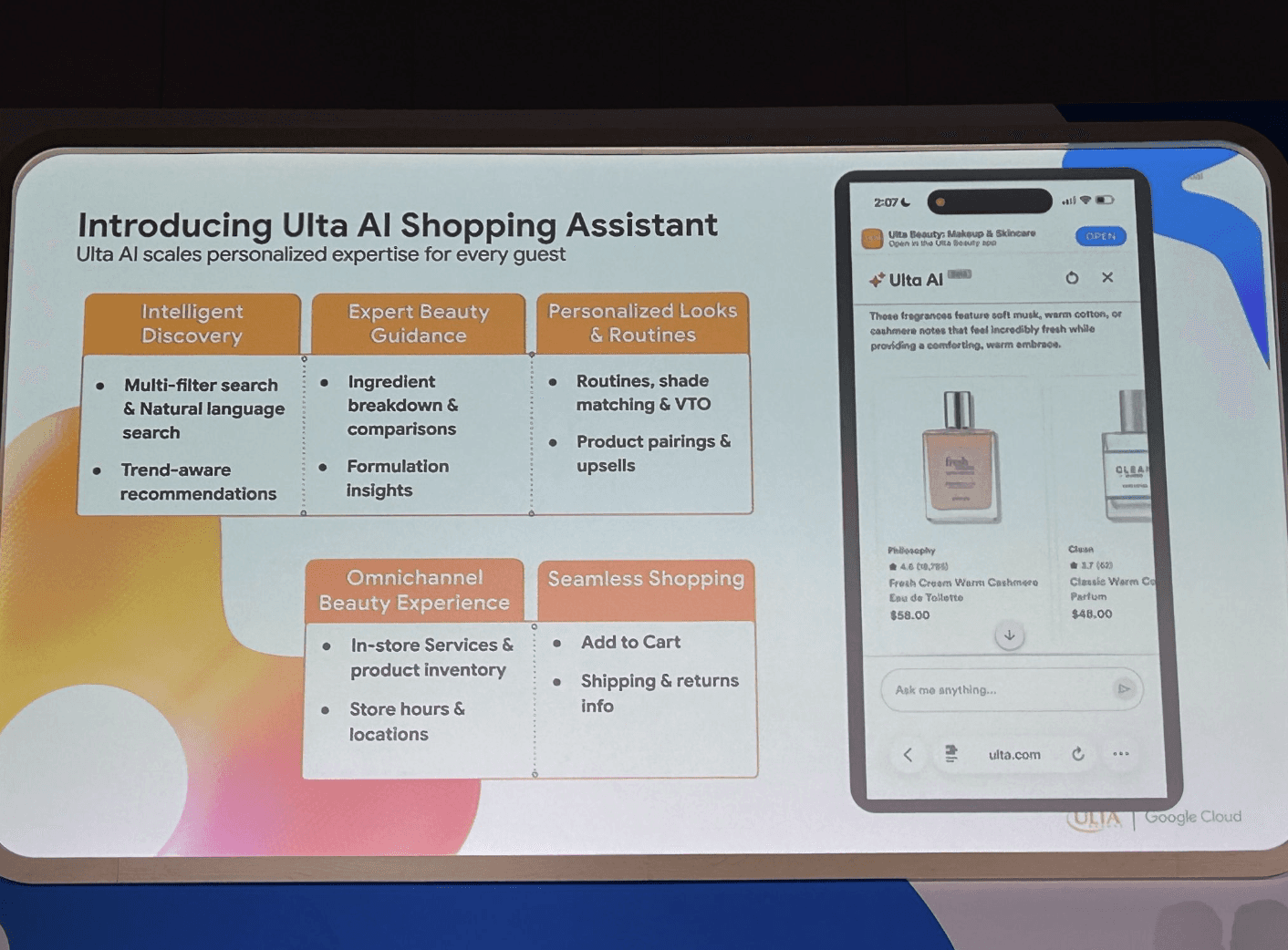
The case of Ulta, one of the largest beauty retailers in the U.S., was also extremely interesting. Based on its 47 million loyalty members, the company is redesigning the complex beauty shopping experience with AI.
To meet requirements such as ingredient understanding, virtual try-on, omnichannel integration, and seamless purchasing, it moved from an initial in-house build to Google infrastructure. As a result, it launched in just a few weeks, and the conversion rate improved 4 to 6 times.
What impressed me most was not the numbers, but the stance behind them.
"AI does not destroy brand experience; it becomes an important touchpoint that shapes CX."
Rather than isolating AI as a "tool for efficiency," it is incorporated into the design of the entire customer experience. This perspective should be useful for every company considering AI adoption.
L'Oréal shows a "scalable AI organization"
L'Oréal's case was not just a use case. It was about how to build the organization and foundation to scale AI across the entire company.
By moving from its in-house "L'Oreal GPT" to Google's Agent Platform (Make→Buy), the scale is astounding.
41,000 people use it weekly
15 million messages per month
More than 30,000 no-code agents
Rolled out across 150 countries and 40 brands
What made this possible was not technology alone. Only when the organizational mechanisms came together — Center of Excellence (from an organization that builds to one that enables use), Governance Task Force (integrated management of security, legal, and ethics), and placing AI champions on the front lines — did this scale become a reality.
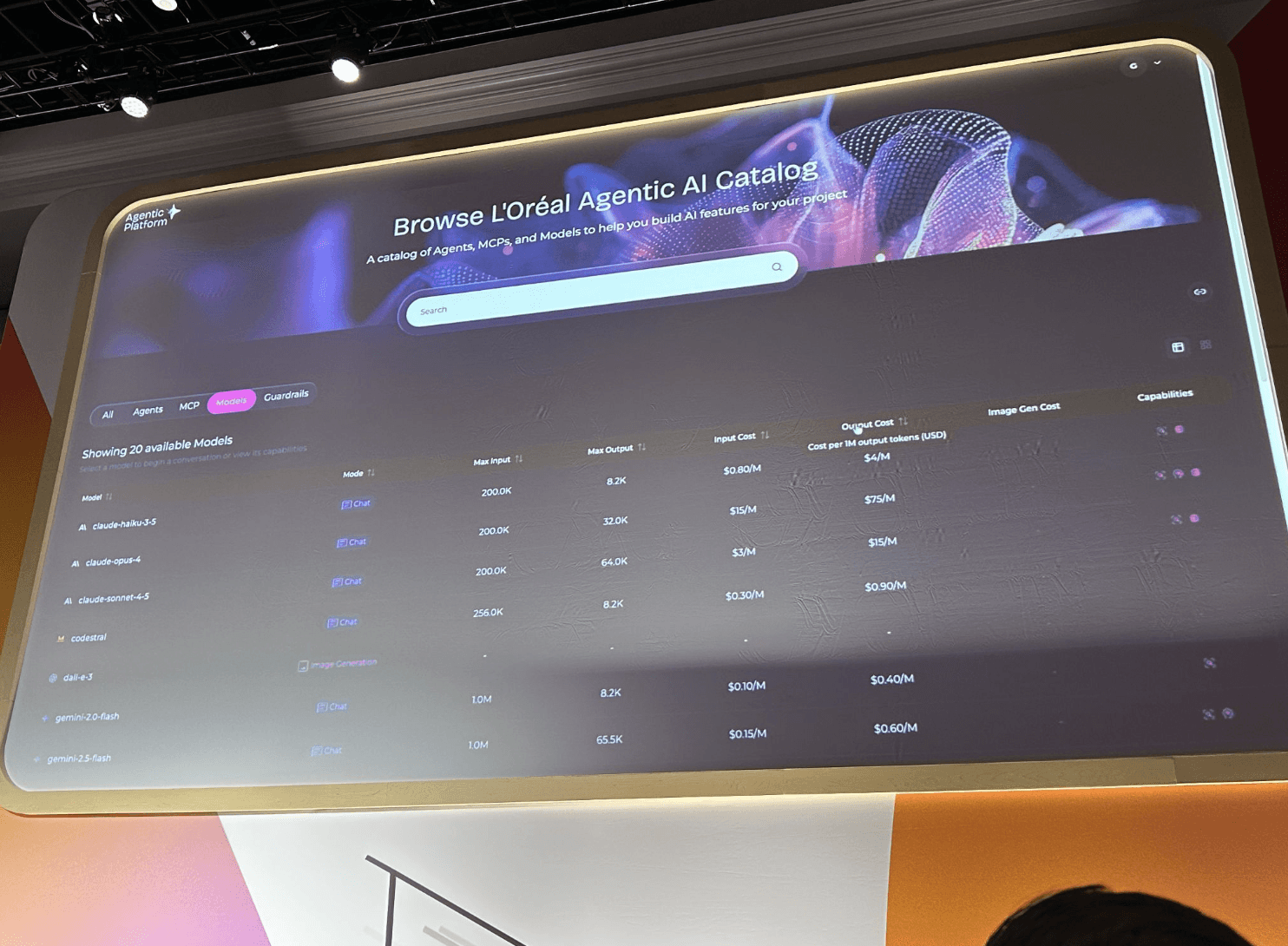
And the most symbolic example is the "Agent Platform Web" for all employees. By creating an environment where ordinary employees can build agents themselves, AI has become infrastructure that all employees use and create, not something limited to a select specialist organization. Rather than mere efficiency, I found this to be a highly advanced approach to turning AI into company-wide competitive strength.
The essence is "making product data AI-ready"
Through the first day, one conviction became clear in my mind.
Whether product data can be made AI-ready will determine future competitiveness.
Structured data, real-time capability, API connections, and attribute design that supports intent understanding — these are the foundations required for anything you do with AI. The reason Wayfair structured 30 million product data points, Woolworths built an agent evaluation framework, and L'Oréal established company-wide infrastructure is all because of this "foundation."
Agentic Commerce has already entered the phase of "implementation and competition." At its center is unquestionably "product data."
Can your company's product data be read by AI?
At Lazuli, we will continue to accelerate value creation in this area as well.
Hagiwara | Lazuli CEO Google Cloud Next 2026 on-site report | April 2026, Las Vegas