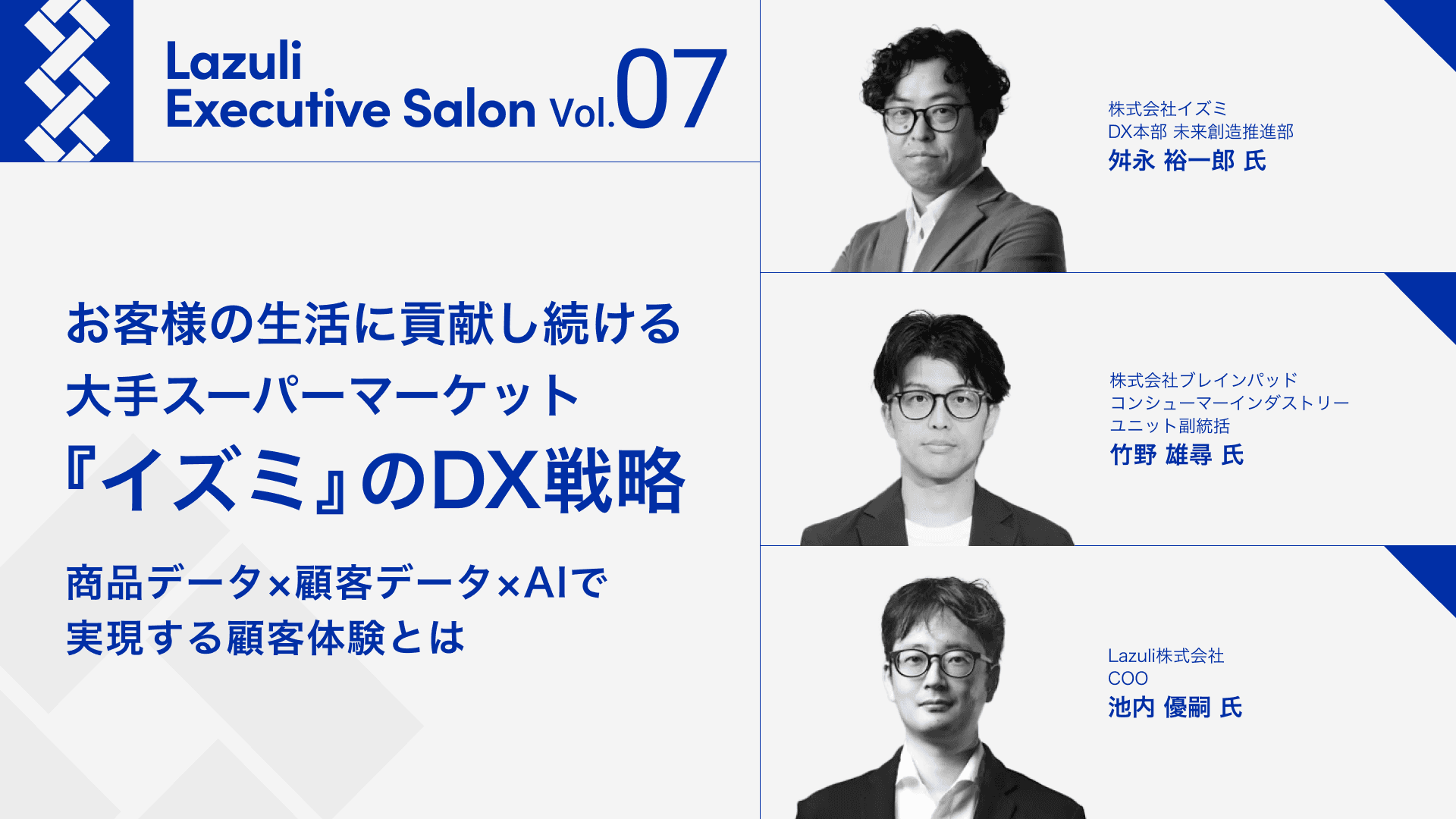
The DX Strategy of Major Supermarket “Izumi,” Continually Contributing to Customers’ Daily Lives — What Kind of Customer Experience Can Be Achieved with Product Data × Customer Data × AI? — Lazuli Executive Salon Vol. 7 Event Report
On June 12, 2025, Lazuli hosted "Lazuli Executive Salon Vol. 7," an executive event featuring Mr. Yuichiro Masunaga of Izumi Architect Co., Ltd., under the theme: "The DX Strategy of ‘Izumi,’ a Major Supermarket that Continues to Contribute to Customers’ Daily Lives: What Kind of Customer Experience Is Made Possible by Product Data × Customer Data × AI?" This event was also co-hosted with BrainPad Inc.
Customer Understanding and Talent Development Driving Izumi's DX
First, Mr. Masunaga of Izumi gave a lecture on the theme “Customer Experience Achieved through Product Data × Customer Data × AI.”
Customer Understanding through Customer DNA × Product DNA
Traditionally, analysis based on attributes such as “women in their 30s” was mainstream, but today, even people of the same gender and age can have very different values and purchase motivations. Surveys are often biased as well, and even ID-POS analysis cannot reveal the deeper psychology behind why a person chose a particular product.
In response to this situation, Izumi is working to make more precise purchase estimates by combining “Customer DNA,” which visualizes customers’ values and purchase tendencies, with “Product DNA,” which structures product characteristics. Masunaga also explained that they are connecting analysis to action by using purpose-specific clustering directly tied to the issues at hand.
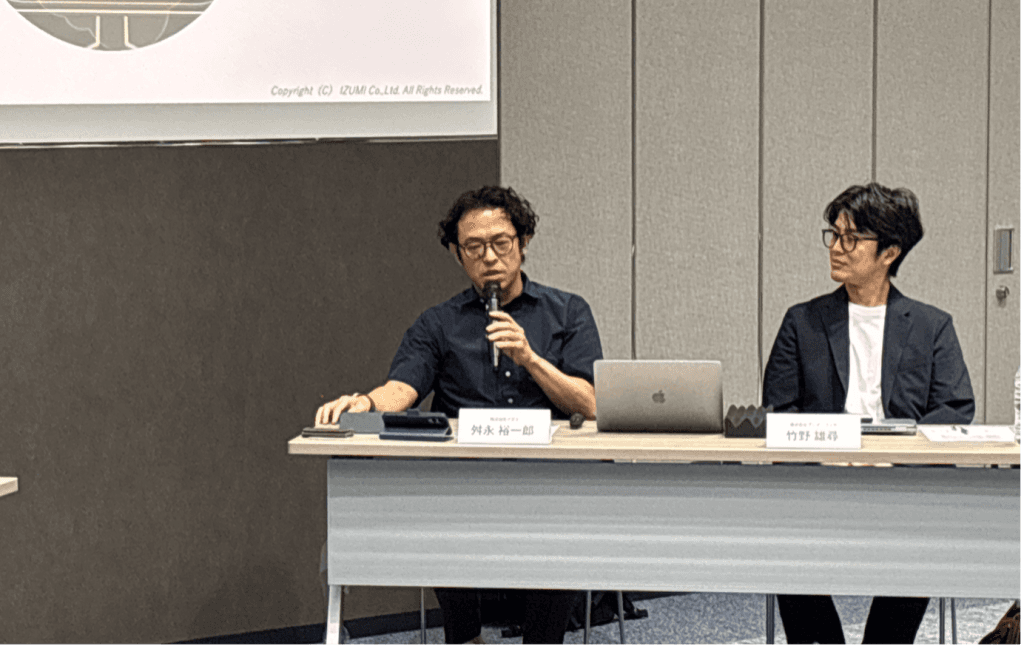
Data Analysis Structure and Talent Development
As another major theme, Mr. Masunaga raised the “limitations of talent and organizational structure.” He said that Izumi is currently feeling the difficulty of securing talent as a regional company.
Before programming skills, he said, what is needed first is the ability to understand the characteristics and value of data, as well as the ability to apply it to the business. To turn analysis into “actions on the front lines,” data scientists themselves must deeply understand the business and communicate carefully with stakeholders.
Currently, Izumi is promoting the introduction of a specialist system and the use of external talent networks while implementing clear goal-setting and regular feedback. It is exploring a framework for “analysis that gets used,” even with a small elite team.
The Retail Frontline Transformed by Data
Next, Mr. Takeno from BrainPad gave a lecture on the theme “The Retail Frontline Transformed by Data — What Changes Does a Data Scientist Bring?”
Mr. Takeno said that data utilization can be broadly divided into five types: [classification], [prediction], [optimization], [generation], and [detection]. He then explained that by combining these five types according to purpose, concrete changes can be brought to operations. For example, with [classification] × [prediction], loyal customer definitions are defined and classified based on customer data. Then, by identifying the factors that lead a customer to become loyal, one can predict things like, “For customers whose first purchased product was XX, the trigger for retention is XX,” or “If customers do not remain after purchase, promoting products in the △△ category may reduce churn,” and use this to design the golden journey.
He further pointed out that it is important to go beyond analysis results and determine how to act in the field, and that organizational design is essential for this.
Organizations and Data Needed to Improve Customer Experience
In Part 2, a discussion was held with people from companies promoting DX among major domestic manufacturers and retailers under the theme: “What organizations and data do you think are needed to further enhance the business and improve customer experience?”
The Talent and Organizational Structure Needed for Data Utilization
Many participants said that while the importance of data utilization is recognized, they face challenges in securing and developing talent. At the same time, it was shared that all companies are grappling with organizational design issues, such as how to develop internal talent and how to foster collaboration across different job functions. Some companies also introduced flexible approaches, such as establishing dedicated organizations and adopting project-based systems.
It was also noted that the company needs people who can understand both business and technology and act as “translators” between them. How to develop and place such talent is a theme directly tied to the future expansion of data utilization, and it was shared that each company continues to explore this area.
How to Collaborate to Deepen Customer Understanding
It was widely recognized that collaboration between retailers and manufacturers is important in order to use the data each side holds and aim for a more realistic understanding of customers. Many opinions were expressed that we need to move away from the conventional “ideal customer image” and shift to marketing based on actual purchase data.
On the other hand, barriers to sharing POS data and the uneven distribution of analysis skills were raised as challenges. Ultimately, it was suggested that what matters is thinking through “what kind of customer experience to provide” through data analysis, and that rather than mere numerical management, a perspective that connects to product and service development is needed.
Conclusion
At this Executive Salon, Mr. Masunaga of Izumi shared practical uses of data grounded in the retail frontline, such as customer understanding through Customer DNA × Product DNA and purpose-specific clustering. Even while facing constraints in location, talent, and organization, the effort to realize “analysis that gets used” with a small elite team may offer valuable hints.
The discussion also reaffirmed the importance of organizational design, talent development, and cross-functional collaboration in data utilization. The shared recognition among participants was that systems make data useful, and people make systems work.
Lazuli supports the foundation for customer understanding by acquiring and organizing product data in real time. By elevating the role of the product master as a “value creation foundation,” we will contribute to realizing data-driven management.
BrainPad Co., Ltd.
BrainPad Co., Ltd. is a group of data utilization experts that supports companies in advancing DX and solving management challenges. Since its founding in 2004, it has operated as Japan’s first “comprehensive data analysis services company that serves all industries,” and has supported more than 1,500 data utilization projects in total.
About Lazuli Inc.
Lazuli Inc., founded in July 2020, is a startup that integrates and organizes corporate product data and provides the SaaS product “Lazuli PDP” to support data/AI utilization. With advanced AI/ML technologies, it enables the collection, structuring, and integration of product data, promoting digital transformation in manufacturing and retail industries. Lazuli PDP automates complex data processing and eliminates data silos between departments. By enabling companies to provide consistent product information, it contributes to improved customer experience and optimized data utilization.
What is Lazuli PDP: https://corporate.lazuli.ninja/product-data-platform/