[Event Report] At the Forefront of Generative AI Adoption: Data Strategy and Business Transformation
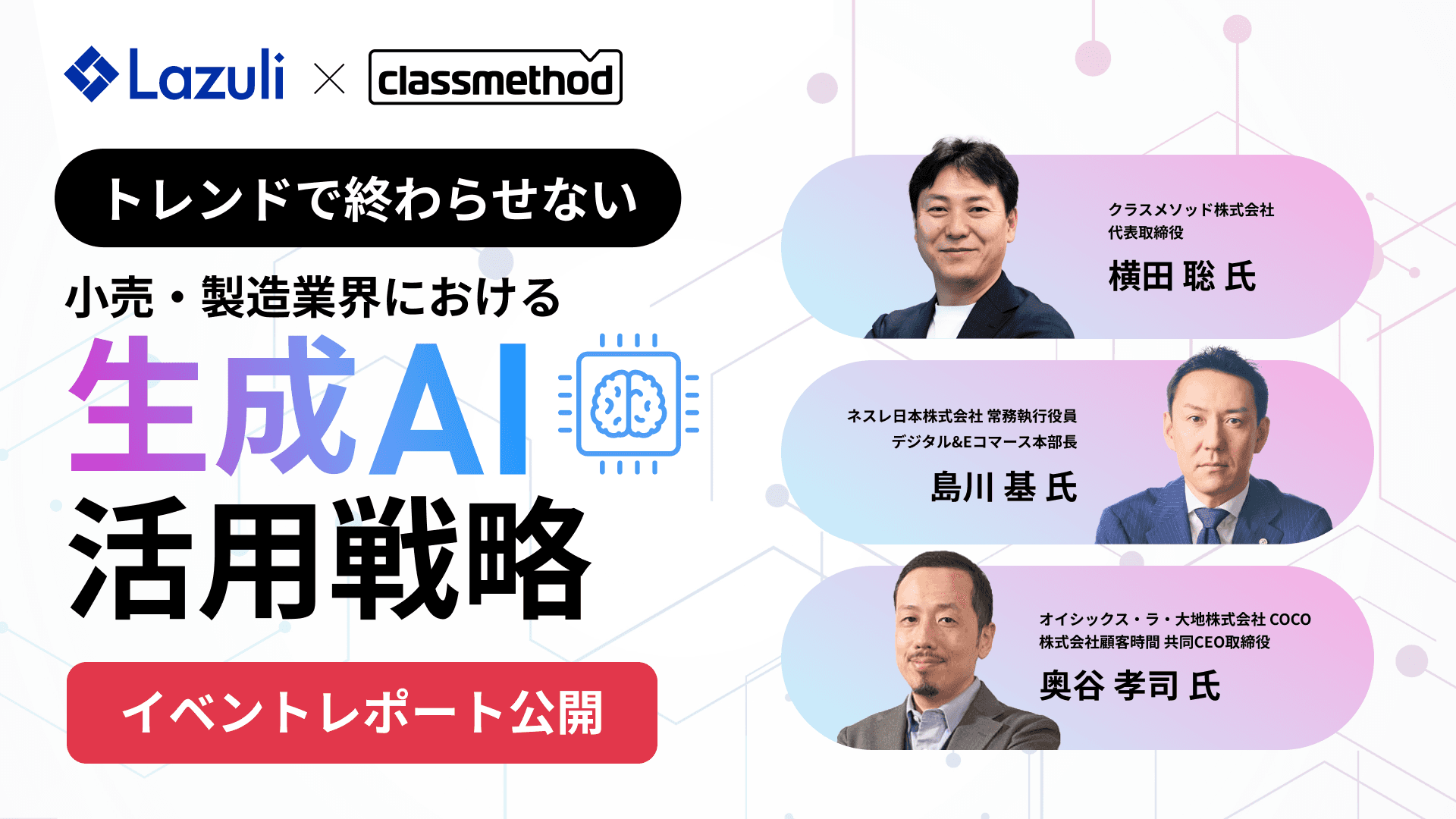
On July 30, 2024, Lazuli Inc. held a seminar, “Don’t let it end as just a trend: Strategies for using generative AI in the retail and manufacturing industries,” and shared the latest strategies for leveraging generative AI with people in the retail and manufacturing sectors. This report summarizes key information that will be useful for those considering AI adoption in their companies.
Part 1 Keynote: “Trends in Generative AI as Told by Mr. Yokota of Classmethod, and What Future Will They Bring to the Distribution Industry?”
From Satoshi Yokota, Representative Director of Classmethod Inc., we heard an explanation of the latest trends in generative AI and their impact on business, with concrete examples of how the evolution of generative AI can bring benefits to companies.
The Evolution of Generative AI and Its Business Applications
Generative AI is not just another passing trend; it has a wide range of functions, including image recognition and text generation from video. In particular, against the backdrop of social changes such as a declining birthrate and aging population, and a shrinking working-age population, the role of generative AI is becoming increasingly important as customer support becomes more automated and office operations are streamlined. For example, generative AI is making a major contribution to improving operational efficiency through tasks such as brainstorming planning ideas, automatically classifying emails, and assisting with code in system development.
The Need for a Data Strategy
Mr. Yokota pointed out, “What matters is not generative AI itself, but the data companies have.” The key points to note are as follows.
Utilizing unstructured data: 90% of internal corporate data is unstructured, and structuring and using it becomes a source of competitiveness.
Centralizing data: It is important to centrally manage data dispersed across departments and build a framework that can be used for decision-making.
Moving to the cloud and building a data foundation: First, move to the cloud, and then build the data foundation. This becomes the basis for using generative AI.
The Importance of Change Management
Mr. Yokota raised “change management” as a challenge when introducing generative AI into a company. In order to use generative AI effectively, employees need to accept new technology and incorporate it into their daily work. At Classmethod, AI accounts are distributed to all employees, and onboarding is supported through guidelines and a help desk.
Part 2: “Learning from Domestic and International Cases. ~What is Nestlé Japan’s Generative AI Strategy?~”
From Mr. Motoi Shimakawa, Executive Officer and Head of the Digital & eCommerce Division at Nestlé Japan, we were introduced to specific examples of generative AI use at Nestlé Japan.
Centralizing Data and Improving Productivity
At Nestlé Japan, efforts to increase productivity and establish a competitive advantage are being driven through CX transformation and business transformation. AI is already being used in these efforts, and generative AI is helping optimize customer experience and strengthen CRM initiatives through the generation of digital content, personalization, analysis of consumer trends, and improvement of business efficiency.
Using Internal AI Tools
At Nestlé Japan, the company uses “NesGPT,” a chatbot based on ChatGPT developed for internal use, creating an environment where employees can use generative AI on a daily basis. This tool is helping with document reading and summarization, improving translation quality, and more; among users around the world, prompt generation and usage by employees in Japan in particular is progressing.
To promote the use of generative AI, the importance of creating systems that encourage proper training and internal adoption, as well as establishing rules for ethical and safe use, was highlighted.
Part 3: “AI Adoption Trends Seen from Overseas Company Case Studies”
Mr. Takashi Okutani of Kokyaku Jikan Inc. and Mr. Seigen Hagiwara of Lazuli Inc. introduced AI use cases from overseas companies.
The Current State of AI Use in Retail
In U.S. retail, AI use that is specialized for specific areas, such as text summarization and insight generation, is advancing. For example, Walmart has added a search function powered by generative AI to its customer app, and Instacart has introduced a chatbot using ChatGPT, both of which are helping improve customer service. It was noted that at retail tech touchpoints, data collection itself is already progressing, and the important question going forward is how to put that data to use for AI adoption.
The Importance of Data Preparation
The key to AI adoption lies in data preparation. It is important to structure the unstructured data companies possess, create a state in which AI can learn easily, and use generative AI to support business decision-making. Lazuli supports the preparation and utilization of product data, helping companies use their data toward realizing unified commerce.
Closing Remarks
Lazuli promotes cloud-based data management and real-time data utilization. Among the diverse data and master data companies hold, it provides the platform “Lazuli PDP,” which uses product data as the key to integrate and generate data and enables data use according to purpose. Classmethod provides support for building generative AI environments and engineering support, helping companies use AI and advance digital transformation.
At this seminar, many insights and case studies were shared on the latest trends in generative AI and its concrete business applications. In particular, it was emphasized that data preparation and change management within the company are the keys to successful generative AI adoption. The use of generative AI is no longer an option, but an essential strategy. We hope this report will be useful to everyone in the retail and manufacturing industries as a reference for future generative AI adoption strategies.