Business Innovation through a Data Integration Strategy: LIXIL’s Organizational Design and Data Utilization Approach – Lazuli Executive Salon Vol. 5 Event Report
On March 12, 2025, Lazuli hosted the executive event “Lazuli Executive Salon Vol. 5,” inviting Mr. Taku Yasui, who leads the digital division at LIXIL Corporation, to speak on the theme “Business Innovation Through a Data Integration Strategy: What Are LIXIL’s Organizational Design and Data Utilization Approaches?” In this session, he gave a talk based on real internal transformation efforts, covering the importance of organizing product information, including the introduction of a Product Information Management (PIM) platform at LIXIL and the use of generative AI, as well as the organizational structure essential to making it happen. The second half featured a discussion.
Background of LIXIL's DX (Digital Transformation) Initiatives
LIXIL is a global company that operates in more than 150 countries and regions around the world, handling a wide range of products for the home, including toilets and bathroom products, as well as windows and sashes. Because the company has grown through repeated mergers, different cultures and systems exist across departments and businesses, and product information was also managed independently by each business division.
In this environment, what the company places importance on is DX that leads to improved customer experience (CX) and employee experience (EX). As an example of a successful DX initiative that affected both CX and EX at LIXIL, Mr. Yasui cited the rollout of online showrooms. During the COVID-19 pandemic, when it became difficult to use physical showrooms, LIXIL launched online showrooms. This enabled customers to continue building their homes together with family members living far away, contributing to improved CX. It also helped secure EX, as employees who had previously done much of their work in showrooms were able to respond to customers from home as well.
At LIXIL, such digitalization measures are being implemented as initiatives that contribute to improving CX and EX.
What Kind of Organizational Structure Is Needed to Achieve Data Cleanup?
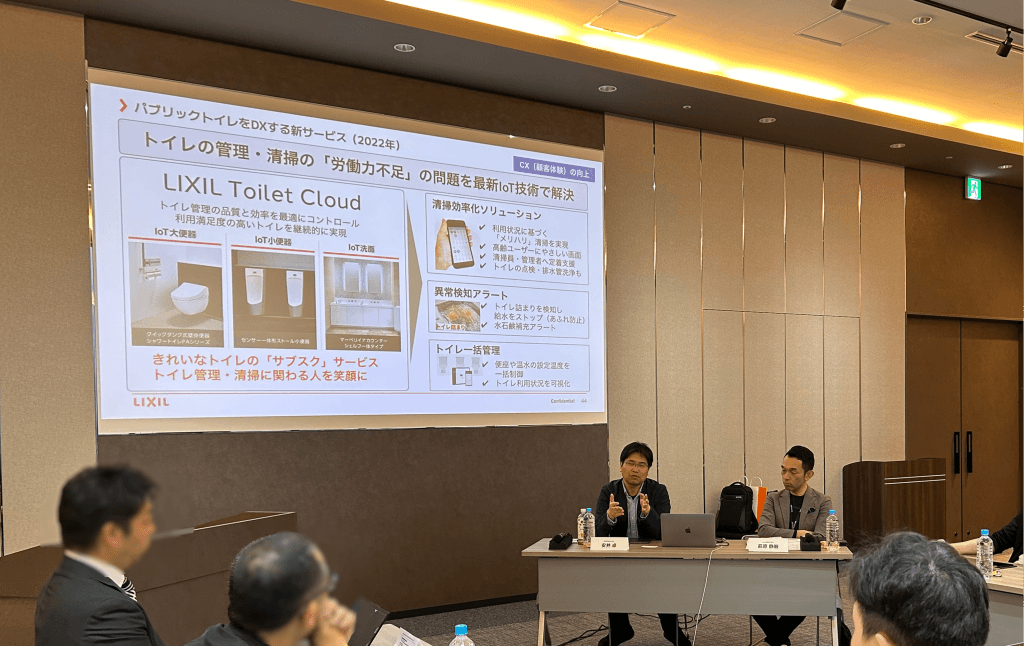
Product data cleanup should not end with simply introducing IT. What LIXIL is focusing on to make that happen is building a cross-functional framework and engaging leadership.
LIXIL had introduced Scrum since 2018 (an agile development method proposed by Dr. Jeff Sutherland in which a team cooperates to deliver results in a short period), and the project that achieved particularly notable results was the PIM implementation project in the tile business division. In this project, the division head himself took the lead as the project champion and formed a cross-functional team with the marketing and systems departments. In addition to system changes, the team simultaneously promoted reforms to the business processes themselves, greatly advancing the organization and sharing of information. In this way, for product information cleanup that requires collaboration across departments, a combination of “transforming the system implementation process × designing the organizational structure” is necessary. In particular, building a cross-functional organization that can oversee both upstream and downstream processes is a major key.
Barriers to Product Information Cleanup and How to Overcome Them
LIXIL introduced PIM with the goal of realizing “one source, multi use,” in which data is centralized and managed in one place while being updated to ensure freshness, quality, and accuracy, and then distributed and utilized where needed. However, if it remains unclear who designs the data format to be entered into PIM and where responsibility for data cleanup lies, the effect is limited.
Even the psychological barrier among frontline employees who did not want to change their on-site operations could not be overcome by the system alone.
Against this backdrop, the company places importance on the following initiatives, based on the premise that “organized data does not emerge naturally.”
Creating awareness of overall optimization through cross-departmental team structures
Involving frontline teams by having leaders participate in the project themselves
Converting past data into PIM and improving efficiency through AI-based tagging and structuring
In this way, fostering a shift from local optimization to overall optimization, and designing an organization that clarifies “for what purpose, at what level of detail, and who should maintain it,” are the keys to successful product information cleanup.
Lessons Learned and Future Outlook
At this Executive Salon, it was reaffirmed that product information cleanup is not merely about “internal efficiency,” but also forms the basis for transforming customer touchpoints and for data-driven business strategy.
At the same time, many participants came to share the understanding that the success or failure of such cleanup depends not only on tools and technology, but also greatly on organizational design and leadership.
Going forward, LIXIL plans to expand the product information management system beyond the tile business division and advance the structuring and automated tagging of past data using generative AI.
— Lazuli will continue to support the creation of mechanisms for acquiring and organizing product data that companies can use, and will contribute to improving CX/EX through the “overall optimization” of product master data.
About Lazuli PDP: https://corporate.lazuli.ninja/product-data-platform/