Lotte’s Vision for a Data Strategy to Create a Sustainable Society - Lazuli Executive Salon Vol. 3 Event Report
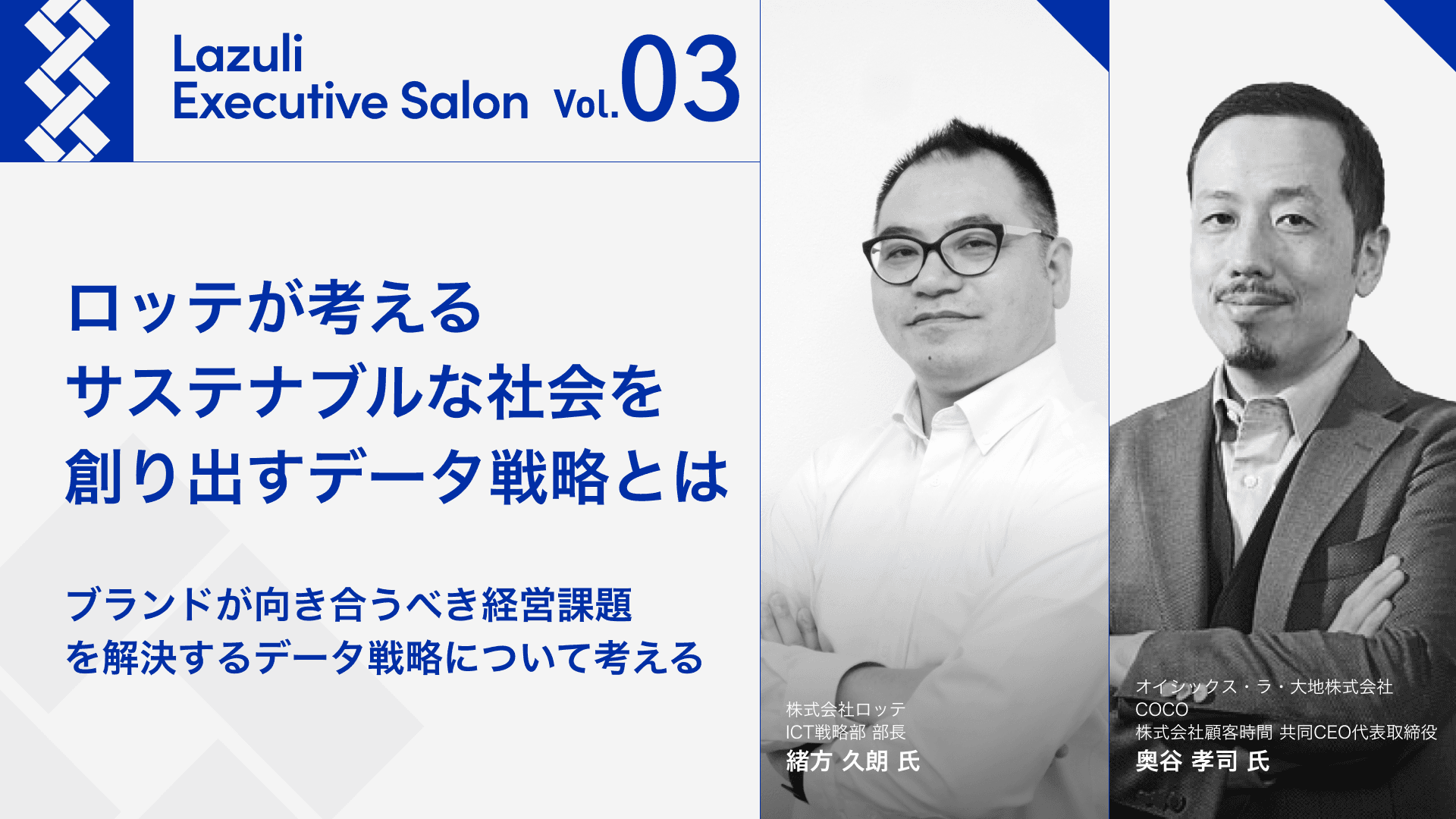
On August 26, 2024, Lazuli hosted the executive event “Lazuli Executive Salon Vol. 3,” featuring Mr. Hisao Ogata, General Manager of the ICT Strategy Department at Lotte Co., Ltd. (hereinafter, Lotte), and Mr. Takashi Okutani, Co-CEO and Representative Director of Kokyaku Jikan Co., Ltd., and COCO of Oisix ra daichi Inc., as speakers. Under the theme “What is the data strategy for creating a sustainable society, as envisioned by Lotte? — Thinking about data strategies to solve management challenges that brands should address —” we brought together participants from companies working on supply chain and DX initiatives among major domestic manufacturers, brands, and retailers, and discussed how companies should use data related to sustainability and traceability, as well as customer experience.
What data strategy does Lotte envision to create a sustainable society?
Lotte’s vision for a sustainable future connected by data
Lotte is a long-established company known for manufacturing and selling confectionery and ice cream. In its materiality and medium-term ESG targets, the company is focusing on decarbonization and reducing FLW (Food Loss & Waste).
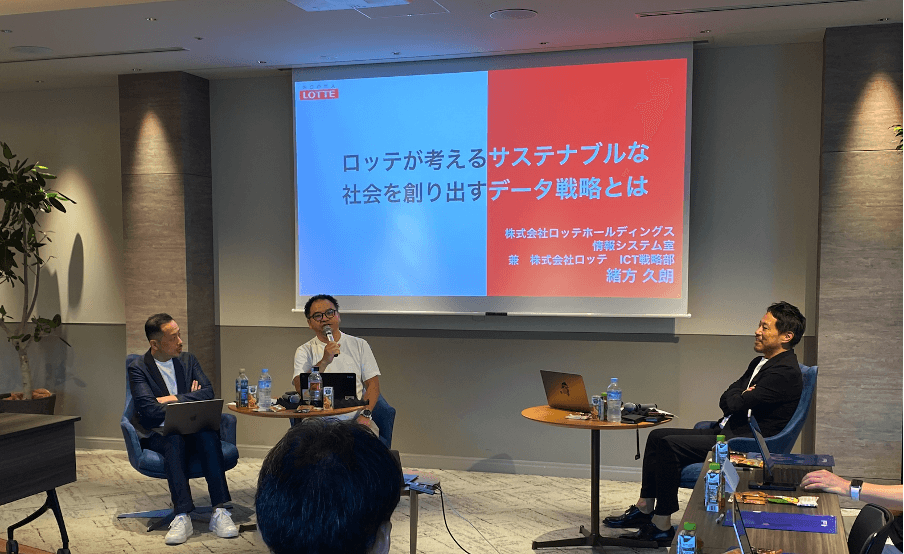
Ogata said, “To achieve these goals, data linkage across the entire supply chain is essential.” However, in conventional SCM, data from manufacturing to sales is disconnected, making it difficult to visualize in-store inventory at retail locations.
Lotte therefore partnered with Lazuli, which helps companies match, integrate, and connect their data, and launched a project to visualize in-store inventory. By linking four types of data—shipment data from wholesalers to retailers, retail sales results, rounder store activity results, and direct shipment records for in-store materials—the project aims to understand the real inventory status of stores.
By leveraging Lazuli’s expertise in matching product master data, the company is connecting data using store information as the key, aiming for more accurate shelf analysis and FLW reduction through inventory optimization. This is expected to enable Lotte to place optimal orders and run promotional activities, which should also lead to higher sales.
The importance of improving customer experience and using data, as seen in overseas trends
Okutani shared the latest trends learned at major overseas retail events such as NRF2024 and SHOPTALK. In particular, he emphasized the importance of improving customer experience and using data.
D2C proliferation and use of 1st Party Data: Not only retailers but also manufacturers are rushing into D2C businesses and trying to build a competitive advantage by collecting and using customer data in-house.
Seamless integration of online and offline: As customer touchpoints expand online, companies are expected to integrate data and provide a unified customer experience that customers can trust.
Use of AI: Marketing is moving away from the funnel model, and AI use focused on solving customer problems is being sought. There is also a growing movement, such as at Walmart, to emphasize the ethical use of AI.
Sustainability and data: To achieve sustainability goals, data-driven partnerships are essential.
Compared with overseas examples, it became clear that the Japanese retail industry still has insufficiently developed data infrastructure. Overseas, innovative data-driven initiatives such as AI-powered personalization and supply chain optimization are progressing, but Japan is still lagging behind.
However, referring to overseas examples, the importance of data utilization is beginning to be recognized in Japan as well. Going forward, customer experience improvement and supply chain optimization based on data are expected to advance in Japan’s retail industry too.
What product-related data should we have to improve customer experience?
In the second part, all participants discussed how product data can be used to improve customer experience. Many interesting opinions were shared, as follows.
Growing awareness of sustainability
In response to growing interest in environmental issues, many companies are focusing on product development that emphasizes sustainability. Participants commented that extending product lifecycles and promoting repair and reuse can reduce environmental impact. They also touched on ethical issues in the sourcing of raw materials and changes in consumer awareness toward purchasing behavior, suggesting that data linkage to retain such information is an important factor.
Focusing on the customer’s “job”
Customers do not simply buy products; they want to use them to accomplish something. This something is called a “job.” Participants noted that to understand the customer’s job and provide the best products for it, product data needs to be enriched with information such as customer behavior history and feedback.
Challenges and solutions for product master data
On the other hand, another issue that became clear was that product master data, which each company manages independently, is not standardized across departments or companies. To solve this, there was agreement that a cross-functional product master should be built and company-wide data linkage promoted.
What emerged through the discussion
Through this discussion, it became clear how companies are using product data and in what direction they intend to move going forward. Below is a simple summary of what emerged from the discussion.
Importance of data: To improve customer experience, it is essential to collect and analyze all data related to products
Contribution to sustainability: Product data can contribute to realizing a sustainable society through the integration and linkage of data that goes beyond inventory visibility
Customer-centric perspective: It is important to understand and respond to the customer’s “job”
Need for data linkage: To use data more effectively, a cross-functional product master is required
Summary
This time, participants pointed out the importance of data linkage across the entire supply chain and the importance of designing the full sequence of experiences in the customer purchasing process. Through these discussions, a shared understanding emerged that integrating and utilizing the various masters and product data that companies hold is essential for them to develop customer-centric businesses. Lazuli’s services centralize the master data held by manufacturers and enable linkage between data and systems, serving as a data foundation that can be used for initiatives to manage more detailed product information and improve customer experience. By continuing to use AI and tackle product data challenges from a global perspective, Lazuli will support company growth.
Lazuli PDP is: https://corporate.lazuli.ninja/product-data-platform/