Lazuli PDP Use Case Vol. 03: Competitive Research Through Web Crawling and Optimizing Our Product Sales for Each Channel
In manufacturing and retail, it is important to analyze other companies’ sales strategies and understand your own sales performance. With Lazuli PDP’s data collection features, you can gather and structure information available on the web, making it possible to research competitors and track the sales status of your own products. In this article, we’ll introduce the details with examples.
At Lazuli, we address a variety of challenges related to product master and product data, such as the following.
Automatic generation of data for EC listings
Control and organization of attribute information
Competitive research via web crawling and optimization of our products’ sales for each channel
Visualizing theoretical inventory by linking retail POS data with wholesale and manufacturer shipment data
Organizing product information to improve CX
This time, we will introduce use cases in manufacturing and retail for “competitive research via web crawling and optimization of our products’ sales for each channel.”
In recent years, the channels and methods through which consumers purchase products have diversified, and the environment is changing rapidly. In such an environment, the importance of competitive research and sales strategy in manufacturing and retail is increasing, and more advanced and speedy collection and analysis of product data (product data) is required.
Product data includes not only product names and specifications, but also various information surrounding products and customers, such as ingredients, category information, feature tags, and reviews.
Among these, in manufacturing and retail, data collection and analysis from the following perspectives is important for competitive research and sales strategy.
◆Manufacturing
・Whether there are any errors in product information across multiple sales channels
・Whether prices on each sales channel are appropriate
・What the differences are between similar products from other companies and our products
◆Retail
・On other companies’ sites, how is the same product being sold, and under what strategy? (price, category)
・Compared with other companies’ sites, what differences are there in product information?
While such information gathering is often done manually by product and systems departments at each company, it is not easy to collect and analyze product data scattered across other companies’ sites and multiple sales channels with high freshness.
Therefore, Lazuli PDP crawls multiple web sites and provides functions to quickly collect the necessary information and generate and process data. This makes it possible to automatically achieve daily competitive research and confirmation of brand value, which had been done manually, at a more advanced level.
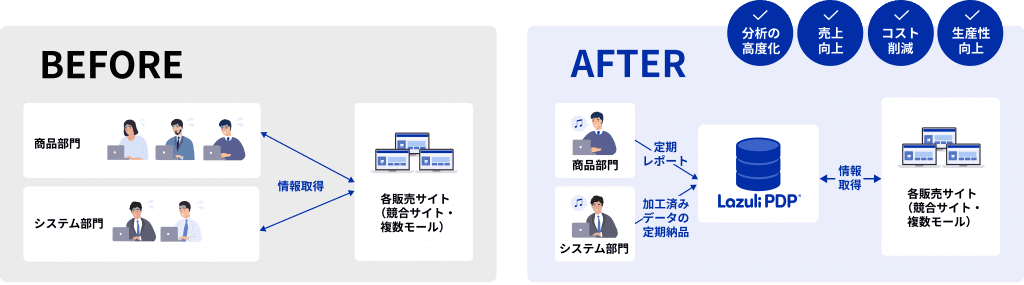
In fact, at Company C, which has introduced Lazuli PDP, they sell their own products across multiple channels, and needed to adjust their sales strategy so as not to damage brand value while taking into account differences in prices and listing information across channels. Therefore, aiming to detect selling prices and information differences across channels and make adjustments aligned with their sales strategy, they have started using Lazuli PDP’s crawling data. In addition, by simultaneously collecting and analyzing competitor product information, they aim to clarify differences from their own products and improve revenue through product improvements and sales strategy revisions.
At Retail Company D as well, they had previously been collecting information and formatting data using internal resources, and the collected information covered a wide range, including price and delivery date, number of reviews, number of images used, amount of descriptive text, product detail information, and more. However, as the market changed—for example, with the diversification of channels—requirements for information freshness and accuracy within the organization increased, making it difficult to achieve with internal resources. So they introduced Lazuli PDP and now use crawling data to enable fast and accurate information collection. Going forward, based on more comprehensive product data, they aim to analyze competitor sites in greater detail and improve their sales strategy.
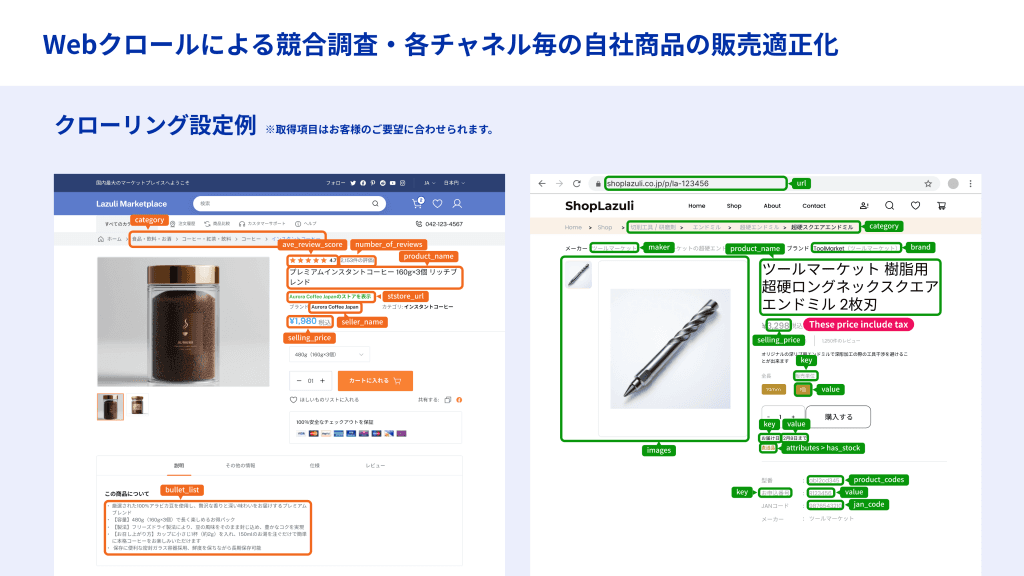
The information that can be crawled with Lazuli PDP can be adjusted based on the intended use, and a wide variety of information can be collected.
Due to the diversification of sales channels and changes in consumer needs, the product data required in the future is expected to become even more diverse, and the importance of information freshness will continue to increase. In that context, crawling is an effective means of faster and more accurate information collection.
With Lazuli PDP, not only web crawling but also the processing and analysis of the collected product data can be handled end to end. This enables not only reductions in man-hours, but also the use of data that leads to increased sales.
Please see below for diverse ways to use product data.
Examples of product data utilization in the manufacturing industry:https://corporate.lazuli.ninja/useful/manufacturer_clients_best_practices/
Examples of product data utilization in the retail industry:https://lazuli.ninja/useful/retail_clients_best_practices/
If you have challenges such as “Data utilization isn’t progressing as expected” or “We want to advance analysis of competitor sites and products,” please feel free to contact us.
https://corporate.lazuli.ninja/contact/