Must-read for manufacturers! What are the three elements needed to deepen data analysis: AI-powered data enrichment, data processing, and record matching?
There are various steps involved, from product planning to sales and analysis. In recent years, the adoption of CDPs (Customer Data Platforms) and other tools has been advancing, and efforts to broaden the use of customer data have become mainstream. So, what should you do to maintain a competitive advantage in response to these trends?
In recent years, the development of AI technology has been rapid, and AI adoption and utilization, as well as the use of CDP and PDP (Product Data Platform), have been advancing across various industries. In this article, we will introduce AI in manufacturing, the expansion and processing of product data using Lazuli PDP, entity resolution, and the effects they bring.
The key to gaining many insights from data analysis lies in data preprocessing
In manufacturing, there are many situations where various types of data, such as customer data, purchasing behavior, and POS data, are collected, linked, and analyzed.
However, even if you obtain POS data and the like, it is not easy to start data analysis right away, is it? This is because product master management methods and the way product information is written differ by retailer. For example, if "ml" is written as "milliliter" or as full-width "ml," you are not yet at the starting line for data analysis unless you standardize them into the same notation.
So how should this product information be prepared into a form suitable for analysis? Depending on the format of the original data, there are broadly three steps involved in organizing the data.
・Data collection and integration
Collect POS data and integrate it with product master information, which includes data such as customer purchase history and detailed product information (product names, categories, brands, specifications, etc.).
・Data cleansing and preprocessing
The collected data may contain missing values, outliers, and variations in notation. These are supplemented and cleansed. Text data such as product names is normalized and converted into a consistent format. This improves data consistency.
Use the time saved by AI for analysis
So what do the "data enrichment" and "data processing" needed to prepare data refer to?
(*The term "data" used here refers to "product information.")
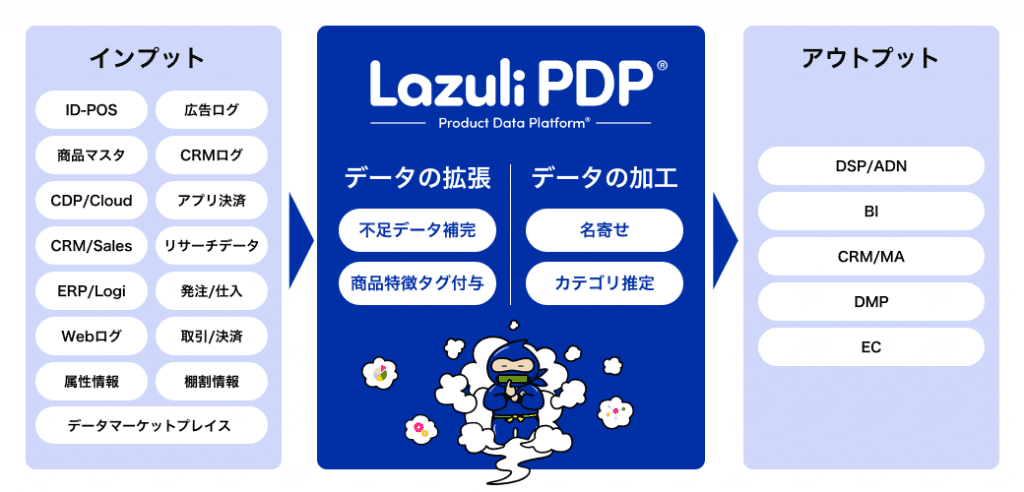
We will introduce how manufacturer-held data is expanded and processed through Lazuli PDP (Product Data Platform) provided by Lazuli.
・What is Lazuli PDP?
"Lazuli PDP" is a cloud service that centrally manages product information scattered across multiple external databases, and organizes and enriches the data into a form that is easy to use. It uses AI to perform entity resolution on diverse product master data held by manufacturers, retailers, pharmaceutical companies, and others, and adds meta tags and associations based on product characteristics. This information is provided to users through "Lazuli PDP".
・How it is used
① Data enrichment
Using the Lazuli database, it collects and adds product-related information that companies do not have and that has been missed in the product master, and also adds Lazuli's proprietary product feature tags.
② Data processing
Based on the product master information a company has, and the information expanded by Lazuli in ①, it can be processed and changed into the data names the company wants. For example, it can process "product name" into the format "existing product name _ brand name." It can also perform entity resolution, infer categories, and add them to categorize similar products.
Lazuli independently maintains a database that collects and cleanses information related to various products using AI/machine learning. By providing this through Lazuli PDP, Lazuli's manufacturing customers can prepare their data before analysis. Because it uses AI, it can be made far more efficient than having staff do it themselves, allowing that staff effort to be devoted to analysis, and more.
Benefits gained from enriched product information
Many pieces of product information exist for the various products manufacturers have, such as specifications, types, and brand names. Customers decide which products to buy based on this wide range of information.
・Insights and competitive advantage provided by product data
Lazuli PDP creates category information and meta tags from product reviews and other information available online, and links them to each product's information using unique codes such as JAN codes and model numbers as keys.
By using this, in addition to customer data such as attribute data, ID-POS, and ad logs that have been collected using CDPs, it becomes possible to conduct deeper analysis by combining information about purchased products.
For example, by combining the meta tags attached to purchased products, such as "nutrition," "walking," and "calorie off," with what was previously analyzed from member information, member behavior logs, and purchasing information, it becomes possible to gain deeper insights, such as concluding that people who bought those products have a "health-oriented" preference.
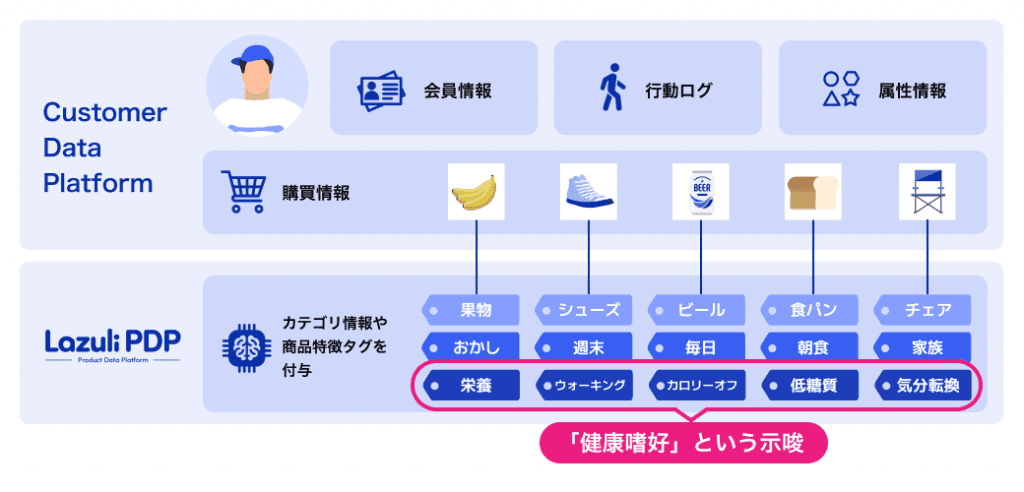
This makes it possible to analyze which competitors' products are selling to which attributes, and to make strategic decisions about what kinds of products we need to create, thereby improving competitiveness.
Further advances in product data processing
Product data processing uses AI to organize information based on the product master information held by a company and the information expanded by Lazuli, and processes it into the data format the company wants (including entity resolution and category inference), enabling data use according to purpose.
By using this processing technology, siloed data across departments—such as internal manufacturing data, logistics data, and POS data—can be integrated and formed into a format that is easy to use for various outputs such as e-commerce sites, CRM, analytics, and supply chains.
Summary
To analyze products and purchasing trends, it is important to work with data in a clean state. The accuracy of the data greatly affects the output of the analysis.
By automatically performing data enrichment and processing, you can not only shorten processing time but also discover consumer needs from new angles and strengthen your competitive advantage.
From the perspective of product data, our company helps expand and process the foundational data of the products you handle. In "Lazuli PDP," we provide tags and categories that are important for improving customer experience and enabling deeper customer analysis, using feature tags assigned to each product. We can also help organize siloed data within your company, so if you are interested, please contact us here.
Lazuli PDP service site: https://corporate.lazuli.ninja/