[Event Report] CES & NRF 2026 Briefing: The Current State of AI Implementation in Retail and Redefining Customer Experience
Lazuli Corporation held a briefing on two of the world's largest tech retail events, 'CES 2026' and 'NRF 2026'. As AI evolves from 'future technology' to 'capabilities that should be implemented on-site', what are the frontline seismic shifts the retail industry faces? We present a report that unravels the 'realities' of AI utilization in business revenues and customer touchpoints from a professional strategic perspective.
In January 2026, the common message presented by the mega-events in the tech and retail sectors, "CES" in Las Vegas and "NRF (Retail’s Big Show)" in New York, was extremely practical and filled with a sense of urgency.
The theme raised was "The Next Now". AI has completely evolved into a power that should be implemented in business settings at this very moment, rather than being discussed as a "technology of the future".
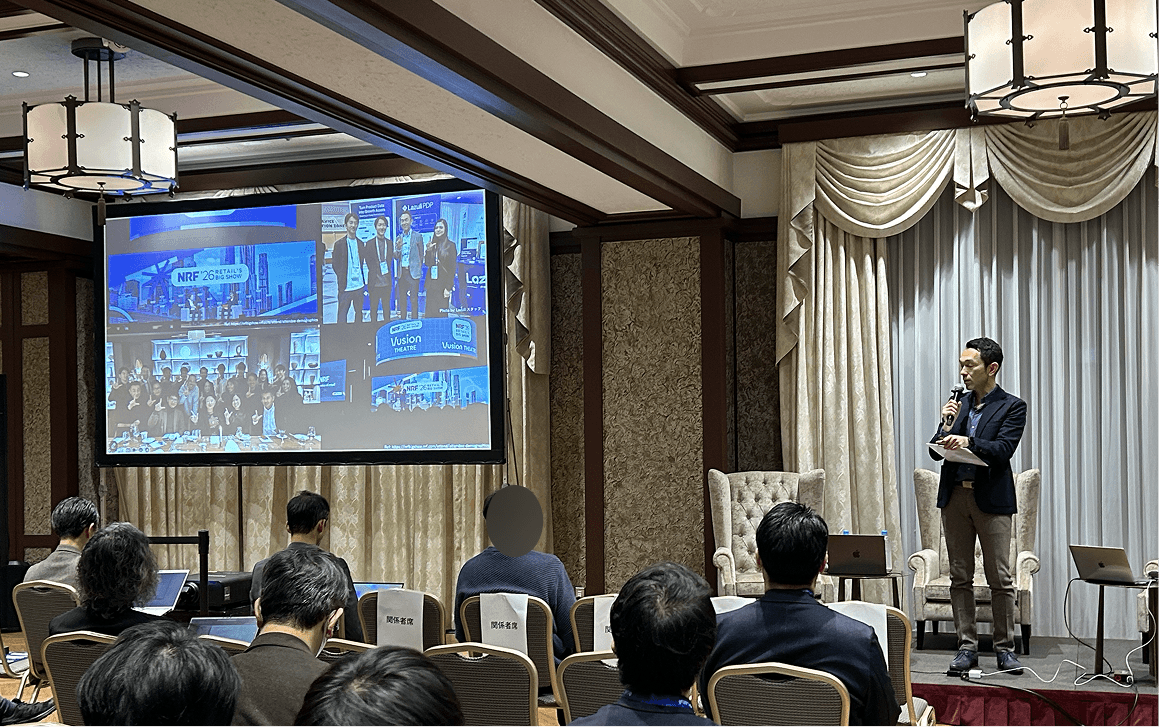
At the beginning of this report, Lazuli's representative, Hagiwara, touched on the overwhelming energy of NRF 2026, with over 41,000 participants and more than 1,000 exhibiting companies, emphasizing the current situation where the utilization of AI is beginning to yield tangible results in the profits of businesses and customer interactions. This article will detail the forefront of the tectonic shifts facing the retail industry from a strategic perspective.
How Generative AI and Data Utilization Are Transforming the "Disappearance of the Purchase Process"
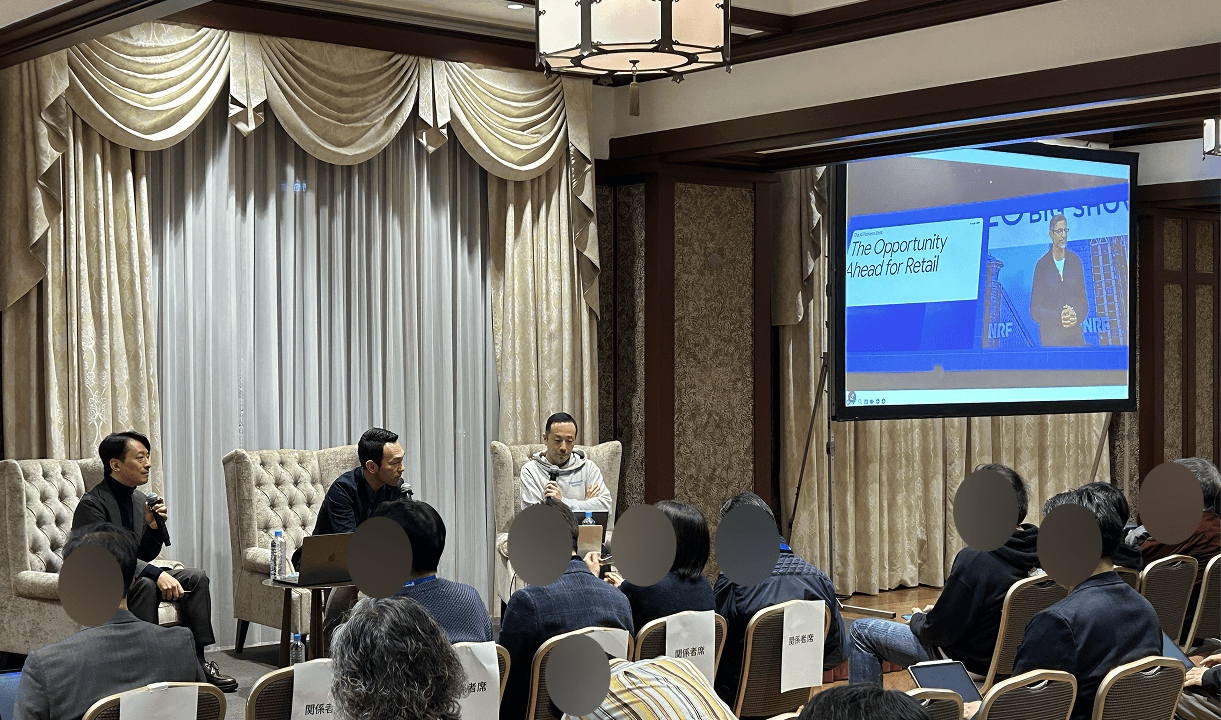
The biggest shock at NRF this time was the appearance of Google's CEO, Sundar Pichai. This symbolizes the irreversible entry of search platformers into the core areas of retail.
"Search-to-Basket": From Search to Consultation, and Then to Payment
Google's announcement of UCT (Universal Commerce Transformation) is a protocol that fundamentally overturns traditional search and purchasing behaviors. The step of "keyword search to page transition and cart insertion," which was once common, has disappeared, transitioning to a "zero-click payment" process that is completed through "dialogue and consultation" with AI agents like Google Gemini.
This means that Google has transformed from a "referral engine" to a "transaction engine." The proportion of "agent commerce," where purchases are completed directly from YouTube, image searches, and conversation contexts, shows a remarkable growth of 11 times year-on-year, and the risk that retailers' own UI and e-commerce sites may become "unnecessary" has become more realistic.
The Geopolitical Struggle Surrounding the "Merchant of Record"
Here, the key issue is the struggle for dominance over the responsibility entity in sales, the "Merchant of Record". If platformers take control of the payment process, retailers will be reduced to mere "delivery agents for products." Will Google monopolize customer interactions and CRM data, or will retailers defend their own value? In this "survival competition," giants like Walmart are trying to counterattack with their unique data strategies.
Retail's Counterattack: Walmart's Data Strategy and Enhancement of "Editorial Power"
Walmart, the largest retailer in the world, is developing a multifaceted strategy that highly integrates physical assets and digital components to prevent platformers from stealing customer interactions.
Retail Media Strategy as a Data Lab
At the core of Walmart's counter-strategy is the ecosystem "Scintilla", which integrates customer data and product data and shares it with manufacturers. Walmart defines retail media not merely as a sales destination for advertising space but as an "experimental space (data lab)" for refining product data. Through Scintilla, they confront manufacturers with deficiencies in their product information (such as missing data) and promote the polishing of data, allowing AI to understand correctly and create a state where products can "sell themselves." This has successfully increased the precision of the platform while pushing the enormous costs of organizing vast product data back onto manufacturers.
Owning the Customer Journey and Generating "Conviction" Through Editorial Power
Additionally, Walmart is using technology to solidify control over the customer's "life flow".
Ownership of Life Flow:Centered around "Walmart+", they are intervening in everyday moments such as healthcare and finance, and the "Auto Care" service (car inspections and tire replacements) which officially started in October 2025. They are strengthening direct contacts that do not go through Google searches.
Real-World Editorial Power: Redefining stores from being merely "storage spaces" to "places that propose styles." They invited fashion experts such as Ralph Lauren and refreshed the previously cluttered sales areas into "edited styles." They have evolved into retailers chosen not just for being cheap but for "conviction" gained through the in-store experience.
Structural Reform of "Product Data" that Distinguishes the Success of AI
No matter how much generative AI and AI agents evolve, if the quality of the underlying information is low, correct matching will not occur. The biggest barrier that OpenAI faced in the commerce domain was the deficiencies in product information on the retailer's side.
AEO (Answer Engine Optimization) and "Jobs to be Done"
What retailers should work on now is "AEO (Answer Engine Optimization)," which is beyond SEO. This requires advanced processing to convert unstructured data into structured data comprehensible to AI. The strategic value lies not in mere descriptions of specs (attributes), but in data-fying the user's "Jobs to be Done".
Providing Context: Keeping information in a form that AI can understand as a shoe that solves an individual's problem of "my feet turn inward during a marathon" (pronation correction).
Expanding Uses: Data-fying "the best kitchen scissors for cutting cables", going beyond conventional category classifications to create a "context of use".
The organization of product information is no longer an IT challenge but a top priority marketing challenge that directly addresses customer problem-solving.
Evolution of Customer Experience and Redefinition of "Trust"
In a world where AI delivering the "correct answer" has become commoditized, the criteria for customers choosing brands has shifted from efficient correctness to "conviction".
Success Stories of Brands That Generate "Conviction"
Signs of change towards 2026 are prominently reflected in the following advanced examples.
JD Sports: Specialized in "style editing" in urban areas. They connect AI with community power and product appeal to propose contexts of self-actualization that go beyond mere purchases.
DICK’S Sporting Goods: Expanding large experience-oriented stores called "House of Sport". By providing experiences through the senses, such as climbing and batting, they have redefined stores from "places to buy" to "places to experience sports and gain conviction".
REI: Strengthening the role of being a "trustworthy guide" that cannot be replaced by AI, based on the trust as a consumer cooperative (Co-op). They prove trust through actions like taking concrete steps against climate change.
What these examples have in common is their use of technology as a means while ultimately deriving value from "emotions, passions, and editing" that only humans can achieve. Just as Ralph Lauren translates traditional values into the "context of today's era" using AI, trust can only be earned through consistent actions, not words.
Implementation in the Japanese Market: The Frontline of Product Data Organization by Lazuli PDP
How should the overseas trends be implemented into domestic business in Japan? The report showcased specific implementation solutions and their practicality.
Lazuli's PDP (Product Data Platform)
To automate the organization of product data, which serves as the foundation for AI utilization, Lazuli offers functions as a "data factory". (Some functions are currently under development.)
Function | Content/Strategic Value |
Advanced Data Extraction | AI instantly extracts product information from unstructured data such as PDF, Excel, images, etc. |
Normalization and Validation | In addition to correcting discrepancies in expression, automating the supplementation and verification of missing JAN codes. |
Category Estimation and Tagging | AI automatically assigns "context" and attribute information essential for AEO. |
YAML-Based Flexibility | Enabling flexible settings for developers, facilitating integration with existing systems. |
API-First Operational Efficiency | Providing APIs that can be integrated into workflows, drastically reducing operating costs. |
Automatic organization of product information will serve as a "catalyst for synergistic effects" that enable the improvement of retail media accuracy and reliable matching by AI agents.
Lazuli PDP: https://lazuli.ninja/ja/pdp
Summary: Action Plan for Japanese Companies Towards 2026
The conclusion posed by CES & NRF 2026 is the harsh reality that "there is no future for retail without AI implementation." The three points that decision-makers must immediately address are:
“North Star” is Solving Customer Issues: Make sure not to purposefully introduce technology but prioritize solving the customer’s "Jobs to be Done" as the foremost objective.
Strategic Coexistence with Platformers: While utilizing infrastructures like Google, control the core "product data" and "customer understanding" that are central to customer interactions, and do not yield authority.
Honing "Editorial Power That Only Humans Can Do": Beyond the "correct answer" provided by AI, present a unique worldview and relationship that customers can choose with "conviction" through both physical stores and digital tools.
In platform-led purchasing, there is no future for retailers that remain mere "delivery agents". Understanding the unique market environment and business practices of Japan, it is crucial to interpret cutting-edge AI technology through the filter of "brand intention" and steadily advance implementation starting from gritty data structural reforms. That is the only way to define the retail experience of 2026.